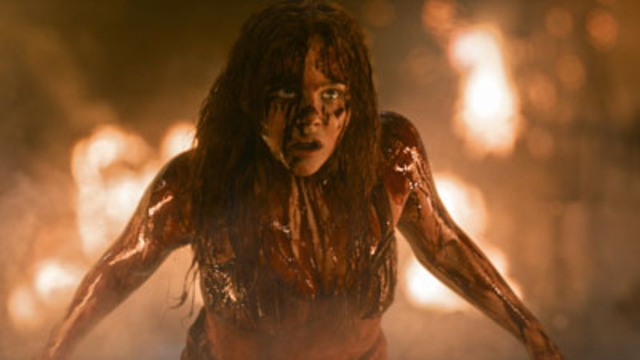
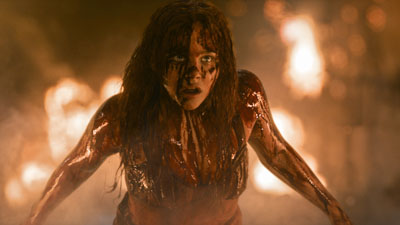
 Chloe Grace Moretz (Michael Gibson/MGM)
“Why is my body changing?” is the cry of coming-of-age movies and horror movies alike. Sometimes they’re the same movie. Is there anything more terrifying to the adolescent than the new and awkward forms that take shape and call attention to a personality still trying to find its voice?
This is the story of Stephen King’sCarrie, previously adapted in Brian DePalma’s bicentennial classic and newly adapted by director Kimberly Peirce, who broke out with a different kind of changing body movie, Boys Don’t Cry. Peirce’s Carrie won’t make anybody forget DePalma’s film, but it does one thing fairly well. The director’s young charges convey the anxiety of growing up and belonging, discovering and nurturing your natural gifts. What Peirce doesn’t do well is the horror.
The movie begins with a woman’s scream. Margaret White (Julianne Moore) is writhing in pain on a bloodstained bed, begging the Lord for mercy upon what she believes is her imminent death. But these are birth pangs, a creation where she thought there was a cancer. The theme of art as destructive, creation as a killer, has a curious recurrence, not just in horror: from Frankenstein to H.G. Lewis’s Color Me Blood Red to the early Roger Corman cheapie A Bucket of Blood to the Eagleheart episode “Exit Wound the Gift Shop.” It’s as if the artist sees creativity as a double-edged sword.
Margaret White almost kills her creation. When that creation, Carrie White, discovers her own means of creation, well maybe you know the rest. But if you don’t, look at this plot with fresh eyes for a minute. Carrie’s first torment comes when she doesn’t understand that she’s having her first period. Fear of sex anyone? Stephen King may have had his issues with the origin of life, but sex isn’t the only creative act she inherits from her mother. Peirce shows us the tools of a seamstress’s trade: measuring tape, dress patterns that Margaret White uses as a cutting guide much in the way she uses her distorted religion as a guide. Carrie recovers from her initial torment by finding her voice as a seamstress, designing her own prom dress. But when that outlet is thwarted, she turns to a more brutal gift.
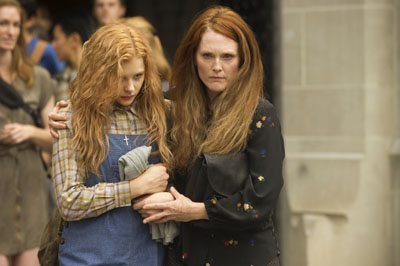 Chloe Grace Moretz and Julianne Moore (Michael Gibson/MGM)
Chloe Grace Moretz has a strong presence, but her strength is her weakness. Even in misguided product like Tim Burton’s Dark Shadows, Moretz’ presence makes her come off older than she is. She exudes a natural confidence that is something Carrie does not have, and while she makes a believable prom queen swan, she’s less convincing as an awkward ugly duckling. And the way she uses her hands to steer her powers is distracting, as if Carrie is performing some kind of evil liturgical dance. Julianne Moore does better as Carrie’s mother – she’s no Piper Laurie, but Moore’s troubled, anxious mother is more shaded than Laurie’s over the top performance.
Peirce takes minor and major liberties with the King and DePalma sources, but there are roads that don’t reach their destination. The mean girls, led by Chris (Portia Doubleday) and the more sympathetic Sue (Gabriella Wilde), don’t stop at teasing poor Carrie in gym class. They make a smartphone video out of it. There is a technological divide between Carrie and her classmates, made clear when Carrie researches her telekinetic powers in actual books, as if the 1970s heroine was transported into the scary world of twenty-first century bullying.
Carrie is a potent revenge fantasy of the tormented rising up against her tormentors, but if there’s any charge in it it’s not the uncertain threat of danger that haunts the best horror movies. After all, we’re not held complicit in Carrie’s bullying are we? If anything, Peirce and her screenwriters don’t take their conceit far enough. If it takes a village to raise a child, does it also take a village to harm it? Carrie’s climactic act is finally too controlled, laying waste along a more discerning path than her King and DePalma’s scathing scorch and burn.
—
Carrie
Directed by Kimberly Peirce
Written by Lawrence D. Cohen and Roberto Aguirre-Sacasa, based on the book by Stephen King
With Chloe Grace Moretz, Julianne Moore, Gabriella Wilde, Ansel Elgort
Rated R for bloody violence, disturbing images, language and some sexual content.
Opens today at a theater near you.