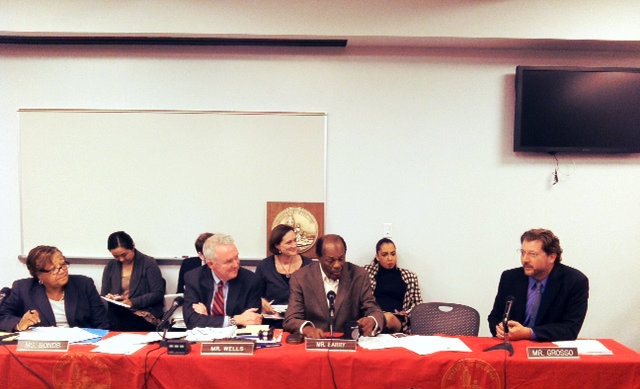
 The panel at last night’s Marijuana Decriminalization Bill hearing. Photo by Matt Cohen.
A revolution is coming in the District. The cannabis revolution. Last night, Councilmember Tommy Wells (D-Ward 6) held a public hearing on his marijuana decriminalization bill— “The Simple Possession of Small Quantities Of Marijuana Decriminalization Amendment Act of 2013″—at the Anacostia Neighborhood Library in Ward 8. During the two-and-half hour hearing, more than 20 people—including lawyers, activists, advocates, pastors, and various other public witnesses— testified to voice their support or distaste for Wells’ bill, which was introduced to the Council in July and goes to vote next week. The hearing found overwhelming support for Wells’ bill, with 22 people voicing their support for it and only one person urging the D.C. Council to not pass the bill.
Wells was joined by Councilmembers Marion Barry (D-Ward 8), who co-introduced the bill, Anita Bonds (D-At Large), a co-sponsor of the bill, and David Grosso (I-At Large), who has also lent his support to the bill but has also introduced his own which proposes the legalization, taxation, and regulation of marijuana, same as alcohol. Throughout the entire hearing, all four Councilmembers heard each of the witnesses’ testimonies, three at a time, and addressed their issues.
In an introduction before the witness testimonies, Wells rattled off several key statistics that address why the Council needs to pass his decriminalization bill. “Nearly half of all drug arrests in our country is for simple possession of marijuana,” Wells said, “and the vast majority of arrests for marijuana possession fall on the shoulders of black and Latino citizens, even though whites use marijuana just as frequently.” The bill, which would reduce the charge of being caught with less than one ounce of marijuana from a crime to a civil fine, punishable by up to a $100 ticket.
Wells explained how the bill addresses the racial disparity of marijuana crime-related arrests in the District and how black communities have become unfair victims of the failed war on drugs. “The racial disparity in terms of marijuana-related arrests and the residual impact on communities of color in the city is frankly alarming,” Grosso said.
According to Wells, D.C. ranks seventh in the nation for arrests per capita for marijuana possession, with the arrest rate for simple marijuana possession four times the national average. “In 2010, 91 pecent of all marijuana arrests were of black residents,” Grosso said. “Quite clearly, the war on drugs has not worked.”
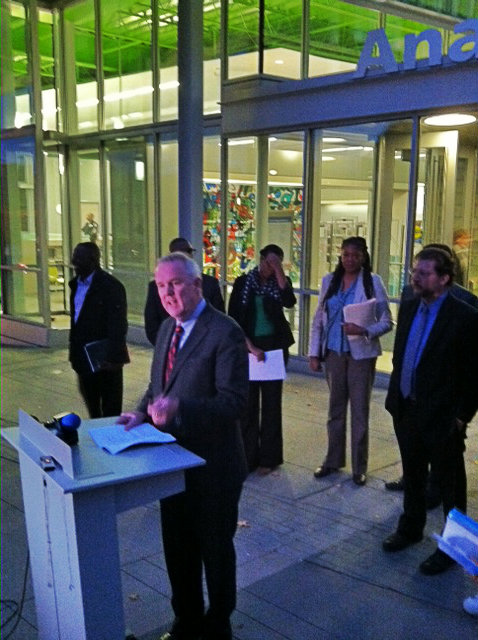 Tommy Wells addresses the press at a conference before last night’s Marijuana Decriminalization Bill hearing. Photo by Matt Cohen.
While nearly all of the witnesses voiced their support for the bill, most still had issues with it, and testified as to how it could be better. Many who testified voiced concern that Wells’ bill, while a great step in the right direction, needs to include an amendment which would expunge the criminal records for those who have been arrested on simple possession charges. Courtney Stewart, chairman of the Reentry Network for Returning Citizens, said that “this bill has to be more about creating jobs for our youth in the future” and how to help those who have already been damaged by D.C.’s simple possession laws. “This is a good bill, and it’s a step in the right direction,” Stewart said, “but we really need to look at reparations and the damage that’s been done to our population. The people who are returning to society who can’t get housing, that can’t get a job, that have been disenfranchised from the mainstream of the flourishing economy in D.C.”
Grosso’s proposed bill would seal criminal records for those with arrests and convictions for non-violent marijuana charges, and Wells, Bonds, and Barry all agreed that that is the next step for the decriminalization bill. “We are working together to the point where we need to, at a minimum, address expungement,” Wells said. “If it’s wrong today, it was wrong yesterday.”
Patrice Sulton, a lawyer with the NAACP, testified in favor of the decriminalization, but said that the Council should go one step further and adopt language that would exclude the odor of marijuana by itself as suspicion to search on probable cause, saying that it is just another tactic for police to discriminate. “They use it as an excuse to justify stopping to search people in certain parts of the city all the time,” Sulton said.
Debra G. Rowe, acting executive director of Returning Citizens United, also pressed the members of the Council about how they will address minimizing police discrimination with this bill. “What is going to be done about the police who are the perpetrators of discrimination?” Rowe said. “Will there be training for them related to this bill? Can our young people of color leave clubs and return home safely, without arrests, the same as the thoroughly intoxicated, disruptive folks who frequent pubs in Georgetown, Adams Morgan, and the U Street Corridor?”
Many witnesses who praised Wells’ bill agreed that, while it’s a step in the right direction, the D.C. Council should instead consider Grosso’s legalization bill. Nikolas Schiller of DCMJ 2014—which recently published their own proposal for a marijuana legalization bill—commended the Council’s efforts in this decriminalization bill, but urged them that they need to go further and push for full legalization and allow home cultivation. Former Council candidate and legalization advocate Paul Zukerberg also testified, suggesting the Council adopt Grosso’s bill. He also commended the great efforts of the Council for making leaps and bounds on this issue without the typical hand-holding from Congress. “Isn’t it great that it’s not the Feds leading the change this time, that it’s a grassroots movement?” he said.
Afterwards, Barry turned to Wells and said, “Mr. Wells, we should look at the idea of allowing residents to grow small amounts of marijuana.”
Just one witness was not in favor of Wells’ decriminalization bill. Elder Bernard Howard, a pastor at Sanctuary of Praise, voiced his objection to the bill, saying that he thinks it’s accepting and endorsing causal marijuana use among young black men.”I just believe that when we say it’s OK to have a little bit of marijuana it’s sanctioning the open door for worse things,” Howard said. “I think it’s a back doorway to the legalization of marijuana.”
Wells responding to Howard, saying that “it’s extremely important that we know that there are many citizens who don’t agree with us,” but that this bill is not endorsing casual marijuana use. “People are concerned that by the Council’s action to decriminalize, we’re saying that it’s OK to use marijuana,” Wells said. “That’s not what we’re doing.”