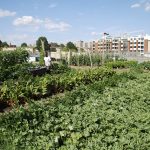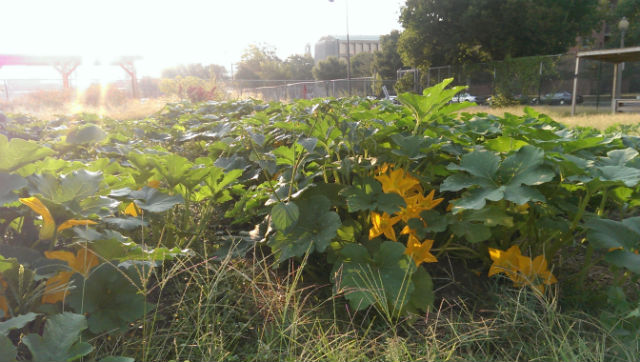
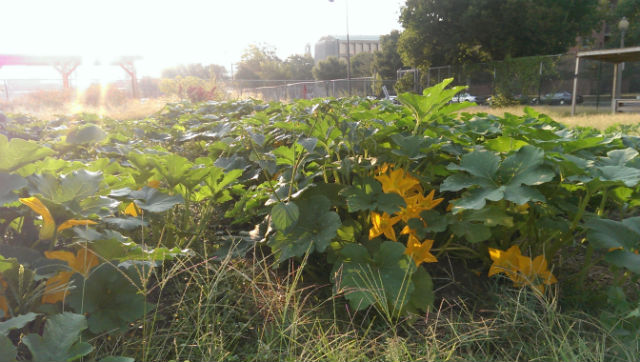
 Photo of the Farm at Walker-Jones. Courtesy Farm at Walker-Jones.
On September 11 of this year, David Hilmy – a teacher at Walker-Jones Education Campus and a trained biologist – received an email from a program manager in the Office of the Deputy Mayor for Planning and Economic Development informing him of their “anticipated” intent to take the school’s farm for a mixed-use housing development.
“The City anticipates using this site for future development. Currently there seems to be a community garden at the corner of K and New Jersey avenue and parking on the first street side,” the email stated. “As we begin preparing for the next steps with this site, we’d like to make sure that the parties that are currently utilizing space are notified of our intent.”
The “community garden” the city may want for the $700 million NorthWest One project, which will include low-income housing complexes when completed, is in fact a working urban farm that Hilmy oversees. Since July 2010, the farm has provided thousands of pounds of food to the school’s students, surrounding neighbors and groups including the DC Central Kitchen. It’s also become a classroom for the students of Walker-Jones, both in traditional subjects (writing, math) and special subjects (nutrition, apiculture).
Hilmy responded to the email with letter he also published on the farm’s website. It begins:
Thank you for your communication. Is this a formal declaration of intent to develop this site or simply an enquiry to ascertain more information?
I ask because you seem, with respect, remarkably ill-informed as to the nature of The Farm at Walker-Jones and its function as a community hub and unique site integral to the educational curriculum at The Walker-Jones Education Campus, a DC Public School. This is not a space that “seems to be a community garden,” this is a farm, an urban farm, and the only urban farm in the some 250 schools in the District of Columbia, whether public, private, or charter.
Since receiving the email, responding to it and publishing the open letter, Hilmy says he has not received a reply from the DMPED office. Neither has the school’s principal, Michael Moss.
Chanda Washington, director of communication for DMPED, told DCist the office has no comment at this time.
The city seemingly has the legal right to take the farm for the project, located in Ward 6, as it’s on city-owned land. (The first completed building of the NorthWest One project, which will replace units for residents of Temple Courts, was the new Walker-Jones campus.) But as Hilmy writes in his letter, the site is an important community asset to many groups.
I wonder if you have already contacted the dozens of community groups and non-profit organizations that have devoted thousands of man-hours in volunteer work? Perhaps you have already considered the support for our Farm’s Food Lab by Rachel Ray’s Yum-O organization? Perhaps you have indeed communicated with the alumni of Stanford University, Yale University, or the University of Delaware, all recent volunteer groups, or the current students at Howard University or the Caribbean Student Association at PG Community College, or perhaps the dozens of prospective college students from the area’s high schools who regularly seek community work experience on the farm? Perhaps the Deputy Mayor for Planning and Economic Development has already created alternative projects where the Arab-American Institute, the Green Muslims, and the Jewish Federation of Greater Washington can come together and work to model for our inner-city youth how food can both strengthen a community and also inform globally?
Charles Allen, former chief of staff to Councilmember Tommy Wells (D-Ward 6) and a newly declared candidate for his former boss’s seat, says “The farm at Walker-Jones is a critical part of the city’s urban agriculture movement. It’s created partnerships not only with the nearby school, but also with senior housing and community organizations in the neighborhood to provide fresh food and great educational opportunities. The city should be looking for ways to strengthen this type of experience, not reduce it.”