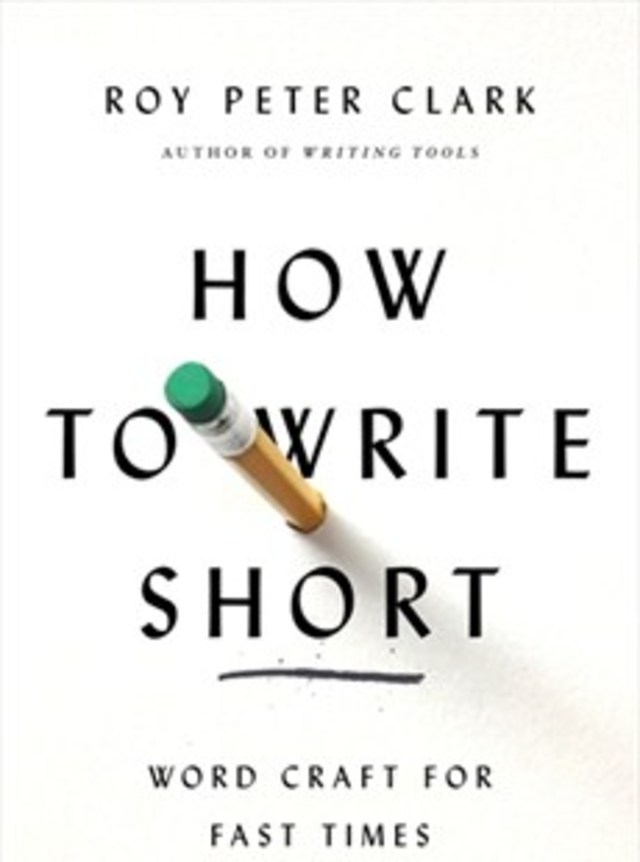
 In 2007, Twitter co-creator Jack Dorsey said tweets were given a 140-character limit because “we’re fond of constraints that inspire creativity.” Since then, brevity has played a crucial role in social media as well as other communication outlets. Roy Peter Clark teaches us how to pare it down for our audience in his latest book, How To Write Short: Word Craft for Fast Times (Little, Brown and Company, $20), which he’ll be discussing at Politics & Prose on Monday, October 28 at 7 p.m.
If writing short seems like a lazy way of communicating, consider Clark’s reminder: “The most important messages are short” (“I do,” “not guilty,” “I love you,” “you’re fired”). We can look at examples like telegrams, epitaphs, bumper stickers, and slogans that stick in our minds. Shorter writing is more direct and understandable, a big benefit for the writer and reader alike. Plus, Clark argues that especially now, “a time-starved culture bloated with information hungers for lean, clean, simple, and direct.”
How to Write Short‘s 250 pages are divided into two sections, on writing short in general and writing short “with a purpose.” To the first end, Clark has many suggestions for becoming a more focused and less wordy writer. For instance, “collect” samples of short writing and “destroy redundancy” wherever possible (looking at you, adverbs). Injecting purpose can be accomplished through “enticing,” using dialogue, and making lists in shorter pieces of text. This allows the writer’s selling point to get across first and foremost.
Clark uses his own advice to deliver a pretty powerful guide for those looking to effectively market themselves or an idea, or just become a better writer. Scattered humor and anecdotes help keep the lesson plan engaging. He encourages readers to think of themselves like poets, who often convey big concepts and emotions in relatively few words. Before long, your Twitter account could give Robert Frost a run for his money.
Clark has been dubbed “America’s writing coach” for teaching writing to everyone from children to Pulitzer Prize winners. He is vice president of The Poynter Institute, a journalism think-tank in St. Petersburg, Florida, and has written and edited 17 books on writing, language, and journalism.
The talk is free and open to the public, and will be followed by a Q&A session and book signing.