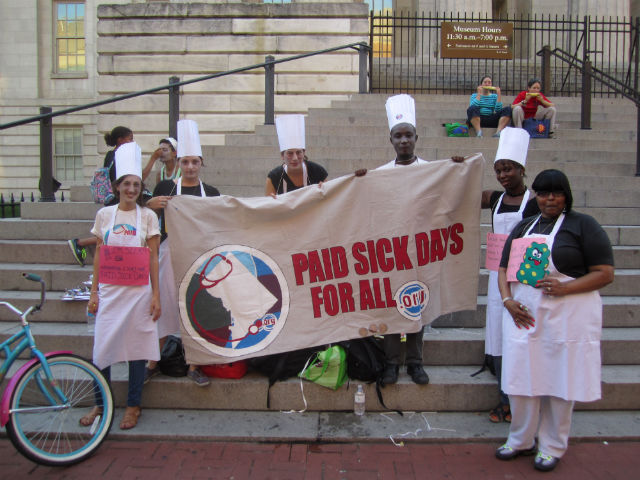
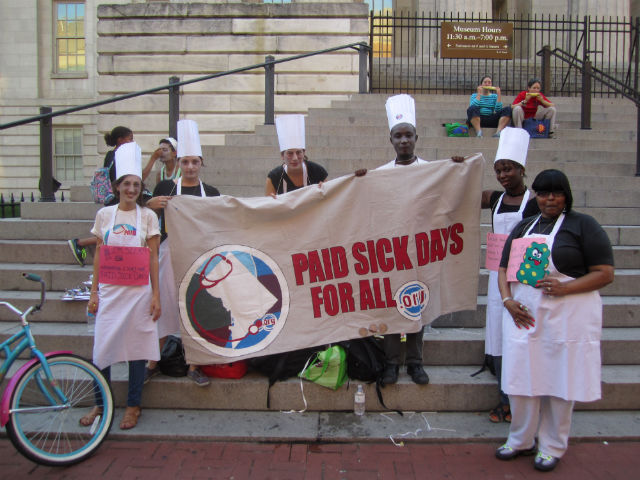
 Photo by Sarah Anne Hughes.
Earlier this week, a Council committee held a hearing on the many minimum wage proposals currently introduced, as well as a bill to require paid sick days for tipped workers.
Claudia Williams of the Institute for Women’s Policy Research was one of the over 100 people to testify that day, presenting some of the estimated benefits of providing sick days to the workers currently excluded from the 2008 Accrued Sick and Safe Leave Act.
According to the IWPR’s analysis, “approximately 9,900 tipped workers and 10,400 part-time and recently hired workers currently have no paid leave benefits of any kind and are eligible to receive new leave under the amendment.”
“Our analysis shows that if the amendment is enacted it will create cost-savings for employers,” Williams told the Council. “Employers are projected to see the cost of implementing this new policy defrayed by increased productivity and a reduction in costs associated with less contagion of communicable diseases, and reduced employee turnover.”
IWPR estimates that employers would spend $5.9 million per year, or $5.60 per worker per week, to provide sick days to newly covered workers. But they would see a benefit of $7.9 million, or $7.45 per worker per week, according to the analysis. The majority of that money ($7,563,342) would come from lower turnover.
“Having earned sick days reduces voluntary job mobility,” the report says. “Because workers value earned sick days, when they have that benefit, they are less likely to look for a different job.”
The D.C. Fiscal Policy Institute’s Ed Lazere also testified in favor of paid sick days. “A study of the impact of the District’s law has found that mandating sick leave has not hurt the city’s economy,” he said. “And local and national research suggests that the benefits to businesses of providing paid sick leave, including lower turnover and lower ‘presenteeism,’ outweigh the costs from providing paid sick leave.”