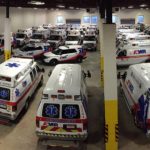
 Photo by Eric Purcell
An audit of the D.C. Fire and EMS Department released today found the city’s fleet to be “aging, showing signs of excessive wear-and-tear, and in overall poor condition.”
“The apparatus inventory we conducted revealed a fleet that is aging, showing signs of excessive wear-and-tear, and in overall poor condition that is reflective of years of hard, urban emergency driving compounded by unstructured and deferred preventative maintenance and repairs,” the assessment, which can be read here, states. “As one might expect, newer apparatus were found to be generally in better shape than older apparatus, but even newer apparatus often had maintenance issues.”
The report by the Washington-based firm BDA Global was commissioned by the fire department and cost $183,000.
The FEMS fleet is composed of 369 vehicles, plus 42 passenger vehicles leased and maintained by the General Services Administration, according to the report. “Units frequently undergo repeated repairs for the same or similar problems,” the report states, adding that the 61 Ford ambulances in the fleet are “in fairly bad shape.”
They break down incessantly, creating a very high volume of work for the Shop. In addition to
the increased volume, the Ford ambulances create a drag on the Shop because they are
significantly harder to maintain than the International Harvester ambulances.
Indeed, the process of fixing broken vehicles in D.C. is itself broken, according to the report, which found a “virtual absence of a preventative maintenance.” The report also states that “FEMS has a ‘come-back’ rate nearly 20 times the industry standard.”
The report does acknowledge FEMS’s “recent acquisition of 30 new or refurbished apparatus, but caution that without systematic improvements to fleet operations, these apparatus too would be at risk of falling into disrepair in the future.
“It is, hence, important that FEMS prioritize recommendations for implementation and develop a Strategic Implementation Plan to define how and when additional improvements are made.” All 30 ambulances are scheduled to be added by the end of this year, with 17 already on the road.
“This study was a significant step in correcting some of the problems that have plagued our fleet division for years,” DCFEMS Chief Kenneth B. Ellerbe said in a statement. “The recommendations in this report will help us become more efficient and responsive in our operations.”
D.C. today announced that the nine new single-role paramedics will start on December 2, as the AP reported. They have the option to also become firefighters.
They still won’t change the number of paramedics on the street at any given time. The district still deploys less than half the paramedics used by urban departments with similar call volumes. And they won’t relieve the stress on the dual-role firefighter-paramedics who are usually the first responders to medical emergencies. The new paramedics are not trained as firefighters and can only ride on ambulances.
Councilmember Tommy Wells, chair of the Judiciary and Public Safety Committee, said in a release he will hold an oversight hearing next Wednesday.
“This audit report is an indictment of the management and maintenance of our Fire and Emergency Medical Services fleet – of our fire trucks and ambulances. The audit shows that there is not an accountable system to ensure that our fleet is repaired, accounted for and replaced,” Wells said in a statement. “The Administration has recently procured new ambulances, but this report does not give me confidence that they have a system to manage and maintain the new or old vehicles, or to know when they will need to buy more.”
He continued, “The audit provides an oversight baseline to ensure that the Administration is replacing, repairing and maintaining the equipment in a responsible way for the citizens of DC. The city needs a radical restructuring in the way they manage the fleet, and I look forward to hearing the Administration’s plans and ideas at my oversight hearing next week.”