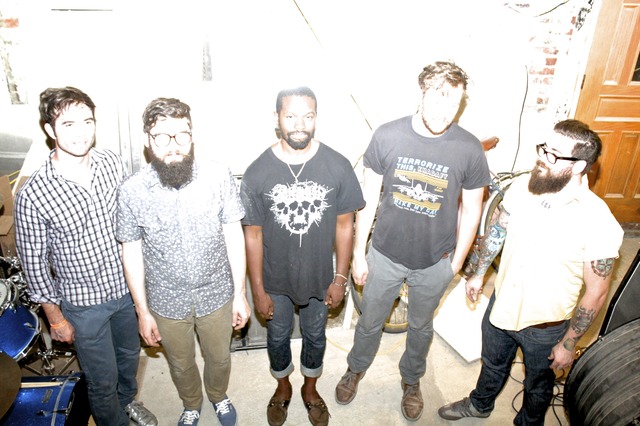
 Photo by Stephanie Breijo.
By DCist Contributor Jessica Garson
Joy Buttons is a relatively new band that plays short, melodic, and enthralling punk songs. While the music is hard and abrasive, it’s also friendly and inviting. Pulling in New Wave hooks to its confronting sound, Joy Buttons makes hardcore accessible to those who wouldn’t normally listen to it. The quintet is also something of a D.C. supergroup, comprised of a vocalist Brandon Moses (of Laughing Man and Paperhaus), guitarist Ryan McLaughlin (of Typefighter), guitarist Erik Sleight (of Lightfoot/Mittenfields), bassist Matt Dowling (of Deleted Scenes), and drummer Dan Ramspacher (of Pray for Polanski).
Last Sunday, they released their album at the Black Cat, headlining a packed bill, along with Title Tracks, The Max Levine Ensemble, and Beasts of No Nation. All great D.C. bands in their own regard. Recently, DCist had the chance to have a beer with Joy Buttons at the Rock & Roll Hotel to talk about their new record, how they got started, where they are going, and the future of the D.C. music scene.
DCist: So what do you have going on?
Ryan McLaughlin: We just put out a record. We had it on CD-R for the show but it’s mainly a digital release. We recorded it February. We have a new record we have written, our plan is to take our time with it since we just released this one.
DCist: How did you get started, how do you know each other?
Dan Ramspacher: Ryan and I would hang out and play pool on Wednesday nights and it morphed into…
Ryan: Dude date!
Dan: Yeah, it morphed into us playing music instead of pool.
Ryan: Yeah, I was like I want to form a punk band. And than we started playing just the two of us. We started reaching out to people shortly after that.
Erik Sleight: I invited myself to play bass and we quickly decided that I was going to be playing guitar.
Ryan: Originally Brandon was going to play bass and sing, but he decided to focus on singing.
Brandon Moses: I feel like I distinctly remember both of us showing up to the first practice with the intention of playing bass. Pretty sure it was two basses at one point.
DCist: You did not want to be a double bass band?
Ryan: I guess we never tried it. We’re open to it.
Brandon: That’s actually a good idea, we never thought of it.
Erik: I brought my guitar amp, because I was not happy with the one we were using and it worked
Ryan: He took lead on the lead guitar. Matt reached out to us, playing bass and actually Brandon was on the tour with Paperhaus and he came back and was a little shocked.
Matt Dowling: Yeah, I started playing and it worked out well. I was like here I am, try to kick me out.
DCist: For your newest record, what was the recording process like?
Ryan: It was really quick. We recorded it with Thomas Orgren, who I play with in Typefighter. It was three days total. We picked five songs we wanted to record. We played the hell out of them and went in there and knocked it out.
Dan: We ate a lot of BBQ and Peruvian food. Also we visited 7-11 often.
Ryan: That 7-11 closed.
Everyone in unison: Nooooo!
Ryan: The night of mixing, it was a 12-13 hour mixing day we did in one night, it was a marathon mixing day. We left at 4am. It was something to get done and we did it and we did as quickly as we could. It turned out a lot better than any of us ever expected it to.
Erik: The album is called Arkhipov.
Brandon: It ended up being influenced by the story of Vasili Arkhipov, he was responsible for not destroying the world on Russia’s end during the Cuban Missile Crisis. Whereas Kennedy and McNamara were a little more responsible on the American side. The album is kinda about that but also how that feeling relates to life.
DCist: What do you see for the future of the band?
Ryan: We don’t have time for it. We’re so busy. We have a lot of shit going on. I’m in no rush to make it something crazy, it’s just fun. It’s so different from our other bands. Our rule is if it takes us more than two practices to finish a song, we ditch it. We just churn songs out like they are not even songs. They just happen and fall into place. It’s so refreshing to have a project that you can go in and just not care. You don’t have to let your own thoughts or sense of perfection get in the way of writing a punk song.
Erik: It’s nice having the release. Our other projects are much more controlled. Not just controlled, but more musical so to speak. The approach of our other bands is much more of a musical intent. This band’s approach is a visceral intent. In my other bands, I care about texture and composition. In this project, I get to be a 16-year-old kid again.
Ryan: We don’t spend a lot of time in the studio compared to how much time we spend playing music. In my other band, it took a year and a half to record our last record. It’s nice to be in a band where you spend most of your time playing. It’s nice to have an immediate release.
DCist: What do you think of the D.C. music scene right now?
Matt: I feel like this has been indicative of something that is healthy about the D.C. music scene, that has not been there for a while. We’ve all been in bands that have worked very hard for many years, go on tour and do the band thing. Everyone gets it, and it makes it work well. It takes a history to make something like this happen. It’s a cool relationship between D.C. now and this band.
Ryan: I totally agree, this band represents the sense of community that exists in the scene. All of our bands are still active. We go to shows and we see all of our friends. There is a venn diagraming of bands happening right now and it’s great.
Erik: I think the scene is on the up and up. There is this energy that I sense now, that I did not when I first started playing in a band five years ago. I used to feel competition as opposed to community. What has helped I think is the growth of house shows, that have a mix of a welcoming community and bands coming from all over the country. I feel like I hang out with musicians and like-minded people instead of socialites. I didn’t always feel that way.
Ryan: It’s exciting and it’s developed to have it’s own personality again. There are a lot of bands that really care and try. You can throw a rock in any direction and there is a cool band. They don’t want to be in a band just to be in a band, they want to make an impact. It’s a small scene, and it’s pretty incestuous.
Dan: When I moved here 5 years, I went to Girl Cave. I went to college in Boston, and I was used to going to house shows but I was immediately struck by the sense of community. I wanted to be a part of it. It’s nice, everyone is in everyone else’s band.
DCist: Do you think that since it’s small group of people playing in bands, that it limits creativity in anyway?
Erik: No, I think it expands upon it. You take any situation where growth is occurring it’s because of the sharing of ideas. It’s all about influence, and that’s why greatness comes from concentrated areas because everyone feeds off each other.
DCist: What’s a fun fact about the band?
Ryan: The name Joy Buttons was taken from a list of potential band names I have on my phone. When we decided to form the band, we looked at the list and chose a band name.