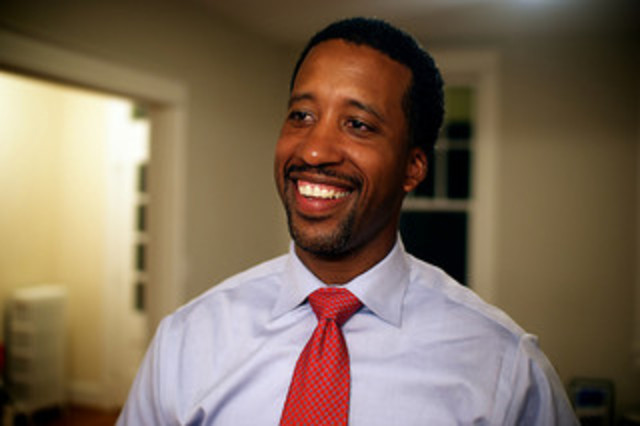
 Photo by mediaslave
By Matt Cohen and Sarah Anne Hughes
In addition to approving a minimum wage hike Tuesday, the D.C. Council also unanimously voted to pass a campaign finance reform bill.
The legislation, which was introduced by Councilmember Kenyan McDuffie (D-Ward 5), will tighten D.C.’s campaign finance laws, specifically by restricting campaign contributions from related businesses, closing the LLC loophole, and requiring campaigns to report all fundraising data online for the Office of Campaign Finance to publish publicly. Additionally, the bill mandates campaign finance training for candidates, boosts the range of penalties for violations, and restricts money order donations to $100. The legislation would also require lobbyists to disclose any contributions bundled and forwarded to a campaign.
“Today’s vote concludes months of deliberation on campaign finance reform. The changes we are enacting include the most significant reforms we’ve seen in years to enhance accountability and transparency in the financing of District elections,” McDuffie said in a press release. “An overarching focus of this reform package is an enhancement of transparency around who finances campaigns and influences the political process.”
While this legislation is a step in the right direction, some Councilmembers—specifically, Tommy Wells (D-Ward 6)—thought it could be tighter. Last month, when the legislation was first introduced, Wells said “there is no reason any D.C. mayoral candidate should accept a campaign donation that isn’t from an individual.” Anything less, he said, “is to betray the public trust already damaged by the shadow campaigns and scandals that continue to plague the city.”
Two proposed amendments to the bill by McDuffie and one proposed by Wells, requiring D.C. contractors to disclose who they are when donating, were discussed during the Council’s hearing yesterday and led to a heated exchange between Councilmembers Jim Graham (D-Ward 1) and Marion Barry (D-Ward 8).
“What we’re doing today is we are sanctioning, we are inviting major donors with lots of money to come into our political races and, provided that they disclose the amounts from the donors … they can donate anything they please, as long as they’re not in concert with a political campaign,” Graham said. “For people who care about elections and keeping elections as uninfluenced as possible by donations, this is anathema.”
Graham said he wished the Council could spend more time discussing this point. He also asked, though not directly, whether the alleged shadow campaign run by Jeff Thompson on behalf of Mayor Gray was actually legal. (The mayor has denied any knowledge of the alleged campaign.) He was not satisfied with the answer he received.
On Wells’ amendment, Graham said it didn’t go far enough and wanted further disclosure.
Barry, however, said the amendment and the unbundling of contributions would affect black elected officials. “We weren’t born with a silver spoon, a wooden spoon, or any kind of spoon,” he said. “We come out of the private sector. We have these connections to law firms and other kinds of construction places.”
Blaming the Washington Post, Barry said the paper made it seem like contracts are for sale in the Wilson Building. “We don’t sell contracts down here,” Barry said. “This Council has more integrity, has more character than to be selling contracts. You think somebody’s gonna give me a $500 contribution and [that’s] gonna … buy my vote for a $500,000 contract? That’s idiocy. We have too much integrity on this Council to do that.”
Councilmember Vincent Orange (D-At Large) countered that the real issue is “ourselves.”
“If we’re going to talk about campaign finance, we have to look at ourselves,” he said, focusing on outside employment of Councilmembers. “I think this bill is trying to appease public perception, the media, but at the end of the day it’s gonna do nothing because these other issues are still going to exist.”
“This is just feel-good politics,” he said.
Graham then spoke again: “I’ve been white all my life.” There was laughter in the chamber. An obvious response to Barry’s comments, Graham said that his family did not have any money when he was growing up. “I want to get race out of this,” he said.
“Race exists in America,” Barry interjected, before being told he was out of order. “Everyone on the dais knows race exists in America,” Graham responded, proposing his own amendment to strike the word “business” before contributor in the bill. He later proposed adding “business or individual,” rather than striking “business.”
Wells’ and Graham’s amendments failed, while McDuffie’s were adopted.
The bill now awaits the signature of Mayor Gray and will go into effect in 2015, if signed.