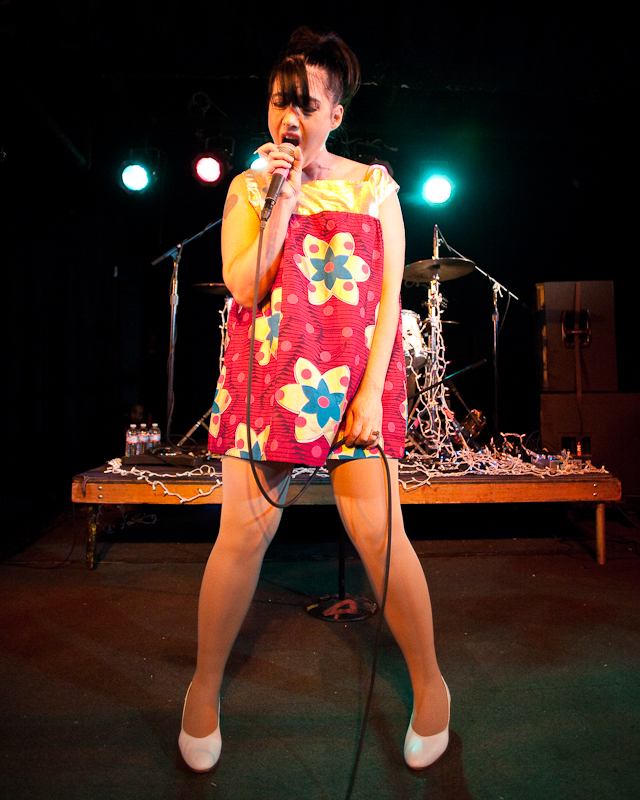
 Kathleen Hanna performing with The Julie Ruin at the Black Cat. Photo by Francis Chung.
As the charismatic and outspoken lead singer of feminist punk band Bikini Kill, Kathleen Hanna helped pioneer the riot grrrl movement. First in the Pacific Northwest, where the band formed, then in D.C. in the early-to-mid ’90s, when they relocated here to be a part of the radical punk movement pioneered by Fugazi and various other Dischord bands. After Bikini Kill dissolved, Hanna put out a starkly personal, sparse bedroom-recorded album, entitled Julie Ruin, before starting the feminist electroclash band, Le Tigre.
Through it all, Hanna became something of a feminist icon, revered by many for her brash stage persona, politics, and message, which she made a career out of making sure all could here. In Bikini Kill’s early days in the masculine-dominated punk scene, it was girls to the front, guys to the back. Those were the rules.
Now, Hanna’s life and career—along with her mysterious departure from music in recent years—is chronicled in the excellent new documentary, The Punk Singer, which opens this weekend. Recently, DCist talked with Hanna about the film, her musical career, and the anxieties she has about making music after all these years.
DCist: Was it uncomfortable for you to open up about these intensely personal details of your life on camera?
Kathleen Hanna: I mean, I wanted the movie to be good, and it wasn’t going to be good if I didn’t put out. This is really crazy, but I grew up with no boundaries in my life. Not understanding what was safe to share and what was not safe to share. Even though I’ve been through years and years and years of therapy, I still think that I have a little bit of that overshare in me. I think that I trusted the audience and I gave everything that I could. Maybe I was too vulnerable, but that’s something that comes naturally to me, so it wasn’t that weird.
DCist: A lot of your music is very vulnerable—especially that first Julie Ruin record. Do you ever feel too vulnerable in your work? Is opening up a painful or cathartic process?
KH: Yeah. I think more in music than this movie, because it wasn’t my movie. I wasn’t making it, I was just being interviewed for a movie, so I didn’t feel as…I’m not as attached to the product as I am with music. Music is what I do, filmmaking isn’t what I do.
I think my most vulnerable moment was when I put out the first Julie Ruin record, which was a solo record. There were sample beats, electronic music, I’d never done that before. I was known in my particular punk scene as being an outspoken feminist in a militant, radical punk band, and then I came out with, like, love songs and really quiet songs and instrumentals. Stuff that wasn’t a band with a drummer, which was what was expected of me. I didn’t write feminist band songs, I just wrote about stuff that was pissing me off personally. I wrote about my feelings in a really personal way. I wasn’t writing any feminist manifestos.
I was really scared about how that record would be perceived because it was so personal to me. That was like my baby that I put into the world by myself. I did the mastering and all the work with that, so it was really very personal. Now I have a new band, The Julie Ruin, and you always feel that thing when you put out a new record: “What is the world going to think?” You try not to pay attention, but you feel it, you feel when people like it or not. I feel like people really received this record well, so I’m really happy about that, but I know that, with every record I’ve ever made that it’s the record I should’ve made. Whether people like it or not, that’s just a matter of taste and subjectivity and the way culture is at that particularly time. But I think I’ve made all the records I’m supposed to make. All the failures I’ve had have led to all the successes I’ve had.
DCist: Definitely. I think the new record is this great synthesis of your past projects, but while injecting some sounds and influences into it.
KH: Thanks! A lot of people have said that too. I think it’s really funny when people say “it’s like the really good things of Le Tigre and the really good things of Bikini Kill in one record!” And I’m like “oh, that’s so sweet to say but, well, it’s always going to sound like me.” Because I can’t help it. You know what I mean? Hopefully I have some different singing voices on it, so it’s not, like, all the same damn thing.
I really like that Janelle Monáe’s record, every single song sounds completely different. I think we do have a sound, but I think a lot of the songs sound different from each other and that’s exciting to me. It’s exciting again to be at that same place I was with that first bedroom record where I’m just making something because I want to make it. I’m not trying to make a huge statement, but I think my punk and political values are always going to be in everything I make. I don’t think I’m a trend-setting artist or trying to be a rock star or anything like that, I just feel like a feminist artist who’s giving myself a little more room to play than I’ve ever given myself before. And I’m asking my friends to come along with me and to help collaborate. I don’t have to do it in my bedroom by myself and then be scared of putting it out by myself!
DCist: You’ve moved around a lot—from Maryland, to Olympia, to D.C., to New York City. Does your geography have a profound impact on your art? How so?
KH: Wow, that’s a great question! Yeah, I think living in Olympia, which was a very in-color scene—K Records was there when we started and they were such a huge inspiration to us—I’d never seen people who were in bands just, like, walking around on the street. K Records showed me that anybody could make music. Because it was such a small town, there was a really tight community when I was there. People were giving each other a listen and helping you out. Slim Moon, who ended up running Kill Rock Stars, which was the label Bikini Kill used to be on, gave me the sampler I used for the first Julie Ruin record. It was just like that, when people would be like “oh I have this sampler, it’s kind of broken, do you want it?” and then that started my record. I started a record because someone gave me a piece of equipment. Having that community was really big.
In D.C., it’s so hard to live there because it’s so expensive! It’s so hard to have a car. At that time, I was doing a job that was less than satisfying. I was a stripper at the Royal Palace, which is right across the street from where Reagan was shot, which I always thought was really interesting. I think that that definitely played into the kinds of songs I wrote during that time. I was really pissed off. I was really stressed out by a lot of stuff I saw at the clubs I worked at.
And then New York totally inspires me every day because it’s just the most incredible place. You don’t have to spend any money, you can just walk down the street and feel totally inspired. Museums here are free on Friday, which is really great. This city just makes me want to make all different kinds of art, because I’m surrounded by it all the time.
DCist: You’ve become something of a feminist icon over the years. Are you treated as a role model? Does that worry you? Does it affect your work?
KH: I think what really worries me … my goal is really to have people look up to my art in a way that leads them to want to know more. More about feminist history, about women’s history, about the history of anti-racist activism, about whatever. I really want people to be like “Wow! There’s a women’s studies class at my school, I’m going to take it!” Or, “I’m going to read this book by Bell Hooks!” Or, “I’m going to read this book by James Baldwin because he’s mentioned in a Le Tigre song!” I really want to be somebody—a conduit—who leads people to other great art, as opposed to just people looking up to me.
At the same time, I understand that when you’re a musician and you go out onstage, and you’re someone who loves attention, like me, you are going to become a role model to some extent. What I try to do with that is to be the kind of role model who sometimes makes mistakes and is willing to talk about those mistakes, and willing to fail, and willing to try new things that don’t always work. Because I just don’t want to be one-dimensional and I don’t want to be like “look at how perfect I am and look at how strong I am!” I have battles in my life the same as everybody else does and hopefully people who look up to me, they can see the things that their inventing that I have in themselves.
But I have people I look up to who inspire me! I look up to Santigold, she’s always inspired me. I listen to her music and I feel like I can do anything. I understand that feeling.
DCist: You mentioned earlier that the music you make is what you’re feeling in the moment. I’m curious, is there any genre that you haven’t done that you’ve always wanted to explore?
KH: I want to write a country record. I haven’t done that yet. I don’t know if I’m going to write it for myself or if I’m going to do demos and try to sell them to actual country singers—or people who can sing a lot better than I can.
I’ve had bands influence me like that. Like I kind of want to write a song like The Stooges. I love The Stooges, there’s something about how sexy their music is that’s really appealing to me. I think Lydia Lunch’s vocals—there’s been times where I’ve been like “Oh, I want to do a Lydia Lunch-inspired vocal,” or “I wanna do something really loose like Ari from The Slits.” The thing that I learned a long time ago is that you can try to copy something but you will never be successful, and that mistake is your song.