By DCist contributor Julia Langley
Christmas is just around the corner, making this the right time to reflect on the history of Christianity. An exhibition currently at The National Gallery of Art provides the perfect opportunity. Heaven and Earth: Art of Byzantium from Greek Collections shows how some aspects of Christian iconography were derived from classical sources and others were a direct refutation of Greco-Roman ideals.
It was the Roman Emperor, Constantine, who forbid the persecution of Christians by the Romans in 313 AD and paved the way for Christianity to become the primary religion of the Byzantine Empire. Constantine promoted Christianity through the building of churches and the commissioning of artwork. For iconographic inspiration, the Emperor appropriated imagery in use since ancient times.
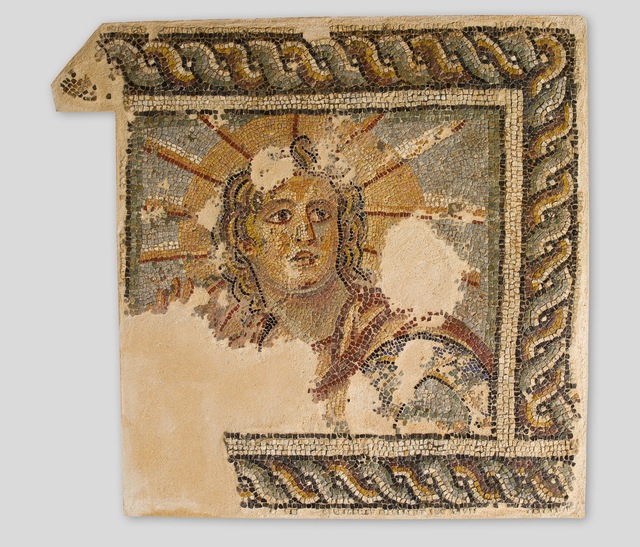
The first room of the exhibition shows the classical influence most clearly. A Spartan mosaic from the third century shows the personification of the sun as a male figure surrounded by a circle of golden light. In Christian imagery, this image becomes Christ with a halo. In the same room, a carved marble table support shows a seated figure, playing the lyre and surrounded by animals. He is the Greek demi-god, Orpheus, who was known for his ability to charm all of nature with music and who, for a short time, descended into the underworld. Orpheus became an allegory of Christ saving the souls of men with his words. The eagle above Orpheus’s head is a Christian symbol indicating that Orpheus/Christ has been resurrected and ascended.
Greco-Roman influence wanes, however, as the exhibition unfolds and the anti-naturalistic Byzantine style takes shape. Ancient art’s emphasis on corporeality, seen in the marble sculptures at the beginning of the exhibition, is replaced by the flat outlines of immaterial forms, instead. Christianity’s emphasis on the soul over the body needed to be expressed through a new medium. Sculpture in the round disappeared — replaced by the two dimensional art of mosaics and painting. Through the use of colored tesserae, paint and gold leaf, artists found a way to replace the natural world with one of transcendent light.
Byzantium flourished for a millennium, until the Ottoman Turks conquered Constantinople in 1453. During that time, wealthy patrons commissioned everything from icons to altarpieces to jewelry, silverware, bibles and books. Religion and government were completely intertwined as is shown by the coins minted by successive Emperors featuring their own portraits, as well as images of Christ, or of Christian symbols. Even so, the art of the ancients was never too far away. Some icons, like that of the Archangel Michael (which is the featured image of the exhibition) from the early 14th century, show a strong classical influence. Michael’s graceful features and robust physique indicate a return to Greco-Roman physicality. At the end of the exhibition, then, a nod to the upcoming Renaissance, and another 500 years of history to muse upon in the holidays ahead.
Heaven and Earth runs through March 2, 2014.