“You’re not a man until you’ve gone to Mecklenburg.”
For years, it was a common saying in many of Richmond, Va.’s roughest neighborhoods, a nod to the juvenile detention center on Mecklenburg Street. For 32 years, the drab, single-story complex in Richmond’s East End housed the city’s worst juvenile offenders while they awaited trial, a holding facility for the city’s youngest criminals.
Many residents of the detention center didn’t have to travel far to reach it — the center sits at a dead end directly across the street from Whitcomb Court, long considered one of the most dangerous places in Richmond. Twenty five people have been slain there in the past decade alone.
The story of this particular detention center is hardly unique: it was overcrowded, understaffed, and grossly underfunded. For years, the facility operated at nearly twice its capacity. At different points in time, nearly 90 inmates lived in quarters designed to hold 52 — 95 percent of those housed at Mecklenburg were facing felony charges, many with severe emotional or behavioral problems. At any given time, 10 to 15 of its inmates were on suicide watch.
Mecklenburg was a microcosm of many adult correctional facilities. Inmates often had to be segregated by gang affiliation or neighborhood. In an interview in the Richmond Times-Dispatch from 1991, former Superintendent Louis Westbrook described the situation at the detention center quite well.
The youngest child Westbrook has ever seen at the home was age 7. That was long ago, he said. The boy returned many times. More recently, the home had a 10-year-old boy who was a “top-of-the-line” car thief. One boy in the home has already been convicted of murder in adult court, Westbrook said. Adult prisons have no room for him: “He’s second in line.”
For a facility that housed some of Richmond’s most dangerous inmates, Mecklenburg was hardly secure. Over the years, many inmates escaped the facility, which looked more like an elementary school than a prison. Completely devoid of all of the hallmarks of any correctional facility — razor wire, spotlights and the like — it proved as easy to get out of as it had been to get in.
After years of planning, Mecklenburg was shuttered in 1996, replaced by a more modern facility just down the hill from the old one. It too has seen its share of problems: the detention center only recently re-opened, several months after inspectors found issues ranging from prisoner abuse to failing locks, intercoms and security cameras.
****
Some things never change — Mecklenburg is still a scary place.
Nearly every window is boarded shut. What little light that manages to find its way into the place does so through a wound in the facility itself, be it a hole in the roof or a crack in the wall. I find myself happy I brought a friend. This is not a place I’d want to be in alone.
We enter through a loading dock and wander through the facility’s kitchen before stumbling upon a set of gymnasiums — one for the male inmates, and another for their female counterparts. Light pours in through a row of transom windows — these are really the only rooms in the entire facility you feel any sense of security in — and you get a good look at the graffiti that’s been left on the its walls. Emblazoned in pink spray paint is a particularly ironic message: “This is what dreams are made of.” Hardly.
Wandering out of the gym, several u-shaped hallways lead you up and down rows of cells. The cells are tiny — maybe 10 square feet — and are practically windowless. In many, a single skylight emits a dim glow on the floor beneath it. A steel toilet, sink and mirror are installed in one corner of the room, while a metal bed frame is bolted to the floor in the corner across from it. Emerald-colored, marbled institutional tiles — the kind so many of us grew up seeing in so many public buildings — line the floor. It is a truly depressing place.
At the ends of each hallway are larger dormitories, perhaps reserved for inmates who proved a bit less troublesome. A bunk bed and table fills one, while three single beds fill another.
The inmates have left their mark throughout the place. I’m unable to see my reflection in a mirror in one particular cell; it looks like someone has ground their fingernails down to the quick scratching into it. In another room “Mutt-Dogg” has left his contribution, a Wu-Tang Clan logo which he’s signed and dated “1996.” A deflated soccer ball sits on the floor next to a cot, as does a piece of Christian literature.
Toward the front door of the facility, the superintendent’s office is bereft of any furniture, though it seems his desk was emptied onto the floor before it was removed. His business cards are there, as are various manuals. One describes how to administer oral medication to an uncooperative inmate, while another describes what to do in cases of abuse.
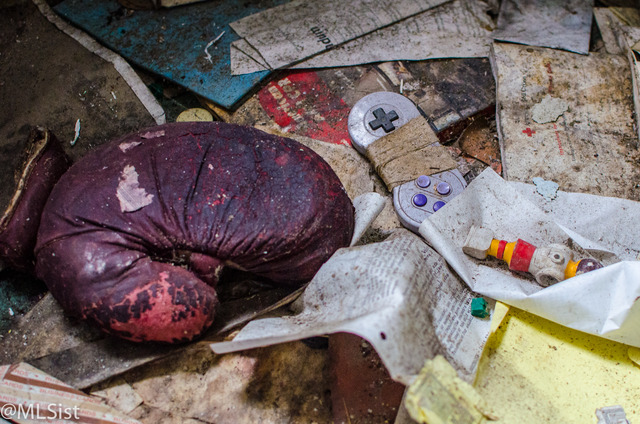
I glance down at the office floor and see several remnants of my own childhood: a Super Nintendo controller and a foosball player, shorn of his post. I find myself a little bothered, and it makes sense: this place closed in 1996, right around the time I was developing into an obdurate, bullheaded, troublemaking sixteen-year-old. I look down the hallway past a row of empty cells, and then I leave.