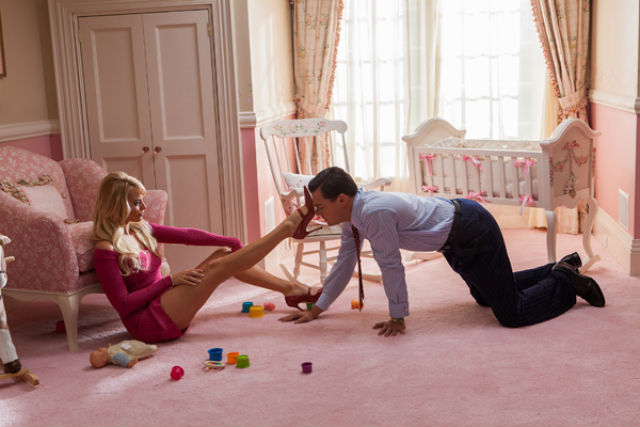
 Margot Robbie and Leonardo DiCaprio. Photo by Mary Cybulski /Paramount.
‘Tis the season to give and to receive — and to watch Oscar bait. For the last few weeks of December, Hollywood sends in their pinch hitters, late season contenders for golden statuettes that mess with critics’ top-ten list deadlines. A common theme runs through many of these 11th-hour award hopefuls: more often than not, they’re about America, or the movies, or both. Inside Llewyn Davis: about America. American Hustle: about America, fakery, and playing a part in America and in the movies. Saving Mr. Banks: about America’s uneasy relationship with art, commerce and the British. Grudge Match: America grows old and ornery and fights among themselves. Walter Mitty: America escapes through dreams and the movies. Her: America falls for technology and the fictions we invent to entertain ourselves and with which we try to fill the void in our lives.
This leaves us Martin Scorsese’s The Wolf of Wall Street, adapted from the memoir of Jordan Belfort, as the most unapologetically American movie among the year-end players. Its protagonists are unrepentant douche bags. Its anti-hero suffers the mildest of comeuppances. Scorsese reins in the stylistic advances of recent films like Hugo and sets his camera to a restrained look at a period of American excess that may inspire as many viewers as it disgusts. The Wolf of Wall Street is a three-hour infomercial, an epic raunch comedy-drama wolf in holiday prestige sheep’s clothing. It’s what America buys. It’s the best movie in theaters this season.
Just don’t take the whole family.
Belfort’s 2007 book begins as a cautionary tale, told from the not especially tragic consequences that nearly derailed his family but didn’t really derail his success story. But Scorsese and screenwriter Terence Winter (Boardwalk Empire, The Sopranos) smartly lure in the unsuspecting viewer like the salesman at the center of their play. The movie begins in the debauched offices of brokerage firm Stratton Oakmont, whose employees cheer as little people are hurled into novelty targets. How did America and these people get to this point?
Jordan Belfort (Leonardo DiCaprio) narrates his own story, and flashes back from this scene of exploitation to his relatively humble beginnings, a young idealist with a
wife and modest home in Brooklyn trying to conquer Manhattan. This puts Jordan in the tradition of outer-borough success stories from Llewyn Davis to Spider-Man.
Belfort, like Scorsese, is a salesman, and if the spoils of battle and the nature of its victims differ, the pitch is just as important whether you’re an artist or a financial whiz kid. Sell penny stocks, make a movie, you too can get rich and have all the decadent sex and drugs you want.
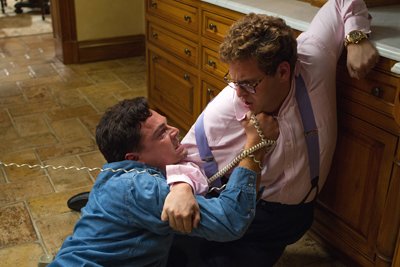 Leonardo DiCaprio and Jonah Hill (Mary Cybulski/Paramount)
The cautionary part of the story does not come along until the final hour of this three-hour tour, but there’s an early danger sign when the guy who wants to work for you and be your best friend is played by Jonah Hill.
Leonardo DiCaprio is a bland everyman, a now aging pretty boy douche with the sales pitch and confidence to carry the movie. He stands on the shoulders of an excellent supporting cast. Matthew McConaughey has a colorful cameo as a senior trader with a penchant for faux-Indian chants, immersing himself in a savage tribalism. Margot Robbie is right on as Belfort’s second wife Naomi, a piece of eye candy that goes sour. But Jonah Hill hits it out of the park. Some critics have taken issue with the fact that you never see the victims of Belfort’s financial malfeasance (it’s based on his own story, so why would he?). But there are at least two prominent victims here: his first wife and his best friend. Donnie Azoff (Hill) is the creepy guy who quits his job when he learns that Belfort pulled in $70K a month. Donnie graduates from a schlub looking to make some extra money to a schlub who whips it out and masturbates in public when he first lays eyes on Naomi at a house party. You probably don’t want to see as much of Hill as you see here, but his performance is thoroughly committed, his inner degradation manifest in outer grotesqueness. When Hill grows up, he’ll make a great Falstaff, telling wild stories to his bros and being left behind with other childlike things.
Whom do you imagine would be cast to play you in your cinematic life story? Leonardo DiCaprio? Or Jonah Hill? The Wolf of Wall Street pitches to the Jonah Hills of the world that you too can be Leonardo DiCaprio. I buy it: it’s one of Scorsese’s best in years.
—
The Wolf of Wall Street
Directed by Martin Scorsese
Written by Terence Winter
With Leonardo DiCaprio, Jonah Hill, Matthew McConaughey, Margot Robbie
Rated R for sequences of strong sexual content, graphic nudity, drug use and language throughout, and for some violence
Opens Christmas Day.