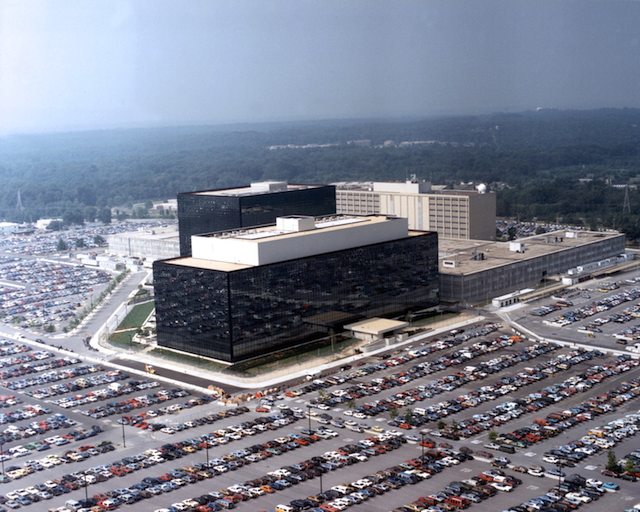
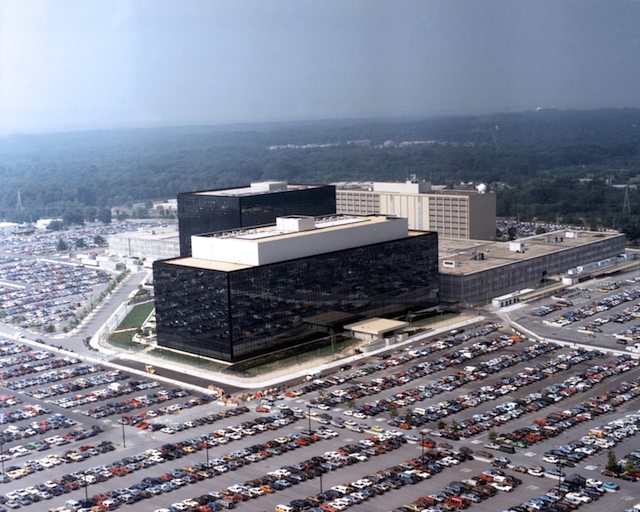
 NSA headquarters (Getty Images)
The massive database of domestic telephone records collected by the National Security Agency, exposed by Edward Snowden, has been declared lawful by a federal judge in New York.
The Post reports that, in a 53-page opinion, U.S. District Judge William Pauley found the NSA’s phone data collection program not to be a breach of constitutional rights, saying it’s “‘ultimately a question of reasonableness’ under the Fourth Amendment.” Pauley’s opinion says that the lawfulness of the NSA’s collection of nearly everyone’s phone records is part of the U.S. government’s “counter-punch” against terrorism. He added that, if the government had access to this information before the terrorist attacks on September 11, 2001, it may have “helped provide critical clues” and possibly identified the hijackers before the attacks happened.
“The government learned from its mistake and adapted to confront a new enemy: a terror network capable of orchestrating attacks across the world,” Pauley said in his statement. “It launched a number of counter-measures, including a bulk telephony metadata collection program—a wide net that could find and isolate gossamer contacts among suspected terrorists in an ocean of seemingly disconnected data.”
Pauley’s ruling, which rejected the American Civil Liberties Union’s challenge to the lawfulness of the NSA’s program, obviously didn’t sit too well with the ACLU, who said in a statement that they plan to appeal the case. “We are extremely disappointed with this decision, which misinterprets the relevant statutes, understates the privacy implications of the government’s surveillance and misapplies a narrow and outdated precedent to read away core constitutional protections,” said ACLU deputy legal director Jameel Jaffer.
This, of course, contradicts the ruling of U.S. District Judge Richard J. Leon last week, who found that the NSA’s “almost-Orwellian technology” to be unconstitutional. Due to these conflicting decisions, you can probably expect that the Supreme Court will weigh in own the issue and make its own ruling.