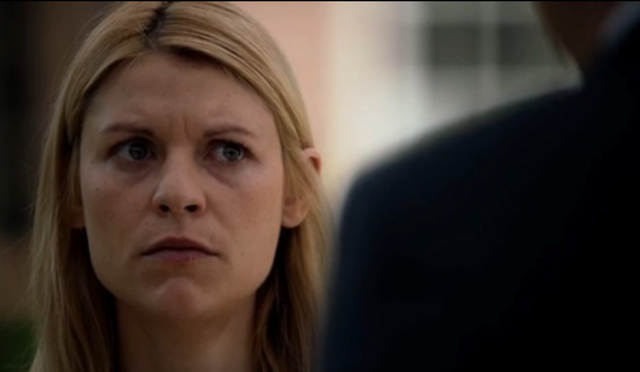
 Carrie Mathison doesn’t want to hear you complain about spoilers. (Photo via Showtime).
Earlier this morning, The New York Post published a piece about spoiler alert etiquette, reigniting a longstanding public debate that seems to flare up every few months or so: When is it OK to discuss spoilers in a public forum?
Now, normally this sort of thing falls out of the umbrella of DCist’s coverage, but considering I recapped Homeland’s with you all this season and have a staunch stance that spoiler alerts are bullshit (I was even scolded on Canadian radio for revealing a characters death on Downton Abbey months after it originally aired), I thought it appropriate for me to chime in. Plus it’s the end of the year!
First things first: I have to applaud the Post for siding on the anti-spoiler alerts side of this debate.
Mention anything about the finales of “Homeland,” “Game of Thrones,” “The Walking Dead,” “Breaking Bad,” “Scandal” or even “Downton Abbey,” and someone always shouts from behind an office cubicle, another room in the apartment or even across a neighborhood bar “Don’t tell me! I haven’t seen it yet.”
Well, why not? If the climactic episode of TV show is scheduled for the third Friday night in November, and the show’s fans have been eagerly discussing exciting plot points all season, are they really supposed to keep quiet about it for days, a week or even longer while cultural laggards get on the same page?
We say no.
Yes, with the convenience of DVR, TiVo, On Demand, various streaming services, and countless other avenues to consume TV, it’s nearly impossible to know when most people are going to be watching the latest episode of a given series. That alone is reason enough for all those cries of “spoiler alert!” at first mention of Walt’s not-so-shocking death at the end of Breaking Bad, or Brody’s death at the end of Homeland’s third season to automatically be voided null.
Next, the Post goes on to outline certain criteria for discussing spoilers in the hours or days after an episode has aired. For a season or series finale, the Post says that “if the show goes out with a bang — which has been true for the dramas mentioned above — people should be expected to wait no longer than 24 hours to talk about it.” And for “plot-twisting episodes” on shows like Scandal or Game of Thrones, the grace period is 36 to 48 hours. That’s right, according to the the Post’s rules, you can’t talk about an episode in a public setting—be it Twitter, Facebook, or by the watercooler—for at least 24 hours or longer, depending on the episode.
That is bullshit.
There should be no waiting period before you can talk about any episode publicly. At all. Why should critics, or any viewer, table their discussions publicly while they wait for the rest of the world to catch up, however long that will be? In this day and age, people are capable enough to navigate social media and the Internet well enough that they should know how to avoid places where a sensitive plot twist may be spoiled. It’s on them to avoid spoilers, not the rest of us to delay our discussion so that others can catch up when it’s convenient for them.
With companies like Netflix and Hulu producing more and more original content, dumping full seasons of shows like House of Cards, Orange is the New Black, and Arrested Development all at once, how are we supposed to gauge how we discuss spoilers? There will be people who binge-watch seasons of these shows at once, whereas others will take their time watching them over a months-long period. Because of this, establishing silly rules for when it’s OK to discuss spoilers becomes increasingly difficult.
So, for the last time, let’s all just relax with spoiler alerts. You’re going to watch the damn show anyway.