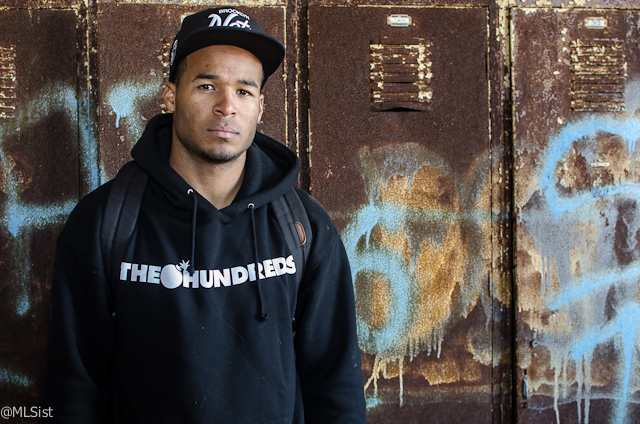
 No, this is not the locker room at RFK. It’s the locker room at Glenn Dale. (Photo by Pablo Maurer)
I’m plodding through the basement of an abandoned tuberculosis sanatorium with D.C. United center back Ethan White.
It’s around noon on a Sunday in December, and Ethan and I have been wandering the halls of the long-abandoned Glenn Dale Hospital for an hour or two. Drawn to the place after seeing our Abandoned D.C. piece on it, White wants to take some photos of his own. He’s been spending the off-season wandering D.C. and its surrounding areas with a camera in hand.
I’m happy to oblige. I arrange a re-visit to the Sanatorium, only this time I reach out to the fire department beforehand: I’m happy to take some photos with the kid, but I’m not trying to get him arrested.
“Why did they put the kitchen next to the morgue?” White asks, motioning toward the refrigeration unit for Glenn Dale’s deceased residents. I don’t have an answer, so I answer his question with an equally dark one. “How bad was last year for you?”
White’s 2013 was a trying one to say the least. D.C. United trudged through the worst campaign in MLS history, winning only three games and setting records for offensive and defensive futility. The Maryland grad was one of United’s only bright spots in ’13, stringing together a number of consistent defensive performances toward the end of the year and earning a starting spot before year’s end.
“It was weird, because we had a really great locker room,” White reflects. “It was just a group of cool, tight-knit guys. We never turned on each other. I think because we felt like some balls didn’t bounce our way, maybe that made things easier. There were games where we were getting 20 shots and just not finishing. I just don’t think we were that bad.”
“I think I learned a lot about myself,” White continues. “Ever since I signed, it was always like ‘We think you’re a good player but don’t know if you’re ready to play.’ Finally last year — when I started the Open Cup [championship] game — it was like ‘Wow, now they know they need me. They know they need me in a situation like this.’ I feel like they gained confidence in me, and I gained confidence in myself.”
White doesn’t ignore the negatives of 2013 — far from it. He mentions a mid-season game against Chicago as his low point, one where he was subbed out at halftime. “I was pretty pissed off,” he says, shaking his head. And he admits to occasionally having had some doubts about the direction the team was led in from time to time. “I feel like even if you’re the best team in the league and you lose three games in a row you have doubts. Look at Sigi [Schmidt, Seattle Sounders Head Coach]: He was supposedly getting fired and his team made the playoffs! You just never know.”
Major League Soccer can be an interesting place for a player like White, a still developing league that finds itself in the midst of a particularly rapid growth spurt. For a homegrown kid from Kensington, Md., taking the pitch against someone like Robbie Keane, Thierry Henry or Landon Donovan can be intimidating. They are the types of international superstars that simply never chose to play in MLS during White’s childhood, players that now thoroughly populate the league.
“I mean, I think we’ve been talking about playing professionally since like sixth grade or something,” he says, chuckling with a friend he’s brought along to the hospital. “It wasn’t a huge deal until I actually played my first game against LA Galaxy. You know, you’re actually playing on the field with [David] Beckham, Donovan — dudes you’ve looked up to for a long time — and the next year you’re guarding them. It was surreal.”
Henry, in particular, struck a bit of fear in White. How could he not? “I was shitting my pants the first time I marked him,” White jokes. “The first time I saw him I was like, ‘I had no idea you were this big in real life.’ To think about him being that big and that fast. Man.”
We walk upstairs, exploring abandoned laboratories and operating rooms before arriving at the end of a hallway, where White spots some animal tracks in the dirt that covers the tile floor. “What kind of animal is that?” he asks the firefighter who’s generously donated his time to walk us through the place.
“They look like raccoon tracks,” he responds. I can’t help but laugh. I wonder if they’ve followed Ethan here.
 Ethan White, during a recent visit to Glenn Dale Hospital. (Photo by Pablo Maurer)
Whether Ethan White knows it or not, he shares something in common with Thierry Henry, the enigmatic Frenchman who he was so terrified to defend: They both ride the train to work.
White lives in Northeast D.C. It’s something that’s a bit of an anomaly among the area’s pro athletes, most of whom live in Virginia or Maryland, for a variety of reasons. And like a lot of District residents, he can’t exactly wrap his head around the idea of moving out of the city, something he’s quick to point out.
“I lived in Virginia, in Alexandria, my rookie year. I hated it,” says White, who doesn’t seem to be a huge fan of NoVa. He points out that teammate Chris Pontius recently moved out of the city and takes the opportunity to do a little ribbing.
“Chris likes college. To me, that Arlington area is like a college campus for people who are 25 to 32. They all know each other’s business, they all hook up with each other. There’s always drama. I don’t do that. I’m just such a city dude. I don’t have a car. I bounce around between my neighborhood, Georgetown, Dupont and Adams Morgan.”
“Come here to die?” White says, raising his lens and motioning toward some crudely applied graffiti. “Jesus.” We’re in the elevator room now, a bleak crawlspace at the apex of the adult building full of rusty beer cans and rapidly decaying machinery.
I drive the conversation toward United’s plans for 2014. It’d be hard for United to do any worse than they did in 2013; White says he expects the team to make the playoffs. I’m wondering what he thinks of the team’s latest slew of acquisitions, and one in particular: controversial forward Eddie Johnson, acquired from Seattle several weeks ago, a player with a bit of reputation for being a locker room distraction.
“He’s a good player. On the field he’ll be great. It’ll be interesting to see how he comes into our locker room, though,” White says. “We’re already a tight-knit group of guys. We’re all cool with Eddie, so we’re optimistic.”
White will certainly be back in 2014, but his long-term future is a bit fuzzier. He still has national team ambitions — White talks of working his way into that picture — and mentions playing abroad. Turnover is the name of the game in MLS, and it’d be hard for any particular player to see where they’ll be in five years.
“With this league, you have no idea where you’re gonna be. I mean obviously, me being homegrown, I feel more like I’m gonna stay, but who knows? You never know in MLS. There’s all this news with the stadium, but with this league’s turnover, will anybody on our team actually see the stadium, or play in it? Probably not.”
Ethan’s friend looks at the ceiling, where something’s dripping, creating a spongy mountain of goo on the floor below it. “What’s that?” he asks. “I’m not sure,” replies the firefighter. “Maybe asbestos?”
Yeah, I guess we should leave this place. I want D.C. United breathing a bit easier next year.
 Ethan White, on the stage in the auditorium at Glenn Dale. (Photo by Pablo Maurer)