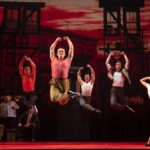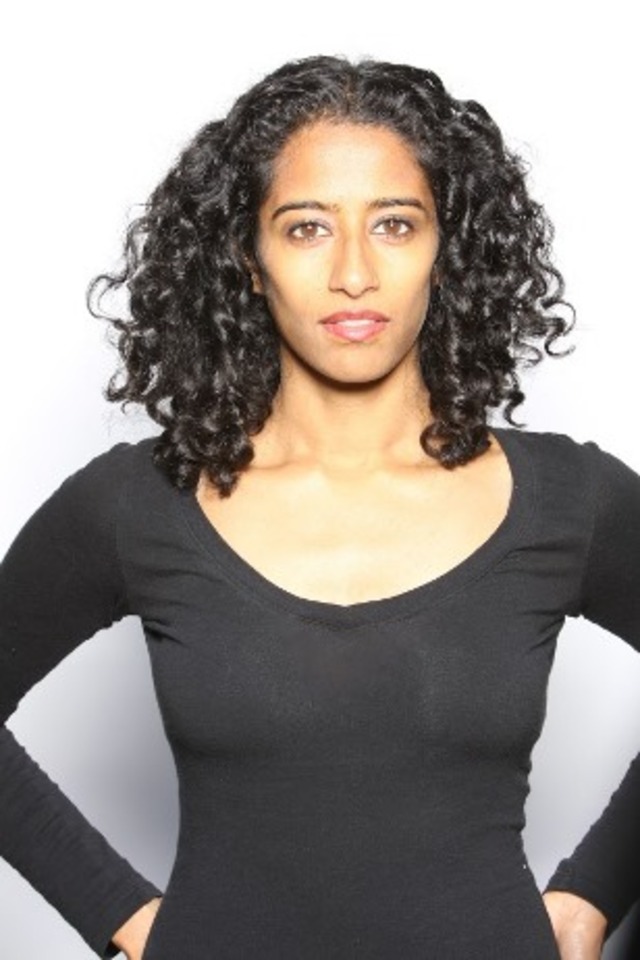
 Area actor/playwright Anu Yadav will be performing her original piece, Meena’s Dream, from January 8 to 18 at Silver Spring’s Round House Theatre. Photo by Jati Lindsay.
As far as local theater events in January go, few are getting as much buzz as Meena’s Dream, a play by area dramatist Anu Yadav and presented with Forum Theatre.
The play sprang out of Yadav’s work as a graduate student at the University of Maryland, where she wrote early versions of the piece while pursuing an MFA in theater performance. Prior to her studies at Maryland, she made her first forays into autobiographical theater as an undergraduate at Bryn Mawr College. Much of her work incorporates a social justice component into the theatrical setting. She gained major notice locally through ‘Capers, a solo play she developed based on the stories of D.C. public housing families who protested the demolition of their community. In addition to spearheading Classlines, a storytelling project about wealth and poverty, Yadav earned fellowships to train at Augusto Boal’s Center for the Theatre of the Oppressed in Rio de Janeiro and to work with the Indian street theater troupe, Jana Natya Manch, in New Delhi.
Yadav is the only actor in Meena’s Dream, playing multiple roles, but a trio of musicians provides live musical accompaniment. The fantastical tale centers around the titular nine-year-old girl, whose mother Aisha is chronically ill and can’t afford the medicine she needs. Her mother’s sickness triggers nightmares in Meena, and she dreams that Hindu deity Krishna needs her help to defeat the fearsome Worry Machine, a force that threatens the universe’s very existence. The story unfolds as she confronts her fears and uses her imagination to envision a world without want.
Yadav took some time out of her preparation of Meena’s Dream to answer a few questions from DCist.
How did the concept for Meena’s Dream develop?
Meena’s Dream is really bringing together a few different strands. I wrote a short story about a Worry Machine when I was trying to calm myself down from my own stressed, packed freelance schedule — juggling teaching and performing and making ends meet. Then in graduate school, I got a chance to work with playwright Dael Orlaendersmith who really boldly encouraged us students to dig deep. She really knows how to support writers to get to hard, raw, gritty emotional truth. It was powerful. It was also all autobiographical work too. While Meena’s Dream is fictional, working with Dael really influenced my approach. How could I still get to that honesty in fiction? I started work on Meena’s Dream in a solo performance class taught by director/playwright Walter Dallas. I used my own experience and childhood dreams and fears as a point of departure for this play.
It’s a whimsical story, more so than your previous work, but what are some of the contemporary themes that you’re trying to weave into the story?
Meena and her mother Aisha can’t afford their existence. At one point, Aisha talks about how these are impossible choices, to have to choose between all the bills, food for her daughter, medicine for herself. I do focus on the issue of access to medicine and healthcare, because Aisha can’t afford medicine and has to cut her pills in half to make them last longer.
But the bigger issue is not simply about that. It’s about having enough, that everyone deserves by virtue of being human. To have the things they need to survive and live with dignity, regardless of whether or not they can afford it. The sheer number of people on this planet who must go without their basic needs is not a question of merit, or fact, it’s a question of distribution of resources. It’s unethical, and I absolutely believe there is enough for everyone to live with dignity. The question is not just about how, but about believing it’s possible. It’s the initial assumption of “it’s possible, let’s go!” that basically shapes the direction of the question of how. I’m hoping that by rekindling that flame of hope through the story of a young girl who dreams, and wants enough for her family, it can soften people in the audience to remember their own bigger sense of the kind of world we all want to live in.
Who are your collaborators on the project?
My main collaborators over the past two years have been musicians Anjna Swaminathan [violin], Rajna Swaminathan [piano/percussion] and Sam McCormally [guitar/vocals] who have been creating the music for the play together as it’s evolved. Patrick Crowley is our director for this world premiere at Forum Theatre, and Paige Hernandez is the choreographer. She also directed the workshop production last February at the MFA in Performance Festival of New Works at Clarice Smith Performing Arts Center. Anjna has also acted as music director, and research dramaturge for the play for the entire process. Over the play development process, there have also been many guides along the way.
What do you want the audience to walk away with after seeing Meena’s Dream?
I want the audience to walk away moved and brimming with hope to take on their own fears, whatever they are. I want people to think about what kind of world they think is fair to live in and have conversations about what they hope it should be like. I’d love to see how the work I do can support more community organizing, and deeper conversations about mapping those dreams and possibilities about a world with enough for everyone.
What do you hope to do with Meena’s Dream in the short-, medium- and long-term?
I want to tour the play in many cities, adapt it into a play that other actors can perform in, and eventually take it to other media. I originally saw it as a film, it could be an animated series, children’s book, novel. I think there is a lot of possibility, and I’m open. We shall see what happens!
What other projects do you have in the pipeline?
My main focus has been Meena’s Dream and also shoring up the business end of being an artist. But I have a few other projects, like Man on the Mountain, about the stories of two men, a coffee farmer from Nicaragua and a former coal miner from West Virginia, each trying to save their land, their side of the mountain. I also am planning to work on a series of comedy sketches and shorts about the economic system with my collaborator, filmmaker Ellie Walton. I also want to just do more comedic work as an actor and improvisation. I’d like to take this year to explore and have more new adventures as an artist.
What are your general thoughts on the D.C. theater scene? What are its strengths and where could it use some help?
There are remarkably talented, driven, positive artists that are passionate about doing work, creating it, sharing it. D.C. could definitely use more help to support artists through funding, support for developing work, workshops, producing, and also generally being an affordable place to live. D.C. is not affordable and that hurts working people, including artists. The fact that people keep creating work in an atmosphere where you are lucky if you break even speaks to the drive and passion inherent to the artist community here. I think there could also be more cross-disciplinary collaboration between the theater scene and other artistic disciplines, as well as encouraging a wider diversity of audiences to the theater.
Forum Theatre presents Meena’s Dream, a play by Anu Yadav and directed by Patrick Crowley, at the Round House Theatre Silver Spring from January 8-18, 2014. A full schedule and ticket information is available here.