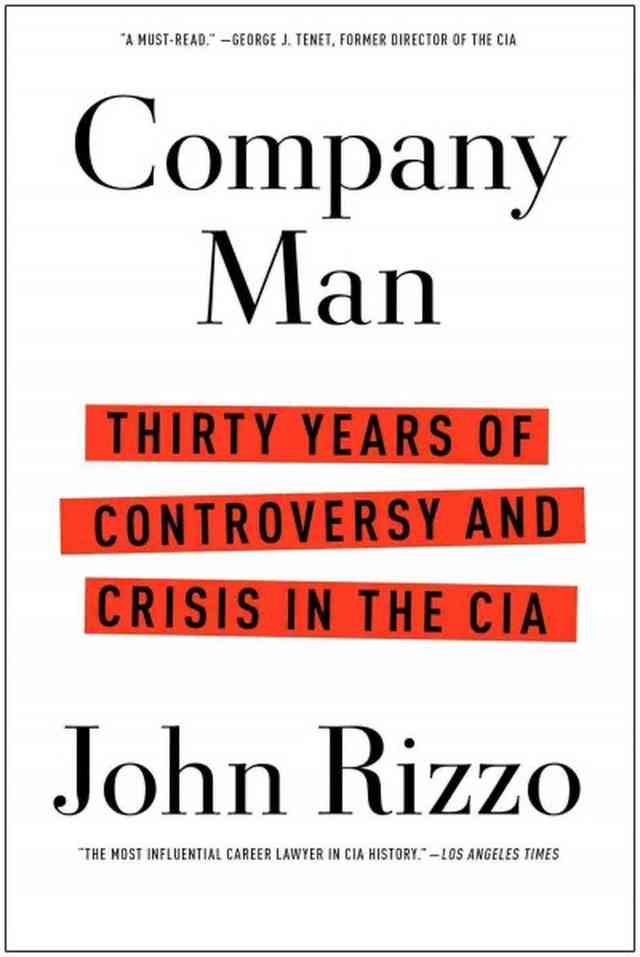
 Gandhi once said, “The truth never damages a cause that is just.” But is it that simple? Former Central Intelligence Agency lawyer John Rizzo makes his case in Company Man: Thirty Years of Controversy and Crisis in the CIA (Scribner, January 2014), and in conversation with The Washington Post’s Dana Priest at Politics and Prose this Saturday, January 18 at 6 p.m.
Rizzo writes that he took a “total shot in the dark” by sending his résumé to the agency in 1975. He told NPR that he remembers thinking, “I have no idea if the CIA has lawyers, but if they don’t, they’re probably going to need some.” This launched his 34-year career at CIA, starting with events like the Iran-Contra affair and culminating in the post-9/11 authorization of enhanced interrogation techniques (EITs) and drone strikes.
The CIA officially formed after World War II and focused on gathering intelligence. But 9/11 expanded the agency’s job description, and as General Counsel to the clandestine branch, Rizzo “helped create and implement the full spectrum of aggressive counterterrorist operations against Al Qaeda.” He and the Justice Department coordinated in explicit detail on what EITs could and could not be used on operatives; some of these documents were dubbed “Torture Memos.”
Company Man describes the government, about six months after the attacks, as seeped in dread about “another horrific strike coming any day.” The CIA saw its first real intel opportunity when Al Qaeda logistics planner Abu Zubaydah was captured, and it was not to be missed.
Rizzo speaks openly about his role: “I Could Have Stopped Waterboarding Before It Happened” was the title to Company Man‘s recent excerpt in Politico. If that alone doesn’t reel you in, read on:
“What I didn’t know [after Zubaydah’s capture] and wouldn’t know until two months later was the decision — I could never determine whether someone at CIA Headquarters or in the field came up with the idea — to videotape Zubaydah around the clock while he was in custody, including periods of interrogation. When he first told me about the videotaping in October 2002, Jose [Rodriguez, chief of CIA’s Counterterrorist Center] offered two reasons. First, our people at the interrogation site wanted to make sure everything Zubaydah said was recorded and preserved. …. It’s important to note here that, prior to 9/11, the CIA had never in my quarter-century experience held and questioned anyone incommunicado. In a popular culture steeped with films, TV shows, and potboiler spy novels portraying the CIA as a no-holds-barred instrument of mayhem, this may be hard for an outsider to believe. But it’s true. The videotaping was seen not just as a reference tool but as a security blanket.
The other reason Jose gave me for the decision to videotape Zubaydah was more basic: His people didn’t want the SOB to die on them.
After several days of taping, however, everyone who had bought into the idea looked at the videotapes, compared them with the notes transcribed and forwarded to headquarters, and concluded that the notes captured everything … Besides that, Zubaydah had recovered from his wounds and was exhibiting no desire to journey to the afterlife — even with the seventy-two virgins presumably awaiting his arrival — anytime soon. The hundred or so hours of videotapes were packed up and stored at the detention facility.
But Jose’s sudden desire that October to destroy the tapes was not spurred by an urgent need to eliminate unnecessary clutter. It was based on what the tapes showed.”
For the record, Rizzo still says waterboarding techniques do not legally constitute torture, and if they did, “we would never have done them.” He mentions there was one EIT he thought pushed the limit, and that he was relieved when it was rejected by the Justice Department.
Rizzo grew up in Boston and is a graduate from Brown University and George Washington University Law School. He left the CIA in 2009, and is now a visiting fellow at the Hoover Institution and senior counsel at the Steptoe & Johnson law firm.
The event is free to the public, and beer and wine will be available (you’ll need it). Priest is a two-time Pulitzer Prize winner and called Company Man “simply the most revealing insider account to date of the top ranks of the CIA during its most historic — and controversial — era. There is news and humor in every chapter. Frankly, I often found myself wondering why the CIA’s pre-publication censors signed off on some of it.”