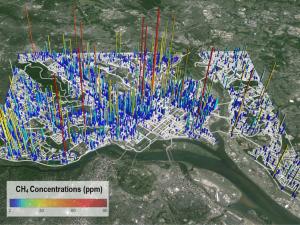
 Via Duke Environment.
A new study by a research team from Duke and Boston universities found more than 5,800 natural gas leaks under Washington D.C., with a dozen that could have posed explosion risks.
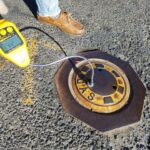
The study, published today in the journal Environmental Science & Technology, was conducted in January and February of last year by driving the streets of D.C. with ” a high-precision Picarro G2301 Cavity Ring-Down Spectrometer installed in a GPS-equipped car.” After finding the 12 dangerous leaks and reporting them to Washington Gas, researchers say they returned four months later to find “nine were still emitting dangerous levels of methane.”
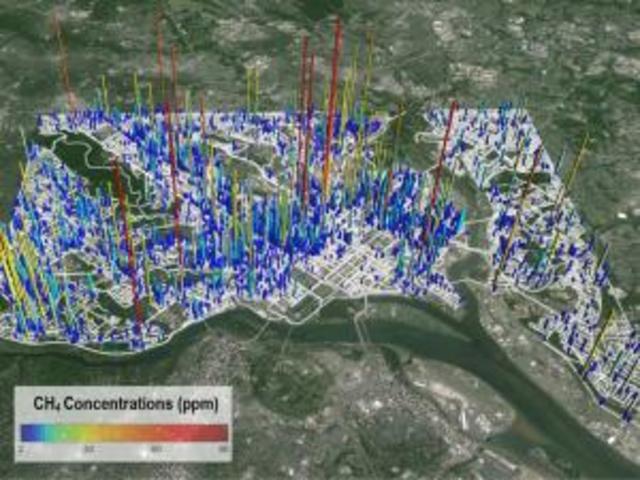
The average methane concentration observed in the leaks was about 2.5 times higher than in background air samples collected in the city. Methane levels in some leaks were as high as 89 parts per million, about 45 times higher than normal background levels.
In a statement, Washington Gas says they’ve yet to review the study, but “maintain rigorous inspection programs, operating procedures and record-keeping protocols.”
Washington Gas practices exceed the leak detection and repair procedures that are required by code, enforced by federal agencies and overseen by each state’s public service commission. The company continually takes appropriate actions to maintain the safety of its gas distribution system in Maryland, the District of Columbia and Virginia.
In accordance with the company’s standard protocol, Washington Gas immediately responds to every report of natural gas odor and repairs leaks 7 days a week, 24 hours a day, 365 days a year. With over 13,000 miles of distribution mains and more than 940,000 service lines in our system, it is not realistic to state that there are no leaks.
Throughout the country, all utilities are challenged with the timely replacement of aging infrastructure. Washington Gas continually replaces old infrastructure, as required. Maryland has recently joined Virginia and over 34 other states in recognizing this challenge by creating a law which allows for the accelerated replacement of aging infrastructure.
The Washington Post created a map of areas with the highest levels of methane detected. Possibly explosive locations included areas in Mount Pleasant, NoMa and Spring Valley.
“Repairing these leaks will improve air quality, increase consumer health and safety, and save money,” Robert B. Jackson, Duke professor and leader of the study, said. “Pipeline safety has been improving over the last two decades. Now is the time to make it even better.