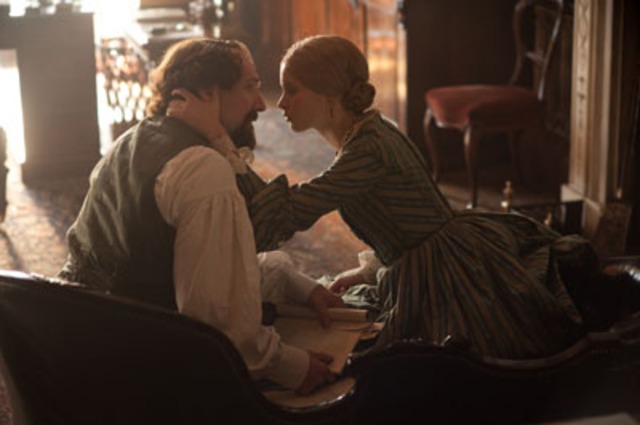
 Ralph Fiennes and Felicity Jones (David Appleby/Sony Pictures Classics)
One of the first sounds you hear in The Invisible Woman is that of an orchestra tuning its instruments. It’s a nice metaphor for which to open a movie: discordant elements working to find shape and direction in order to make beautiful music. Unfortunately, the ensemble in charge of the film never gets their varied and considerable talents to work in harmony. Director Ralph Fiennes tells the story of Charles Dickens’ affair with Nelly Ternan, a woman more than 25 years his junior, with period reverence and propriety, but precious few sparks.
This is Fiennes’ second time behind the camera. His 2011 adaptation of William Shakespeare’s Coriolanus was an impressive debut that used Skype and cellphones with an eye to modernization, but stayed in keeping with themes of distant and ineffective leadership. As inventive as those technological updates were, Fiennes stayed faithful to the text, and guided his ensemble cast to vivid performances that made this centuries old play into a vital, living work.
Fiennes turns to another giant of English literature for his sophomore outing, with considerably duller results. The movie opens in the coastal town of Margate with a long shot of Nelly Ternan (Felicity Jones) walking across the beach, her Victorian-garbed figure making an insignificant dot on the sand. She’s headed for the boys school she runs with her husband George (Tom Burke). Inside, teenage musicians are getting ready for a school production of Charles Dickens and Wilkie Collins’ stage play No Thoroughfare. As Nelly directs her charges in the nuances of performing Dickens, she becomes lost in memory, for as it happens, she met the play’s co-author when she was performing a part in that very same play.
Ternan was an 18-year-old fangirl when she met the 45-year old Dickens. The script by Abi Morgan (who wrote Steve McQueen’s Shame) puts us in the uncomfortable position of watching young Nelly tell Dickens’ wife Catherine (Joanna Scanlan) how much she thinks he’s really, really great.
I exaggerate, but the awkwardness of this encounter isn’t just in the situation but in the writing, which is heavy on exposition and light on Dickensian texture. The film introduces discomfort but fails to capitalize on it dramatically. Nelly’s mother Frances is played by Kristin Scott Thomas, a casting ploy to remind viewers that the man playing Dickens (Ralph Fiennes) played Thomas’s lover in The English Patient. It’s all so very awkward, but the writing and acting doesn’t play up to the resonances inherent in the material.
Fiennes was commanding in Coriolanus, but he’s a hammy, unconvincing Dickens, and his scenes with Jones lack spark. A candlelit scene of supposed sexual tension, Jones’s décolletage heaving in a groupie’s breathless desire, made me sleepy. Rob Hardy’s cinematography, especially the earth tones with which he bathes dimly-lit interiors, is gorgeous, but its soothing beauty is a superficial comfort that works against the human play that unfolds before us. The drop-off in quality for Ralph Fiennes as a director is alarming. If he can get a decent performance out of Gerard Butler in Coriolanus, why can’t he make Dickens come alive?
Directed by Ralph Fiennes
Written by Abi Morgan
With Ralph Fiennes, Felicity Jones, Kristin Scott Thomas
Rated R for some sexual content
Opens today at Landmark E Street Cinema