ASHLEY, PA – “I’ve been at it for 22 years,” he said, “just trying to save it.”
I’ve just driven four hours, from D.C. to Ashley, Pa., taking the scenic route, through towns like Frackville and Minerstown, past smokestacks and wind farms.
I’ve come to Ashley — a sleepy, one-stoplight town about a mile outside of Wilkes Barre — to talk to Ray Clarke.
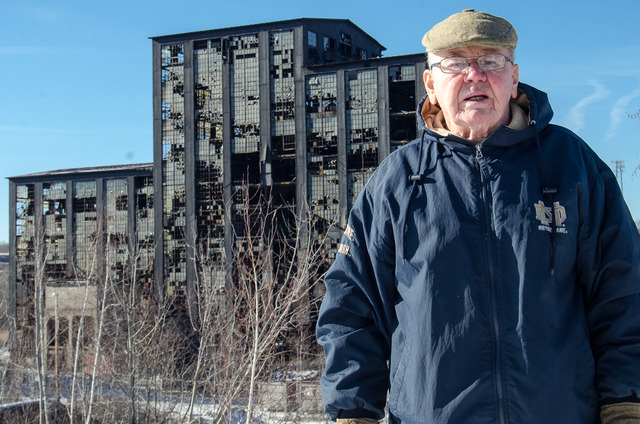
“I just don’t know if you could put a dollar value on it,” he says. Behind him sits the Huber Coal Breaker — what’s left of it, anyway. Demolition on the site began several weeks ago and picked up recently. Ray, an 80-year-old man who’s lived in Ashley his entire life and spent years hauling coal out of the place, has a front row seat he never asked for.
“I was born and raised up the street from it,” he says. “It was noisy. The whole place shook. And dirty — you had to be careful when you hung clothes out on the line. I went by it every day going to school. In the summer, when we were off of school, I went and got dynamite boxes from the miners. We’d jump the fence and go down by the powder house and ask for them. My father would build shelves out of them in the basement or chop them up for firewood.”
Ashley, like so many other towns in the anthracite fields of Eastern Pennsylvania, was built on coal. And at the center of it, on Main Street, is its breaker. Built in the late 1800s and completely rebuilt in the ’30s, the Glen Alden Coal Company’s towering, 11-story steel and glass goliath used to crush, clean and sort 7,000 tons of coal a day. A technological marvel that employed some 1,750 residents at its peak, it has long been silenced. Underground mining fell out of favor in the ’60s and ’70s, rendering obsolete all 450 or so breakers in the region. Huber is the last one standing — for a few more months.
Clarke began fighting to save the place in the early ’90s. He’s the chairman of the Huber Breaker Preservation Society, a non-profit that aims to preserve the site, and I’m chatting with him at a memorial park the organization has created on the grounds of the breaker. It’s modest but beautiful; an image of the breaker in its heyday is engraved into a slab of granite. Under it, an inscription: “To all those who worked in the northern coal field.”
Among the society’s biggest allies is Robert Hughes, executive director of the Eastern Pennsylvania Coalition for Abandoned Mine Reclamation. Though his organization primarily works to clean the hundreds of streams contaminated by centuries of mining in the region, Hughes took a personal interest in the breaker, which he can see from his office window. “From our perspective, it’s history. It’s something we could teach our kids and grandkids about.”
Preserving the site was un uphill battle from the start, one only made more difficult by the negative perception of the coal industry. Though many area residents showed interest in sparing the breaker from demolition, few came forward with money. “A lot of lip service,” Clarke says.
“There are lots of tiffs that go on about preservation vs. progress and economic development. Those kind of arguments always take place up here,” Hughes shared. “This is a valley very resistant to change. They’ve still got that mentality of the coal mining; it’s burned into them about what it did to us here. This is a symbol, for a lot of people, of what it did to us.”
What mining did to Ashley — and many other communities in the area — is as complicated as the breaker itself. “There certainly weren’t any jobs at one point, and then you have this influx of work. But with the decline you’re in poverty again,” Hughes laments. “That’s probably what a lot of people feel. The landscape that it’s left for us, since the ’70s, has been pretty detrimental. It’s a devastating black landscape with streams that are polluted by mines, water pollution all of over the place, underground mines that are filled up, areas prone to mine subsidence.”
Despite all that, Hughes, Clarke, a small army of former mine employees, local preservationists and business owners fought to save the breaker. At one point there was a sliver of hope: the county thought of taking the land by eminent domain. But that led to legal wrangling and broken promises. In August, the site was sold in bankruptcy court for $1.25 million to Philadelphia-based Paselo Logistics, LLC, who are looking to recover their investment in scrap metal and re-development.
Hughes couldn’t believe nobody put up money for preservation, especially when “all of the locals here were harboring and banging and clamoring to save this damn thing.” It was hard to couple private investment and historical appreciation. “Maybe some of those folks see it as a detriment. It’s something in the skyline here that’s a reminder of the past.”
Hughes and Clarke have given the property owners a list of items they’ve like preserved from the breaker. They’ve been promised a couple of coal cars, some track, and some of the more unusual coal-processing equipment. There’ll be a small building on the site—a center where area children can learn mining history. But the rest of the breaker will soon be gone. “I imagine they’ll come in here with a wrecking ball,” says Hughes. “Maybe they’ll just bring Miley Cyrus in to do it.”
Black humor for sure. No denying that the loss of the breaker is painful. Difficult days for Hughes.
“Oh my god, yeah,” he says. “It’s the old timers, the storytellers that can tell you anything and everything about the days they worked there. They’re the ones hardest hit by this. They sit here and watch a little bit more of it disappear every day.”
“They’re the hardest hit.”
Ed. Note: If you’d like to contribute to the preservation society, you can do so on their website. They’re still working to preserve what they can of the site and are also tasked with the preservation of tens of thousands of documents related to the breaker and its parent company. Please consider donating!