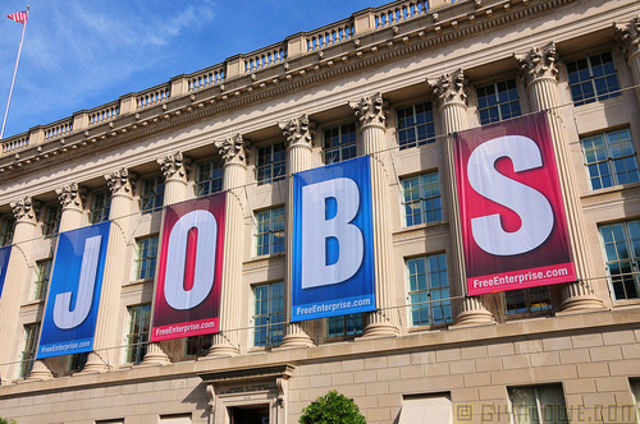
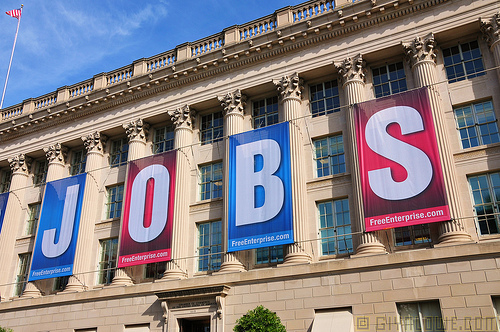
 Photo by Glyn Lowe Photos.
The unemployment rate in D.C. is the lowest it’s been in five years, according to figures from the Federal Bureau of Labor Statistics released yesterday.
But while unemployment citywide is now 8.1 percent, Wards 5 (9.4 percent), 7 (11.6 percent) and 8 (17.7 percent) are still experiencing very high levels of joblessness, although they’ve each seen significant drops since 2011. D.C. also lost 1,900 jobs last month, while the size of the labor force increased.
“I am pleased to see that our efforts to get District residents — and particularly those in the hard-hit East End of our city — back to work continue to bear significant fruit,” Mayor Vince Gray said in a release. “Nonetheless, we still have a long way to go to ensure that everyone in the District who wants to work can find a good job with a good wage, and I will continue to work hard at reaching that goal.”
Brian Marroquin is the program manager for the non-profit organization LIFT-DC, which, in part, provides services to unemployed and underemployed people. He says many of people who come to LIFT-DC — which opened an office in the Ward 8 arts recreation campus THEARC in 2011 — were employed for a long time, then laid off from a company. “That’s the challenge we saw in Ward 8,” he said, adding that it can be “really difficult to find an employer” in that area. Transportation costs to other parts of the city also provide a day-to-day, practical challenge, he says. “Ward 8 and Southeast in general can kind of be forgotten a little bit.”
With three offices in Washington, LIFT-DC served 1,100 members during its last program year. Marroquin has been with the organization since 2009 and says demand for their services has increased. He’s seen members who believe they were let go from companies because they did not want to pay higher wages commensurate to experience. And when these laid off people come to LIFT-DC, they say they can’t find work that pays at the level their used to.
Marroquin says he believes the minimum wage hike, signed into law last year, to $9.50 this summer and eventually $11.50 in 2016 will help their clients, who he says felt “mixed emotions” during the Large Retailer Accountability Act debate. It’s common, he says, to find low-paying jobs that don’t advertise their wages before an interview. “Those are good because you can get hired on the spot,” he said. “But those are bad also because they didn’t have to advertise the wage … and they’re usually really low wages.
“People are torn. They don’t want to say no to a job offer, but they also realize, ‘It’s not gonna help me pay my rent every month.'”
LIFT-DC encourages clients to think about new skills that will allow them to change careers or become a better candidate for jobs they’ve already done. “We often have trouble finding a job training program that’s available when our members are available,” he said, adding that scheduling can be an issue as well as the availability of slots. “A commitment so that every resident who wants to can take a job training program would be really transformational,” he says.
In D.C., the One City, One Hire program encourages businesses to employ D.C. residents by “facilitating training, recruitment, and screening processes for potential hires.” Since it launched in 2011, the program has connected more than 8,700 District residents with jobs at 1,103 partner employers, according to a release from Gray’s office. The city’s American Job Centers also provides “career counseling, career planning, resume assistance, direct job placement” and more.
And today, the DC Central Kitchen and the University of the District of Columbia Community College were awarded up to $700,000 in hospitality job-training grants, Gray announced. Administered by the Workforce Investment Council, “DC Central Kitchen will provide training for at least 70 District residents in culinary-arts occupations, and UDC-CC will partner with Goodwill of Greater Washington and Progressive Partners LLC to provide training for at least 70 residents for jobs in the hotel industry.”
Marroquin says LIFT-DC’s members are “optimistic” as they see other parts of the city booming economically. “The great outcome would be for people to live in Southeast, work in Southeast, send their kids to school in Southeast, and access city services in Southeast,” he said. “Right now, our members have to go across town for a lot of things.”