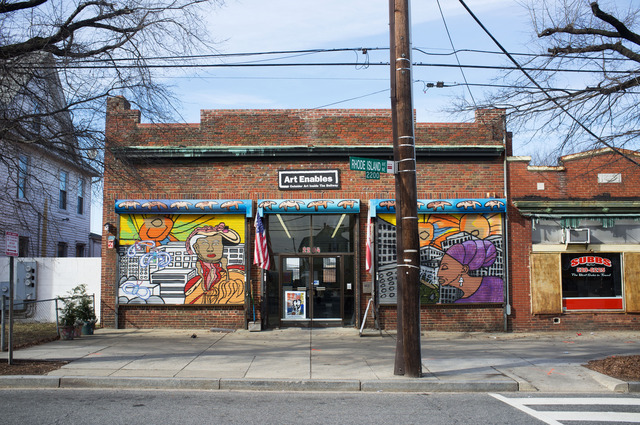
On a recent Friday afternoon in January, a strip of Rhode Island Avenue NE near the Woodridge neighborhood was fairly quiet, save for a few passing cars. But inside a brick art studio wedged between a sub shop and older home, around 30 artists were busy with their latest work, surrounded by their colorful pieces.
“At least once a day, somebody tells a joke that’s so funny that somebody falls out of their chair laughing,” said Mary Liniger, who’s served as executive director of Art Enables since February 2012. “This is the kind of work environment where laughing to the point where you fall out of your chair in encouraged.”
For the past 12 years, Art Enables has given artists with a range of disabilities a space where they can create and their creations can be seen. Located at 2204 Rhode Island Avenue NE, the outsider art studio and gallery will celebrate its 12th anniversary with a show and free workshop on Saturday, February 8, from 1 to 4 p.m.
Liniger previously worked at the D.C. Commission on the Arts and Humanities, which awarded grants to Art Enables when it first began. “I’ve been a fan — a stalker — for years, and I always used to see their work at Artomatic,” she said. “But every time I’d go to Artomatic, the pieces I wanted would have red dots on them.”
So when Art Enables founder Joyce Muis-Lowery retired in 2012 after ten years, Liniger said she jumped at the chance to apply. “Getting to work with the artists here has been the best job of my life,” Liniger said. “They’re just amazing.”
All of the artists at Art Enables have some sort of disability — from intellectual to persistent mental illness — and range in age from 22 to 78: “But what they all have in common is that they are artists.”
“We having a saying,” Liniger explained of the artwork’s integrity. “‘No sympathy buys.'”
The best of the program, according to Liniger, is how people surprise her. The danger? “You’re seeing beautiful pieces being made all day long, and you have a credit card.”
Art Enables occupies a space on Rhode Island Avenue that was previously a library. The main floor, with its tall ceilings and abundant natural lights, serves as a workspace and gallery. A basement gallery serves as a space for the “rest of the cultural community.”
In 2013, Art Enables sold $70,000 worth of artwork with the average piece costing around $100. Artists receive a 60 percent commission from a sale. A lot of the work is sold locally, although also nationally and internationally: “Somewhere in Tokyo, there’s a hair salon where all of the artwork on the walls is from Charles [Meissner].” A realtor purchased the rights to a piece to use on her business cards, while Jon Wye — the creator of graphic belts sold at Eastern Market who leases space from Art Enables — is doing a t-shirt featuring a dog painted by Darnell Curtis. (The original piece was sold to a woman from the World Bank, who lives in Indonesia.) Another piece was featured in the background of the Adam Scott film Adult Children Of Divorce.
“Being able to represent these artists with respect and to have them tell their story through their artwork, to me, is one of things that I think is most important about what we do,” Liniger said.
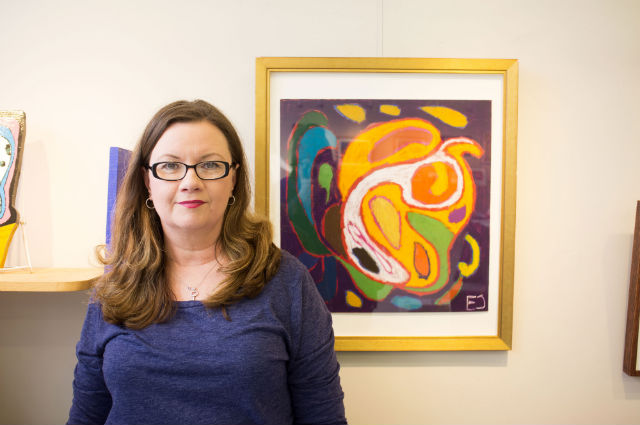 Executive director Mary Liniger. Photo by Justin Gellerson.
Art Enables works with different partners — the Department of Disability Services, mental health center Green Door, Community Services for Autistic Adults and Children — to fill spots. Liniger said they’re not looking for amazing talent, but interest, drive and the ability to focus for 20 minutes. Art Enables is not a place for people who want to color; it’s a place for artists.
Initially a job training program, Art Enables became a place of employment for the people who would say, “But this is my job.” Liniger said the most successful artists are the ones who would be creating regardless of whether Art Enables existed.
But because it does, these artists are able to tell the community their stories, which may have gone unheard. “For a lot of our artists, their artwork is the easiest, most direct way … for them to communicate,” Liniger said. “When you see what someone’s able to create, you look at them in a different way.”
“So many times with media portrayals of people with disabilities, it’s always the sad story … or look at this nobel, suffering person,” she continued. “Nobody’s suffering upstairs. Everybody’s working.”
Community support is “huge,” Liniger said, adding that they’re “excited and glad” to be in Ward 5 for the past five years: “We’ve had great support both from the entire city and the arts community, but also our neighbors who stop in and volunteers who come in and chat with the artists, help us out, get ready for shows.”
Their neighbors, like Carl’s sub shop and the Family Dollar across the street, have learned from experience how to accommodate the artists.
“We want people to feel like this is your neighborhood, self-taught art gallery.”
But with increased development in Ward 5, Liniger said they want to make sure Art Enables can stay: “So many arts groups, they come in and make a place wonderful. And the place gets really, really popular, and they’re the first ones to go.”
As for the next 12 years, Liniger wants to serve more people — namely those with persistent mental illness — and hopes to see one of their artists go beyond Art Enables. “Then we’ll be all bitter and twisted,” she joked.
“My focus is to bring more to our artists, more opportunities to exhibit, both here and in other galleries,” Liniger said. “More opportunities to meet their fans and have people appreciate what they do.”
“I don’t think we’ll ever get so huge that we take over D.C.,” she said with a laugh. “We’ll never be huge as far as the amount of artists that we serve, but [we’ll be] able to serve as many people well as we can.”
When asked what she wants people to know about Art Enables, Liniger replied, “If you come here you get it. The minute you walk in the door.”