Happy Valentine’s Day, theater nerds. Here’s the latest on what’s going on right now, listed in descending order from “must see” to “take it or leave it.”
1) Tribes, Studio Theatre
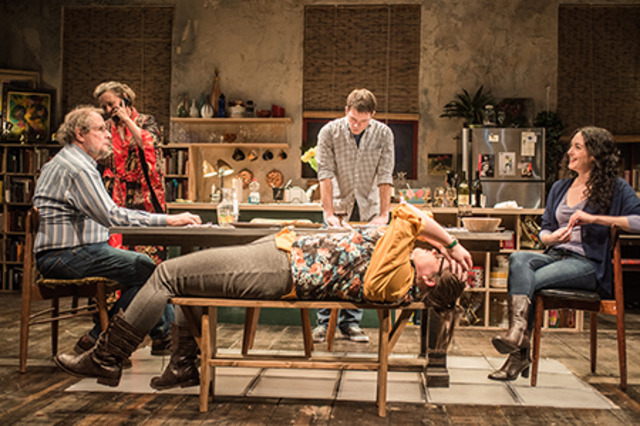
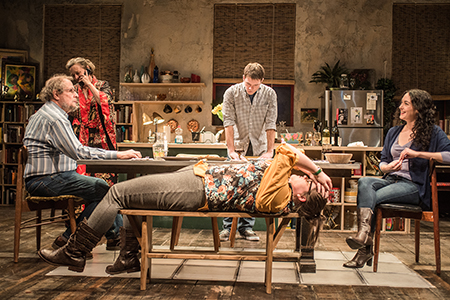 Failure to Communicate: Michael Tolaydo, Nancy Robinette, James Caverly, Annie Funke and Helen Cespedes in “Tribes.” Photo by Teddy Wolff.
When people love each other, they use a specialized vocabulary, weighted by the past. Nina Raines’ Tribes, directed by David Muse at Studio Theatre and running through March 2, is a fascinating and moving exploration of the way we communicate and interpret one other. At center is Billy, a deaf man who finds himself drawn into the deaf community by a woman he’s in love with, which puts him at odds with the family that has refused to acknowledge the unique language of their hearing-less son.
We open in the kitchen. Billy’s mother, father and two adult siblings all jabber away, often turning their heads away so that it’s impossible for Billy to even read lips. It’s clearly a habitual scene, and it’s infuriating. Even when Billy does ask what’s going on, he’s roundly ignored. This isn’t because his family is deliberately cruel; they’re just not thinking.
By trying to treat his disability as if it simply doesn’t exist, they have managed to alienate him. Not that this has led to the usual symptoms you’d see in a less creative piece of writing — Billy is still a confident, relatively accepting person. When he meets a young woman he’s attracted to, he almost immediately kisses her. He’s confident and forthright.
The young woman, Sylvia (Helen Cespedes), is going deaf slowly, after a lifetime of hearing. “You don’t know what you’re missing,” she tells him. “Yes I do,” he insists.
James Caverly, who is actually deaf, brings a sweetness and depth to Billy, and he’s matched in talent by the ensemble cast, in particular Michael Tolaydo as Billy’s father, Christopher, who essentially calls sign language “a cult,” saying it’s “founded on exclusion.” Sadly, he doesn’t realize that he could easily join himself. The whole family is destined for heartbreak as they — and we — are finally forced to reckon with the result of their hearing-centrism.
It’s not a perfect production. While it’s lovely to see imagery projected on the back wall of what music might look like to someone who can’t hear it, the idea to display lines of “subtext” as the characters sign is at first slightly amusing but very quickly gets old.
At times, Tribes can also feel a bit oversaturated with the amount of issues it’s trying to tackle: Adult kids staying at home as they flounder through life; Jealousy; Mental illness; Marital strife; Courtroom ethics; Hierarchy in the deaf community.
But that’s a welcome side effect of attending the work of an intelligent, ambitious and dexterous new playwright. The story is most successful when it’s anchored around the dinner table. Parents can be oblivious to the voices raised by their children, no matter the language.
Gallaudet University’s Linguistics and ASL & Deaf Studies faculties will participate in a post-show conversation on February 23.
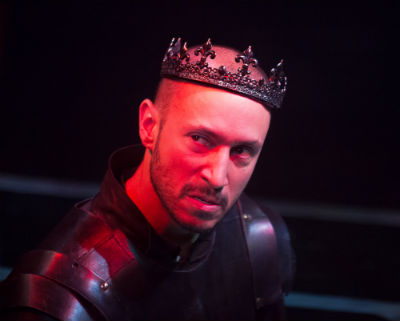 Drew Cortese stars as King Richard in Folger Theatre’s production of Richard III. Photo by Jeff Malet.
 2) Richard III, Folger
Playing up the horror of Shakespeare’s tale of a sociopath’s climb to power, this production gives us an interesting twist on Richard III’s famous deformity: It’s all a matter of perception.
I mean, Drew Cortese (of last year’s excellent Motherfucker With the Hat) walks around with a limp, yes, but he’s also quite the dashing, limber Duke of Gloucester. This creates the intriguing theory that everyone simply finds something (correctly) off about Richard; something scary about his presence.
And well they should.
Striding the thrilling set, a playground of glowing trap doors, Cortese’s Richard narrates his series of betrayals and murders on the way to the throne, burning everyone in his path, conscience absent, with the blithe air of someone playing a challenging game. It’s still not an entirely believable scene when he seduces Lady Anne (Alyssa Wilmoth Keegan) practically atop her dead husband’s corpse, but it’s malevolently fun to watch. This may also be the first time I have snorted with laughter when someone offers a decapitated head a strawberry.
[Insert obligatory observation about how it’s the winter of D.C.’s discontent here.]
3) The Importance of Being Earnest, Shakespeare Theatre Company
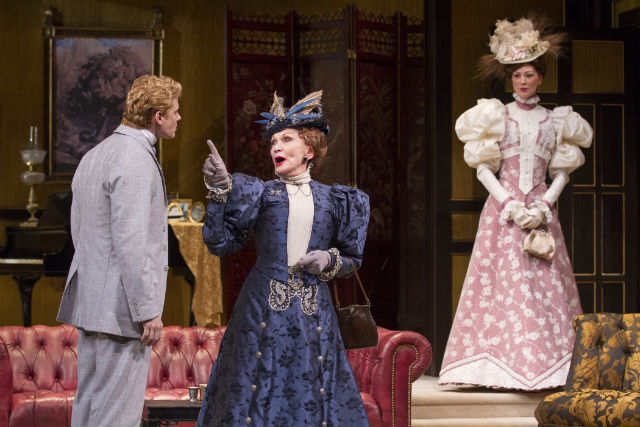 Anthony Roach as Algernon, Siân Phillips as Lady Bracknell and Vanessa Morosco as Gwendolen (background) in the Shakespeare Theatre Company’s production of The Importance of Being Earnest. Photo by Scott Suchman.
Monty Python’s “Oscar Wilde sketch” features Graham Chapman in full-on dandy attire as the famous wit, holding court among London’s intellectuals, throwing out one clever contrarian statement after another. When some of his lines flop, he attributes it to either Michael Palin’s George Bernard Shaw or John Cleese’s James McNeill Whistler.
Example:
OSCAR: “There is only one thing worse than playing squash together, and that is playing it by yourself. (Silence.) I wish I hadn’t said that.”
WHISTLER: “But you did, Oscar. You did.”
The brilliance of the sketch is how it manages to capture Wilde’s voice expertly, paying tribute to it and poking fun of it at the same time.
I freaking love Wilde, but couldn’t help but come back to that Monty Python sketch as I watched STC’s two-and-a-half hour production of The Importance of Being Earnest. It truly is one zinger after another, to the point where you almost want the characters to choke on their watercress sandwiches.
Staging Wilde’s production in a way that makes for modern-day theatrical entertainment, I’ve realized, may be nigh impossible. This is after having seen several iterations of it that were all very well done but ultimately lagged. The characters were purposefully made to be boring and stupid — a not-so-subtle criticism of the frivolous aristocracy of that Wilde moved about in.
Algernon Moncrieff (Anthony Roach) and John Worthing (Gregory Wooddell), who in case you’ve never seen it or read it both pretend that their names are “Earnest” for their respective love interests, are shallow but charming throughout.
Everything that can go right with this by-the-book production goes off without a hitch: You’ve got the stiff physicality and faux British accents, engaging comic timing and rapid-fire repartee. Especially delightful are the two lead actresses, as Gwendolyn (Vanessa Morosco) and Cecily (Katie Fabel). (Todd Scofield does nice work as a Jeeves-like butler.)
But there’s nothing particularly new or revelatory about the production, and as lovely as it is (the sets by Simon Higlett especially), you may find your attention wandering well before intermission.