
 Via Metro.
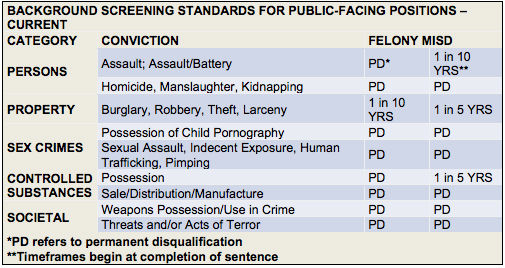
In 2011, the Washington Metropolitan Area Transit Authority established a “comprehensive” background check policy, which led to the permanent disqualification of people convicted of certain felonies (from murder to possession of a controlled substance) from being hired for certain positions.
This policy change also extended to current employees under consideration for reinstatement, those who have been on leave for 90 days or longer, and those transitioning into public-facing (bus operators, janitors) or fiduciary (purchasing agents, inventory control technicians) positions.
Councilmember Muriel Bowser held a roundtable today on a resolution she’s proposed asking WMATA to “adopt a revised background screening policy and take additional steps to promote the hiring of returning citizens.”
It is the sense of the Council that WMATA’s Board of Directors should adopt a revised background screening policy that addresses these concerns by giving officials in charge of hiring decisions the flexibility to consider criminal records as one of several factors in a holistic review of job applicants. If done properly, revisions to WMATA’s background screening policy would in no way endanger the safety and security of its riders and employees as well as the good stewardship of WMATA’s public assets.
It is the further sense of the Council that WMATA should take additional steps to actively recruit and hire more returning citizens given the challenges they face in finding employment, and these steps should be comparable WMATA’s efforts to hire military veterans, minorities, and other disadvantaged groups.
“The District and many other governments have a much more reasonable background check policy that takes a holistic view of the applicant’s criminal record, instead of automatically disqualifying him or her,” Bowser said at the roundtable. “WMATA, as a government entity, is subsided by this government, by District residents with $300 million a year. … We must do more to insist that our residents are hired.”
Bowser described WMATA’s current background check policy as “overly restrictive.”
Thomas Luparello, Interim Director of the D.C. Department of Employment Services, testified on behalf of Mayor Vince Gray’s administration, which he said supports the spirit of the resolution. He said they’re “very aware” of the “significant barriers” that face returning citizens looking for work.
When asked by Bowser how DOES interacts with WMATA on hiring, Luparello — who has been in his position for six weeks — was unable to provide background. Bowser said in fiscal year 2013, WMATA hired five D.C. residents through DOES and one in fiscal year 2014, numbers she described as “abysmal.”
In his testimony, Metro General Manager Richard Sarles defended the policy developed in 2011, calling it “balanced and fair.”
“In developing the policy, WMATA Human Resources staff reached out to the local jurisdictions and peer transit agencies, researched relevant case law, considered Title VII of the Civil Rights Act and closely examined our own internal practices, as well as accounted for our business needs and safety responsibilities to the public and to our own employees,” Sarles said. “While conducting our review, we found that our internal practices were previously inconsistent and unevenly applied. In reviewing how other transit properties or government agencies approached hiring, we found that a lot of practices are on a case-by-case basis, and while some used similar criteria as WMATA’s, we also found a lack of specifics.”
Sarles declined to discuss the specific cases of people who had testified at the roundtable. Tawnya Moore-McGee, a WMATA human resources official, said if adverse information is found, applicants can supply supporting documents.
When asked about the termination fear current employees who have previously disclosed a crime and have been out for more than 90 days face, Moore-McGee said they need to do additional education. She said only one person, to her knowledge, has been terminated this way.
Sarles said “better dissemination of information” about the policy is needed. He said refinements will be made as different aspects are reviewed. When asked, Sarles said no study has been done on if and how a criminal record indicates future criminal behavior.
Moore-McGee described WMATA’s relationship with DOES as good, saying they’ve encouraged job seekers to obtain a commercial driver’s license. Bowser said she wants both sides to “work hard” to put D.C. residents in open positions.
WMATA also released a fact sheet that refutes claims about the background check policy made by the NAACP on its site.
NAACP WEBSITE: “Under WMATA’s current policy, a person who has been convicted of any felony – including non-violent drug offenses – or two or more misdemeanor offenses within the last ten years will be automatically disqualified for many positions.”
Absolutely false. Consider:
A candidate for a position that does not require access to the general public would be considered with any of the following felonies on his/her record in the past 10 years: one felony conviction for possession of a controlled/illegal substance; one felony conviction for receiving stolen goods; one felony conviction for assault; one felony conviction for robbery, theft, larceny; one felony conviction for driving under the influence*; one felony conviction for criminal mischief; one felony conviction for reckless driving*; one felony conviction for destruction of property. A candidate for a position that requires access to the general public would be considered with any of the following felonies on his/her record in the past 10 years: one felony conviction for robbery, theft, larceny; one felony conviction for driving under the influence*; one felony conviction for criminal mischief; one felony conviction for reckless driving*; one felony conviction for destruction of property. * Driving under the influence and reckless driving convictions are only reviewed if the position requires a valid C/DL.
NAACP WEBSITE: “Also, WMATA decided to permanently disqualify from employment anyone who has been convicted of certain crimes, no matter how old the conviction is.”
To be clear, the only crimes that result in permanent disqualification are: homicide; kidnapping, abduction or unlawful restraint; rape, sexual assault, sodomy or indecent exposure; human trafficking, prostitution or pimping; threats or acts of terror, possession or use of a weapon during the commission of a crime; and possession or distribution of child pornography.