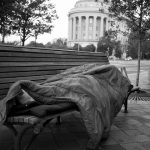
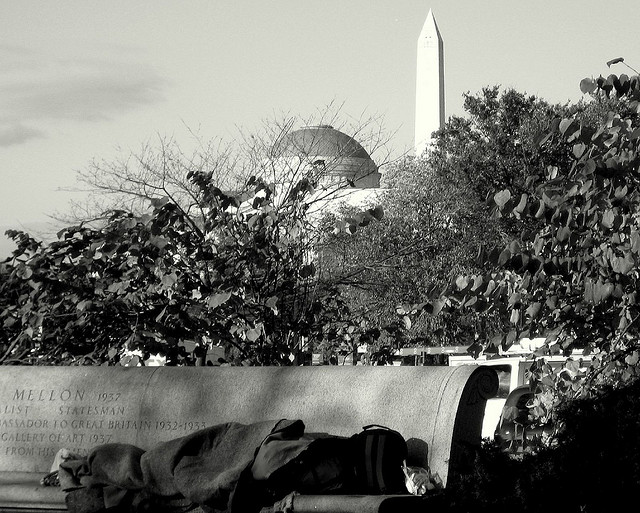
 Photo by rjs1322.
Mayor Vincent Gray will ask the D.C. Council to alter the city’s right-to-shelter law, saying he wants to provide resources to people seeking shelter to “reconnect them with where they’ve been.”
As the Washington Post reported, the emergency legislation would give families shelter on a provisional basis, “but caseworkers would immediately begin to determine whether they have other housing prospects, including sleeping on the couches or floors of relatives or friends. The city would have to make a decision within 14 days.”
In D.C., all residents are guaranteed a place to stay during hypothermia season. As of February 2, there were 285 homeless families — 355 adults and 536 children — at D.C. General, the city’s largest family shelter, and 469 families — 603 adults and 897 children — at hotels. In testimony to the Council, D.C. Department of Human Services Director David Berns said the family homelessness crisis is “worse than it sounds.”
Gray told Bruce DePuyt this morning that he will ask the Council for more “flexibility,” which the city had in the past.
“When people come in, the first thing we do is try to find out where they have been and then work with them in ways that will say, ‘Look, if there was a problem with the utility bill, or you had a spat … or there were too many people, what is it that will help us resolve that? Who is it that we can contact?'” Gray said. “And our staff had done a great job with that, and there were lots of people who we could immediately reconnect with where they were.”
During this hypothermia season, Gray says, that hasn’t “existed in that way.”
“If somebody came in and we couldn’t get to them quickly to try to reconnect them with where they were, once they got into the shelter system there’s virtually nothing that we can do at that stage,” he said. “People can say, ‘No, I’m staying here. I’m going to stay in this hotel room until you find an apartment for me. The system is working in such a way at this stage — or not working, depending on how you want to put it — that it’s really requiring us to be able to keep people longer than we otherwise would.”
Gray said they’re “not putting people out,” but providing resources to allow them to “reconnect with where they’ve been.”
When asked if he sees the issue as a “crisis,” Gray said people may see it that way “because of the numbers we have at this stage without realizing … the options that have been available to us in the past, especially outside of hypothermia season.”
“Once they get into the shelter system, after a matter of hours, they are essentially there,” he continued. “During hypothermia season … there’s very little we can do.”
For families, single people and youths who are homeless, Gray said the goal is “to get people to permanence,” touting his $187 million affordable housing initiative. The homeless services budget has increased from $85 million in fiscal year 2012 to $120 million in fiscual year 2014.