 Via Shutterstock.
Dish of the Week: Arepas
Where: La Caraqueña, Restaurante Monserrate
I first came to know them as a kind of exotic entry in the New York City street festival circuit. They’re called MozzArepas, a thick yellow griddle cake with a slice of mozzarella melted in the middle; a Latin taste with an Italian-American kiss. That’s the same style that was sold at a Marlins game I attended in Miami Gardens a few years ago where I lathered mine up with pickled banana pepper rings from the condiment station—the best ballpark concession I’ve encountered yet.
Yellow or white maize flour is mixed with a touch of water and a pinch of salt, formed into even patties and grilled, griddled, or fried to make an arepa. They resemble a cousin much more common in these parts—the Salvadorian pupusa—or a really thick tortilla. The major difference is in the flour: for pupusas and tortillas, the corn goes through a process called nixtamalization, where it’s soaked and cooked with an alkaline solution. The result is a more Latin American-type food. The arepa won’t be pounded thin before going on the griddle or rolled up, lest you want to break it apart. But fear not— it won’t crumble apart, it’s unrefined dough is a bit too sturdy for that.
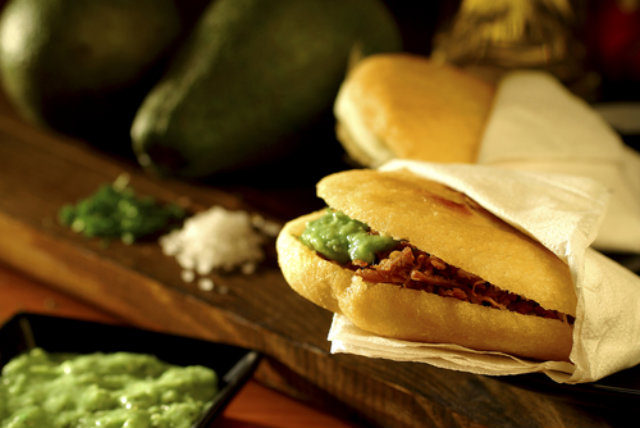
In Venezuela, you won’t find a wad of chicharrón cooked inside of your arepa. At restaurants like La Caraqueña—the unexpectedly cute space that shares a lot with a nondescript motor lodge in Falls Church, Va.— arepas are more of a sandwich with stuffing options; the doughy corn disks are sliced lengthwise through the center to create a thin top and bottom. Stuffings might include a chicken salad with avocado and mayonnaise, pulled slow-cooked beef, or black beans. The corn cake is pretty impervious, refusing to sop up much of whatever is filling it, so the outside stays fairly dry and intact and if the inside is something wet like slow-cooked beef. Expect the juices to be dripping down your arm.
Venezuela’s neighbor, Colombia, has a thicker and narrower take—and don’t expect avocado chicken salad stuffed inside. The arepa is used as traditional breakfast, snack, or accompaniment that’s something more akin to a sandwich. There’s not much to it on its own, so butter, cheese, condensed milk, or eggs are often served with the arepa. This style is what you’d find if you checked out Restaurante Monserrate, a small café off Glebe Road named after the mountain that overlooks Colombia’s capital city of Bogotá. I was amused by a Yelper’s one-star review, questioning their arepa. “[F]ried and yellow? I even learned to make arepas I like them so much, and this my friends was NOT an arepa.”
Oh my friend, you don’t quite understand. I’ll agree that I don’t find the simple Colombian versions as exciting as those of their Venezuelan neighbors. But that doesn’t mean they’re wrong. Arepas are one of those regional staples that can be cooked in many ways. I like how one food writer put it: “[To] think in that narrow scope is the equivalent of a Colombian native hearing about bread and saying, ‘Oh, it’s that European wheat cake, right?'”
One of those many ways to eat it is the arepa de choclo I wolfed down on a busy Bogotá street corner while passing through the country last week. A sweet batter poured into a circular mold on a hot griddle with a piece of white farmer’s cheese in the center. They were pretty much like the MozzArepas of the New York street fairs, and a little like those of the “arepa lady,” who sells them from a cart in Queens when she’s not home in Colombia over the winter. Arepas used to be available on the streets of D.C. from the now-defunct Sabo’s Street food truck. They’re a wonderful ballpark concession or street food (especially at 1,000 pesos, which is roughly $.50). But until the Nats come around or the Arepa Lady moves to D.C., there’s the brick and mortar Colombian snack-style at Monseratte and Venezualan sandwich-style at La Caraqueña.
Small Bites
Meat, Meat, and More Meat
Expanding from its locations in Union Market and Merrifield, Va., Red Apron Butcher opened a third location downtown on Wednesday at 709 D Street NW. In addition to the butchery, charcuterie, and salumi, look forward to an adjoining 60-seat restaurant, The Partisan, opening in a few weeks. A creation of chefs Nate Anda and Ed Witt, the restaurant will feature meat-centric dishes and 20-plus wines on tap. —Ashley Wetzel
Look Sharp, Live Smart
Casa Luca and Daikaya made the list of GQ’s 25 Best New Restaurants in America. Food critic Alan Richman praises Chef Fabio Trabocchi and his 16th-ranked Casa Luca for expanding beyond traditional Italian, highlighting branzino, a lamb shoulder rack and a new take on affogato; a sundae with chocolate sauce and mocha liqueur. Chef Katsuya Fukushima’s Daikaya nabs the #15 slot thanks to his “brilliant fusions” that take brunch to a whole new level. Think smoked salmon with rice balls, braised pork hash with citrus-yuzu and an egg, fried chicken, and waffles stuffed with red-bean paste. —Ashley Wetzel
Sandoval Takes Over
Restaurateur Richard Sandoval confirmed this week a late March opening for Toro Toro at 1300 Eye Street NW, a 140-seat pan-Latin steakhouse concept. There will be an outdoor patio and a lounge that hosts dancing on select nights. Also look forward to bottomless brunch cocktails/small plates on the weekends and a “rodizio experience” on weekdays. The Washington Business Journal also reports that Mango Tree, an upscale Thai restaurant from Sandoval, will be among the new dining offerings at CityCenterDC. The flagship Mango Tree is located in London and features dishes from Thailand’s four regions. —Ashley Wetzel
March Madness: Martini Bracket
Bethesda Row will be hosting its third annual March Martini Madness cocktail contest. Ten restaurants will compete for the coveted “Best Martini on the Row” title. After trying the martinis (at happy hour prices…all day long…for the entire month of March) vote for your favorite on Bethesda Row’s Facebook page. The martinis will be eliminated week-by-week until a winner emerges. And if you need more motivation on top of discounted martinis for an entire month, can enter to win a $500 dining certificate from one of the participating restaurants after voting on Facebook. —Ashley Wetzel
Oysters Near and Far
Tomorrow afternoon BlackSalt hosts an oyster and sparkling wine tasting, featuring bivalves from Maryland’s Barren Island Oyster Company and Roederer Estate sparklers. Tickets are $70 for the 3 – 5 p.m. event. But if you prefer to get out to the farmlands to do your oyster tasting, Early Mountain Vineyards hosts their second annual oyster fest next Saturday featuring wines from Chatham Vineyards and whole lot of Eastern Shore oysters. Oysters from Magotha Bay will be steamed and roasted, while others from Magotha, Church Creek, and Hungar’s Creek, as well as clams from Hungar’s Creek will be set up on a raw bar. Tickets are $85. Early Mountain is in Madison, Va. on the way to Charlottesville.
It’s the Mardi Gras Season
Fat Tuesday is coming up. One of the biggest parties around will be Acadiana’s. A $100 all-inclusive ticket includes a food list full of creole favorites: oyster po’boys, mini muffalettas, shrimp and crab claws, crawfish, and a dessert station with beignets and pralines). There will also be several specialty cocktails, martinis, and beer and wine choices. Menu MBK will be selling individually sized king cakes for $4.50, Sticky Fingers is taking special orders for vegan beignets and king cakes, and Del Campo will have $7 caiprinhas all night tonight, $7 chicha rosada cocktails all Sunday and Monday.