 Inequality between high-wage and low-wage workers in D.C. is at its widest level in decades, according to a new report from the D.C. Fiscal Policy Institute that shows the city’s economic recovery isn’t benefitting everyone equally.
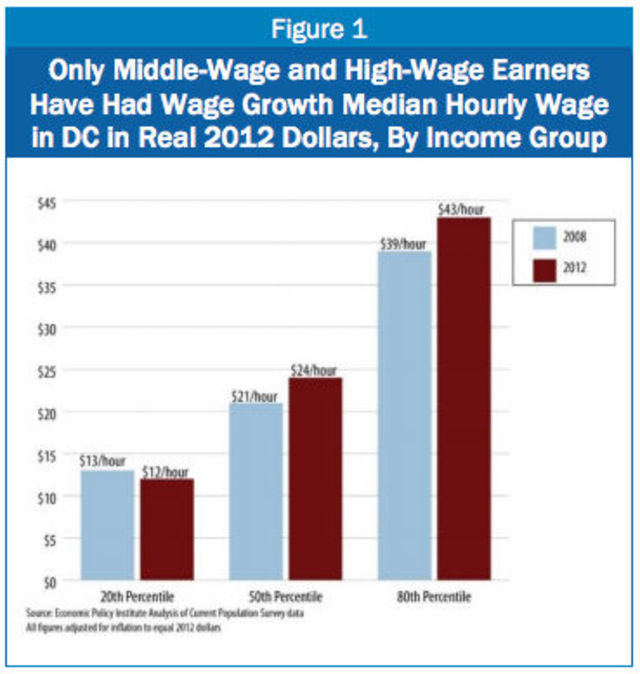
For D.C. residents in the 20th percentile — meaning they earn wages less than 80 percent of the population — the median hourly wage fell from $13.08 in 2008 to $12.31 in 2012. For people with just a high school diploma, the median wage fell from $15.16 to $12.29 during that period, an 18.9 percent change. Data for the report came from the Census Bureau’s Current Population Survey.
“The benefits of the District’s recent economic growth have been concentrated among a few demographic groups,” the report by Jasmin Griffin and Jenny Reed states. “Unemployment rates have fully or nearly recovered to pre-recession levels for residents with a college degree and white, non-Hispanic residents. And wages for middle- and high-wage workers have increased significantly.”
But wage growth for black and Hispanic residents grew at a much slower rate from 2008 and 2012 (2.2 percent and 0.6 percent, respectively) than for white residents (8.6 percent.) And while unemployment for white residents fell during that period, it grew from 10.4 percent to 17.4 percent for black residents, and 4.7 percent and 7.8 percent for Hispanic residents.
“District workers with higher education have recovered from the recession and are now making economic gains, but those without a bachelor’s degree are falling further behind,” the DCFPI report says. “Many jobs in the District require a bachelor’s degree, yet there are living-wage jobs in expanding sectors such as hospitality, where workers without advanced degrees can create a career ladder with help from workforce preparation programs. The District needs to make sure that D.C. workers are prepared to take these jobs, by addressing literacy and skills gaps, by taking steps to make work pay better, and providing resources such as child care subsidies and reliable transportation to make getting to work easier.”
DCFPI specifically recommends increasing resources for adult literacy, focusing sector-specific training and certification, putting more emphasis on a year-round youth employment program, and expanding the Earned Income Tax Credit.