Tony Revolori and Ralph Fiennes (Fox Searchlight)
There’s one sequence in Wes Anderson’s new cinematic confection, The Grand Budapest Hotel, that I love. With the help of pastry chef Agatha (Saoirse Ronan), the lobby boy, Zero (Tony Revolori), smuggles digging tools into the jail where Grand Budapest Hotel concierge M. Gustave (Ralph Fiennes) has been incarcerated, falsely accused of murder. Will the candy-colored package make it past prison inspectors? The camera takes us into an impeccably photographed hovel where a gruff inspector slices through cheese and sausages in search of contraband, each foodstuff lit as if ready for a magazine cover. When the inspector comes to the pretty pink box that holds barely disguised tools, he declines to slice them, distracted by the sheer loveliness of it all.
I wish I were so easily distracted. That sequence would make a lovely photo essay in a glossy magazine, and there are any number of scenes in The Grand Budapest Hotel that are as carefully art directed and photographed, as meticulously crafted as the pastries that play a crucial role in the film. But however delicious they may be, they’re empty calories. The film is quintessential Wes Anderson—colorful whimsy so carefully designed it smothers the emotional resonance it so desperately wants to achieve.
The image of the fading luxury hotel in an exotic Eastern European location sends the imagination reeling. Who knows what kind of intrigue has taken place at such an establishment over the years? How many vivid characters have passed through its decadent corridors for but a brief moment, never to be seen again? A colorful ensemble cast and a jewel box of a set piece dropped in the midst of political unrest is certainly the recipe for living, breathing chaos, no? Not in Anderson’s precisely controlled world.
I hoped it would be otherwise. The film opens with a teenaged girl carrying a book into a cemetery in The Republic of Zubrowka, Anderson’s fictional Eastern European locale. On her way to a heavily art-directed memorial, she passes by headstones that aren’t art-directed within a centimeter of their life, her stroll accompanied by music that vaguely reminded me of director Dusan Makaveyev’s semi-fictional WR: Mysteries of the Organism, a study in chaos and political volatility that was sexy and hilarious and full of life. The old world streetscapes of Zubrowka also recalls Guy Maddin’s Tales of The Gimli Hospital, which invented a mythological old world town and mythology on a low budget that still managed to evocatively suggest a 1930s movie in 1989.
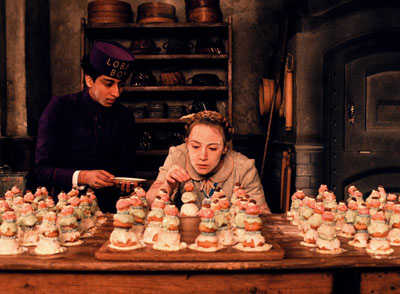 Tony Revolori and Saoirse Ronan are making a movie (Fox Searchlight)
Those directors, however inconsistent their work may be, revel in the mess and chaos that is life. Anderson meticulously creates visual worlds, from composition to art direction, from costume to font, from lighting to sound, all too perfectly for a recognizable human emotion to survive. Anderson’s quirky style delights a lot of moviegoers, but others find it precious and contrived. I’m in the latter camp, hungry for a world populated with more than just prettily dressed, heavily made up cartoons; though to be fair, I find Spongebob Squarepants a more densely layered personality than a typical Anderson figure.
Anderson shows the grand hotel in various states from a 1930s heyday that calls up opulent all-star spectacles like Grand Hotel, through an earthy-colored mid-century redesign in the 1960s that suggests the colors of the womb. In the case of the declining hotel, an empty one, signifying Anderson’s retreat into a solipsistic childhood where only his own aesthetic is welcome. The film is structured as a series of narratives within narratives, beginning with the present-day girl who opens the film, descending into the 1980s, then to the 60s, then to the 30s, each timeline shot in a different aspect ratio. The bulk of The Grand Budapest Hotel was shot in the square Academy ratio, a Hollywood standard established in the 1930s that became the preferred format of movies for decades. But the effect is like a beautiful stacking petruschka doll — open up another and another of its layers until you reach an empty center.
I had my reservations about Moonrise Kingdom too, though that film at least had a heart in Bruce Willis. The dozens of actors that Anderson puts before the camera here amount to a puppet show with cameos, a living Muppets movie. The one exception for me was Willem Dafoe’s thug Jopling. Dafoe’s role is to upset the delicate balance of the plot, an impossible task in so much precision storyboarding. But he tries, and the movie almost comes alive when he’s onsceen.
Anderson’s design elements take on a curious note when you realize that the central 1930s timeline takes on the rise of fascism. The film replaces the familiar swastika with a (naturally) artfully designed surrogate, revealing perhaps the director’s awareness that his films are like candy-colored dictatorships. There’s war and peace and love and murder to spare in The Grand Budapest Hotel, numerous cinematic cues that typically push the moviegoer’s heartstrings. I wish I could say I felt any of it.
—
The Grand Budapest Hotel
Written and directed by Wes Anderson
With Ralph Fiennes, F. Murray Abraham, Saoirse Ronan, Tilda Swinton, and a cast of regulars.
Rated R for language, some sexual content and violence
Running time 99 minutes
Opens today at Landmark E Street Cinema, Landmark Bethesda Row and Angelika Mosaic