 By Contributor Riley Croghan
Tonight and tomorrow are the final days of Forum Theatre’s run of Los Angeles-based playwright Steve Yockey’s challenging, disturbing Pluto, a play that gleefully moves between disparate extremes in a way topped only by the recently bipolar weather. Penned by Yockey as part of the National New Play Network’s Rolling World Premiere, it has gained a reputation for making audiences uneasy in its D.C. run, apparently to the point of making at least one audience member physically ill, as covered by the Washington Post.
Forum’s artistic director Michael Dove doesn’t shy away from the fact that Pluto is an uncomfortable play. As we covered in our preview, Dove and Yockey stacked the production with tricks designed to make the audience cringe, from bloody gun violence to deafening, eerie sound cues that might be more at home in a horror movie soundtrack.
While the play is hard to watch, attending shouldn’t be confused for an act of masochism. Some heartfelt, sincere performances delivered by the ensemble ground the performance through its fanciful highs and horrific lows, making the often otherworldly play surprisingly human and relatable.
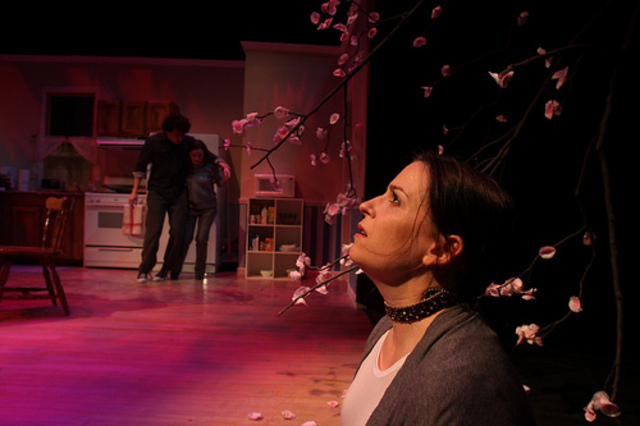
Pluto is a puzzle of a play, one that Dove orchestrates with ever-building intensity as the mystery unravels. A radio broadcasts news of a tragic school shooting at a local community college, although it’s not immediately clear how the events relate to the mother and son at the heart of the play as they go about their mundane morning routine—making coffee, unloading groceries, eating Poptarts—in a kitchen set that is perfectly ordinary, save for the unnerving protrusion of a cherry tree suspended from the ceiling.
The cherry tree is only the first surreal object in a series of bizarre intrusions that threaten to disrupt the ordinary day that Elizabeth (Jennifer Mendenhall) and her son Bailey (Mark Halpern) are determined to maintain. The humdrum quality of the set quickly deteriorates, and by the end we are left with a (literally) hellish portal, walls sprayed with blood and a floor littered with bullet casings.
Mendenhall’s Elizabeth resolutely tries to hold herself and her family together, providing a vital anchor for the audience to latch onto. Her attempts to communicate with her son on difficult topics like the death or potential mental illness of a family member are an important mirror to a takeaway of the play: It may be difficult and uncomfortable to face certain realities, but the consequences of not facing them head-on can be even more disastrous.
As the family’s three-headed dog—best to just embrace Yockey’s penchant for the fantastic—Kimberly Gilbert changes fluidly, shifting her mood as the tone of the play shifts. Gilbert is equally comfortable spouting complex astrophysics, delivering a slow morose dance with a miniature umbrella and tenderly providing comfort and solace to Mendenhall’s heartbreakingly vulnerable Elizabeth.
Brynn Tucker is also a standout as Maxine, a mean girl who would eat Regina George alive. Maxine is blessed with some of the wittiest and funniest lines in the show, which Tucker delivers with brilliant timing and increasing acidity as her character becomes more and more unhinged. It’s hard to think of anyone touched by something as tragic as a school shooting in anything less than a heroic light, and asking the audience to find sympathy and pity for such a cruel character is one of the bigger challenges posed by the play.
Pluto is one of those rare plays that approaches Artaud’s (by definition unachievable) Theatre of Cruelty, which is named not for literal, sadistic cruelty, but meant to describe a type of play that forces an audience to face uncomfortable truths. Yockey’s piece may deal with subjects we’d rather not talk about, but it has a good reason for doing so, and underscores how important it is that we find ways to talk about uncomfortable things, as openly as possible, with the people we care about—and reminds us of the disastrous results that can occur if we fail at that.