By DCist contributor Tori Kerr
On what could be considered one of the first real days of spring in D.C., the 9:30 Club was positively blooming. Birds of Chicago, David Wax Museum and Carolina Chocolate Drops washed away the city’s winter blues with a night of folk, country and bluegrass music. Naturally, the stage was strewn with a mind-boggling array of instruments: violins, banjos of all kinds, guitars, accordions, ukuleles, bells, a clarinet, cajónes and even bones. The evening was also a family affair. Many musicians shared the stage with a spouse or family member, and each of the bands brought with them a baby. The recent trend of Americana-influenced popular music (which folk revival are we on now, the third?) challenges ideas of authenticity.
Birds of Chicago warmed up the crowd with their soulful twang. The recently married JT Nero and Allison Russell were on the road with their three-month old daughter, born during the Polar Vortex. “Today,” they proudly announced, “is the first day she’s been able to wear a short sleeved onesie.” The Birds began their set with “Mountains / Forests,” off 2013’s Live From Space, a sprawling song blanketed in breathy harmonies. Nero’s voice has a tone similar to Ryan Adams, but rough, like if Adams lived off of whiskey and cigarettes. His voice, coupled with Russell’s sweet and dreamy one, was a tasty, addictive cocktail. Their set was confident and seamless. Standout “Cannonball” was the perfect love song. Nero explained that the tune is about “trying to carve out your piece of love in a turbulent place.” Birds of Chicago ended their set with the infectious rocker, “Trampoline,” which had the crowd dancing and shouting in celebration of the words, “Spring is coming back to the land / It’s only four degrees out but I feel it’s true.”
Fronted by David Wax and Suz Slezak, David Wax Museum delivered groovy and powerful songs with a Mexican spin. The band began with “Yes, Maria, Yes,” from 2011’s Everything is Saved. In addition to the fiddle, Slezak plays a quijada, a percussive instrument made out of a donkey’s jawbone. Jordan Wax, David’s cousin, ripped on his accordion and provided the most commanding vocals of the quartet, especially on Spanish language songs. The band’s blend of Mexican folk and American roots takes a careful blend of precision and spirit. Percussionist Philip Mayer — lovingly dubbed “road uncle” to four-month-old Calliope, daughter of David Wax and Slezak — not only played a cajón, but also tied bells to his feet and smashed cymbals with his hands. The soft and peaceful “Rest” brought each player from his or her instrument to circle around a microphone for irresistible harmonies.
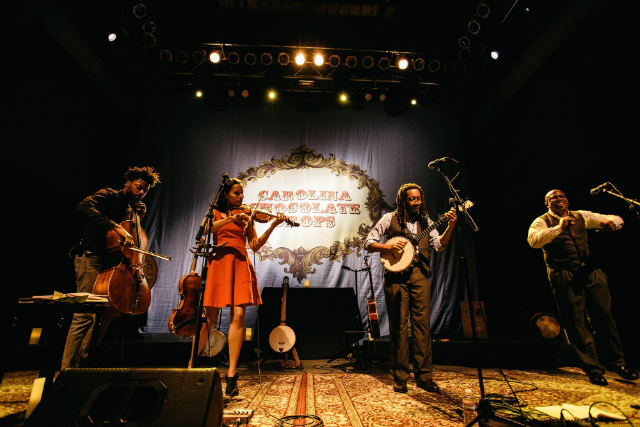
If Birds of Chicago and David Wax Museum welcomed the spring, Carolina Chocolate Drops brought in hot Southern summer. The band is composed of frontwoman Rhiannon Giddens, who plays fiddle and banjo, Hubby Jenkins on guitar and banjo, classically trained cellist Malcolm Parson and jack-of-all-trades Rowan Corbett. The traditional African American string band ripped open their set of old time folk, blues, bluegrass and gospel songs with “Black Annie,” a song they learned from legendary fiddler Joe Thompson when he was 86-years-old. The Drops describe themselves as a collective, a flexible, expanding community with a mission: to save traditional songs and stories from becoming lost to the pages of history. Much of their inspiration comes from Civil War-era slave narratives, which inspired Giddens’ original song, “Come, Love, Come.”
Old time tunes “Sandy Boys” and “Snowden’s Jig (Genuine Negro Jig)” came from Genuine Negro Jig, which won the band a Grammy in 2010. But Hobart Smith’s “Last Chance,” a favorite of Jenkins, was a unique selection that doesn’t appear on their recordings. Hardly any of the songs can be described as “originals,” as they have been passed down by generations of musicians. But the Drops are hardly unoriginal. Each song was accompanied by a credit to whoever wrote or taught them a song and a short anecdote about the musician. In addition to Thompson’s songs, they played “Please Don’t Let Me Love You,” originally by Hank Williams, Mississippi Fred McDowell’s “Mean Old Frisco” and Ethel Water’s “No Man’s Mama.”
Local banjo master Greg Adams joined Corbett and his bones (the percussive kind) for a combination of “Yankee Doodle” and other banjo tunes, providing a brief history lesson. Some of the songs Adams and Corbett played come from a time of blackface minstrelsy, which, according to Giddens, is why most people avoid that historical musical moment. But, she said, those songs also represent some of the first cultural interaction between black and white Americans.
They closed their set with fan favorite “Hit ‘Em Up Style,” a cover of Blu Cantrell’s 2001 single, and a blend of traditional songs “Old Cat Died/Brown’s Dream.” When they returned for an encore, Jenkins thrust the microphone into the audience for the insanely catchy “Cornbread and Butterbeans.” It was the perfect way to conclude the performance: modern spirit and energy fused with old time style to deliver truly explosive music.