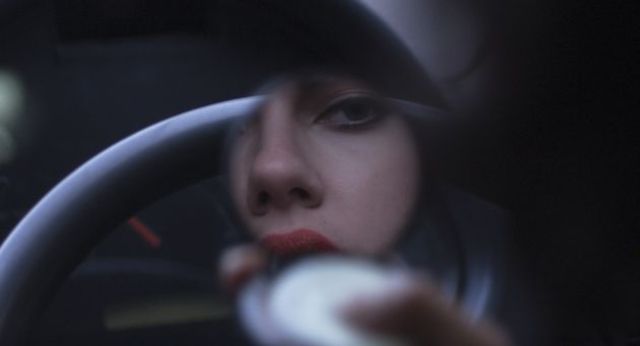
 Scarlett Johansson (A24)
The first human sound you hear in Under the Skin is the din of a shopping mall. We’ve all been to one. We all know what it’s like. But in ScarJo’s extraterrestrial eyes it’s an alien world, and what is the most alien indigenous environment to immerse oneself in than that of consumerism?
Director Jonathan Glazer and his charges take familiar and even derivative visual, narrative, and musical elements to create something that seems bleakly familiar and real. But it’s just unreal enough to unsettle the viewer. Laura (Scarlett Johansson) enters this world like an awkward but precocious feral child of the ‘80s who doesn’t know how to behave in a shopping mall. But she slyly observes and assimilates imperceptibly, like a bit of social camouflage in which she can hide as she awaits her prey: you.
The film’s visuals alternate between studio set pieces of utter simplicity and an almost sepia landscape out of Nicholas Roeg’s The Man Who Fell to Earth. I have little patience for David Bowie’s self-pitying, misunderstood white man, but ScarJo’s alien is no victim. Under the Skin brilliantly conveys the sense of being a stranger on Earth. For American audiences, it does this by sending us to a land whose denizens ostensibly speak the same language, but who are almost completely unintelligible. She travels to Scotland on dark highways and barren country roads, asking directions from Glaswegians whose brogues are so thick they might as well be speaking in tongues. Laura repeats what they said back to them as if in some kind of sinister therapy. Her lack of misunderstanding doesn’t make her sympathetic, but her quick assimilation makes her formidable (a metaphor for attitudes on immigration?). Every unfamiliar situation is a potential showcase for intellectual hunger. What a big brain she has. All the better to eat you with. (I’m curious how the movie plays in Scotland—would audiences who can understand the native accents find this brown wasteland banal? I imagine the movie takes on an entirely different kind of alienation across the pond.)
If humans are unintelligible, the very planet is a living, predatory beast. ScarJo watches as the cold sea washes away an entire family, the waves lapping in anger as if aware there is an intruder in their midst. And fire is not a friend.
But humans are why she’s here, and how she sustains herself. She lures hitchhikers into her black den, Micah Levi’s score punctuating these seductions with what sounds like alien stripper music.
What’s remarkable is that Glazer has made something that’s derivative but unique; visually strange without high-budget production values. How much does it cost to show the void? From the white space that starts the film to the black space where she lures her prey, the effects are uncomplicated but uncanny just the same. Levi’s score strikes the perfect note for this dark journey. The composer is still in her 20s, too young to be steeped in the movie music tropes that sink so many scores. She uses familiar instrumentation—strings and synthesizers—but what she comes up with is a distinct blend of din and creepy dance beats.
In one of the movie’s most powerful sequences, Laura takes in the sounds and chatter of earth in a Berlitz crash course in humanity, the end result being a cacophonous, horrifying summation of Earth that’s recognizable, yet not. Alienation is the modern state of man, and it’s been done many times before, but Under the Skin doesn’t waste time with explanations or sentiment (except for perhaps the very end). This art-house B-movie is a lean and absorbing vision of Earth and society as an incomprehensible place.
—
Under the Skin
Directed by Jonathan Glazer
Written by Walter Campbell and Jonathan Glazer, based on the novel by Michel Faber
With Scarlett Johansson and Jeremy McWilliams
Rated R for graphic nudity, sexual content, some violence and language
Running time 108 minutes
Opens today at E Street Landmark Cinema, Landmark Bethesda Row, AMC Hoffman, and Angelika Mosaic