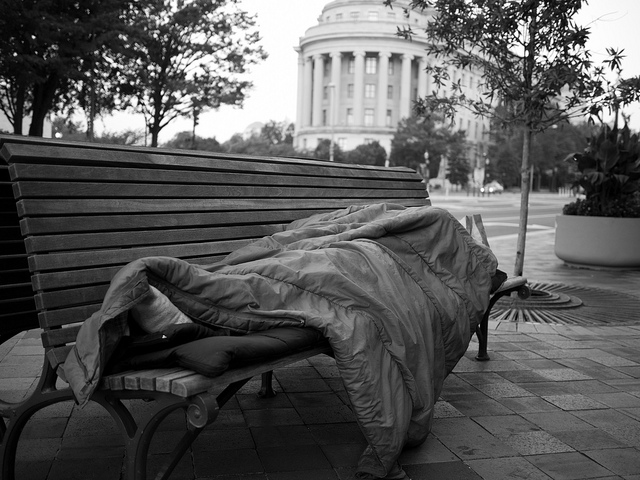
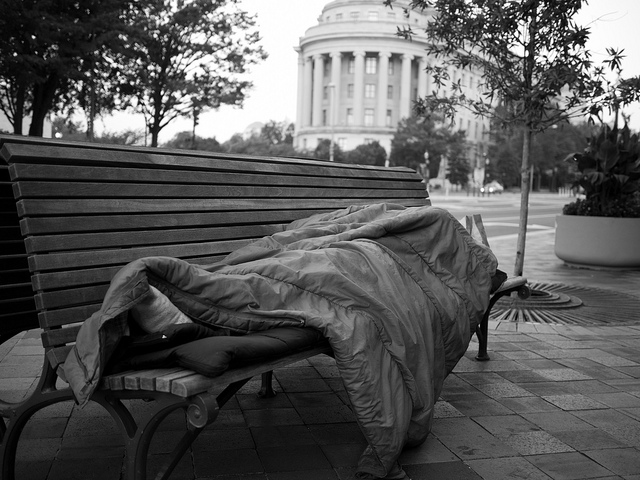
 Photo by Devin Smith.
While it began on April 1, the 500 Families, 100 Days campaign had its public kickoff this morning at a meeting with Mayor Vince Gray, representatives from the Department of Human Services, landlords, non-profit groups and the press.
And while a basic outline of how the program will work — by providing rapid re-housing vouchers to families and conducting landlord outreach to find units — was enthusiastically outlined, some of the details had yet to be ironed yet.
The goal of the campaign is as clear as its name: Put 500 families in homes through rapid re-housing — a rent subsidy provided for four months with a renewal option — by the end of June. This comes after months of what Sue Marshall, executive director of The Community Partnership, called an “unprecedented increase in the number of homeless families.” While the city anticipated that 509 families would seek shelter during the entire hypothermia season, 700 had actually done so by the end of January.
“And lo and behold,” DHS Director David Berns said, “we were in the situation of having completely exhausted all of our space and capability. … This was truly a crisis situation.”
With the hypothermia night this week, there are around 640 families in the shelter system, Gray said.
Berns said he doesn’t believe that many people became homeless during this period, but rather the city discovered a “pent up need” for housing by questioning Temporary Assistance for Needy Families participants about their living situation. What they found in some cases, he said, is that they were doubled up with other families.
The 500 Families, 100 Days program, which Berns credited to Mayor Vincent Gray, made him “hesitant,” he said. But it was clear today he was a full convert to the idea, even if it’s not completely clear how it its implementation will go.
“The magic of the mayor’s formula here is that we’re going to take the resources that we have [and] invest it primarily in rapid re-housing,” Berns said, adding that about 80 percent of families who come to DHS can be served this way. Around the same amount of families are successful and don’t return to shelter, he said. “Once the family gets in, it’s phenomenal just the magic that happens from the stability that comes from living in their own home.”
Berns said the campaign will allow the city to get families out of hotels and make a “sizable dent” in the number of families at D.C. General, the city’s family homeless shelter that advocates agree must be updated or shut down. The campaign also, he said, will allow the city to begin planning how to “replace” the shelter.
To accomplish such a big goal, DHS has enhanced the rapid re-housing program to encourage landlords to offer units. If a family misses two consecutive payments, for example, DHS will have the option to pay that rent out of a family’s TANF benefit. The city will also be available to assist with the eviction process.
Another part of the campaign is the One Congregation, One Family program, which asks one faith community to form a team around one homeless family to provide support, child care and other basic needs.
“Who cares the most about families and their success and poverty?” Berns said. “It really is our faith community.”
Gray echoed this in his remarks. “All we’re asking our congregations to do — our mosques, our synagogues, our churches to do — is simply make available to these families what you do through your social justice mission,” Gray said. “We’re not asking you to pay the rent. We’re not asking you to feed anybody. We’re not asking you to cloth anybody. We’re not asking you to put money on the table. We’re simply asking you to put your arms around this family and bring them to a place where they’d otherwise have difficultly getting to.”
“We will never be the great city we can be unless we stand up and take care of the least of thee,” Gray said. “Isn’t this the season to be able to do this, ladies and gentleman?”
When asked after the event how people who don’t belong to a religious community can get involved in the program, Berns said it will eventually be expanded to include private groups like businesses and rotaries, as it did in Colorado. “They’ll be ways to expand it beyond the faith community, but we had to start some place,” he said. As to whether volunteers will be trained, Berns said they would with a “well-developed curriculum.” They will also be screened, but DHS is “working out the details” on that, Berns said.
During a question and answer portion, some landlords expressed concerns about renting to homeless families with rapid re-housing vouchers.
One landlord brought up a current lack of communication with case managers. (“I get a new case manager every three months almost.”) Berns said additional training and “guidance” will be provided. Another landlord said damage from rapid re-housing tenants is “tremendous.” “We are setting aside funds for that,” a DHS representative said of money for repairs. “Our goal is to keep the unit.”
“We need more assurance that we’re gonna get our money,” a third landlord said, while yet another landlord — who said he has nine rapid re-housing tenants — said the program is “outstanding.”
“We’ve put a whole bunch of new things on the table,” Berns said. “We are asking for you to give it a chance and for us to work with you to get the families in. But there are a number of systems and promises right here that we have on the table. The system is not the same one that we had a couple months ago.”
And despite the concerns, it was clear to everyone present that the city cannot wait any longer to make a big first move. “We can’t wait to make it perfect in order to move forward,” Berns said of the program. “Work with us. Stretch a little bit. We’re trying to stretch ourselves.”
“It’s a little bit of a risk. It’s a risk for us. It’s a risk for everybody,” he later added. “But we want to be your partner so the families can be successful.”