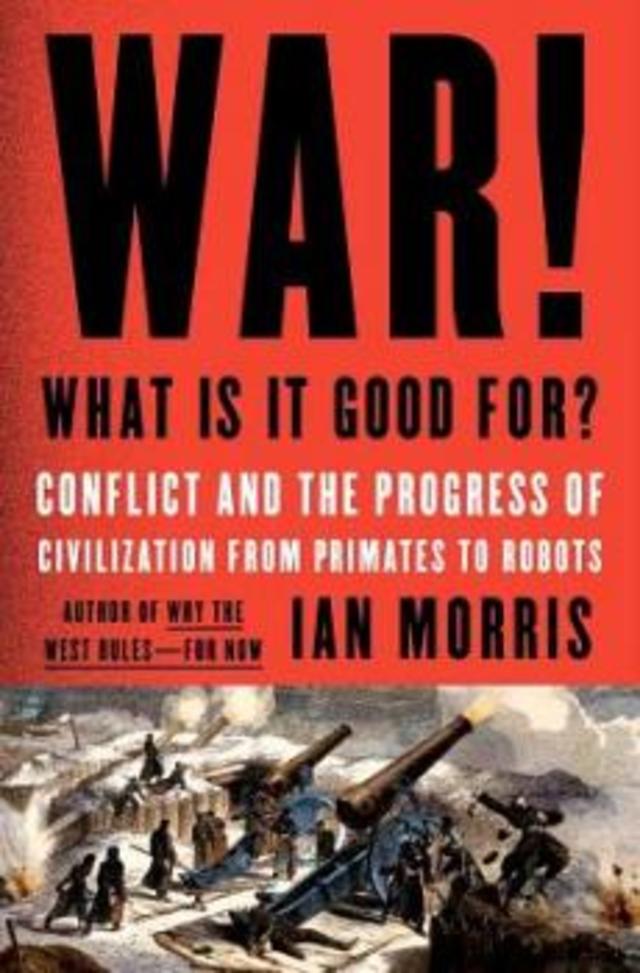
 War! What is it good for? No, but really: can we identify any redeeming qualities from the “mass murders” we’ve committed over the last fifteen thousand years? Ian Morris says “yes” in his new book, War! What Is It Good For?: Conflict and the Progress of Civilization from Primates to Robots (Farrar, Straus and Giroux, $30), which he’ll be discussing at Politics and Prose on Wednesday, April 23rd at 7 p.m.
The book rests on the uplifting premise that, despite what it may feel like sometimes, the world is far less violent than it used to be. For example, in the twentieth century, fewer than one in a hundred people died violently. Compare this to the one-in-ten or one-in-five odds during the Stone Age, where if someone wanted to use force against another person, there were “far fewer constraints on him — or occasionally, her” than there are today.
The author writes that we partially have war to thank for this. He sums up why in four main reasons backed by evidence.
First and foremost, fighting wars has “created larger, more organized societies that have reduced the risk that their members will die violently.” The wide-eyed hippie in all of us asks, “Couldn’t this have been accomplished peacefully?” Apparently not, Morris responds; his second reason is that war is “pretty much the only way humans have found” to create these societies, given that almost every documented population has engaged in war and it therefore may be part of the human condition. Thirdly, the large societies yielded by war make us all richer, improving economic growth and standards of living.
The fourth reason is the story in the book itself: “That the ten-thousand-year-long story of war … is in fact a single narrative leading up to this point, in which war has been the major actor in making today’s world safer and richer than ever before.” Like the way war brings peace, Morris admits, it is a total paradox.
Adding to the dilemma is government, a product of organized society and also a player in war. Morris outlines the choice as “at least some law and order” provided by government, or none of either. President Reagan once joked that “the ten most terrifying words in the English language are ‘Hi, I’m from the government, and I’m here to help'”, but Morris says they really are “there is no government, and I’m here to kill you.”
War! What Is It Good For? tracks thousands of years of philosophy, archaeology, geography, and military technology that have brought us to 2014, a century past the start of World War I. And what does it all suggest about what’s next?
Morris was born in England, has directed excavations in Greece and Italy, and is now a professor of classics, history, and archaeology at Stanford University. This is his eleventh book.
This talk is free and open to the public.