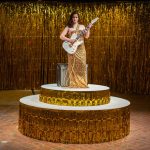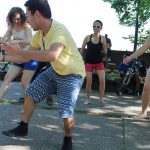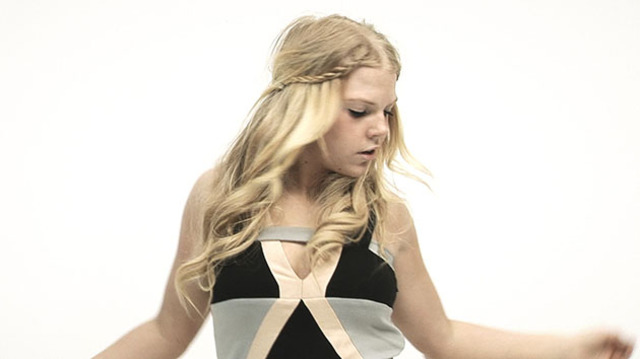
 Rineke Dijkstra, still from The Krazyhouse (Megan, Simon, Nicky, Philip, Dee), Liverpool, UK, 2009. Four channel HD video-installation. 32 minutes. Museum purchase, Charlotte and Jacob Lehrman Art Acquisition Endowment and Firestone Contemporary Art Fund, 2014.001. Image courtesy of the artist and Marian Goodman Gallery, New York / Paris. © Rineke Dijkstra.
The Corcoran Gallery of Art recently added several fine examples of Dutch portraiture to its august coffers. But these new acquisitions are a far cry from Rembrandt’s “Portrait of a Musician.” Dutch photographer Rineke Dijkstra’s gorgeous video installation The Krazyhouse is portraiture you can dance to.
Dijkstra was the subject of an excellent mid-career retrospective at the Guggenheim in 2012. She has made portraits of pregnant mothers, bullfighters and soldiers, but her favorite subjects are the awkward, still developing creatures of adolescence. The photographer made her early reputation on a series of nearly life-sized beach portraits of young people made in the early ‘90s, about which she told The New York Times, “They showed what we don’t want to show anymore but still feel.” Dijkstra allows her subjects to reveal not just a youthful openness but a vulnerable uncertainty, sometimes shifting from moment to moment.
This living, moving portraiture is what makes Dijkstra’s video pieces so fascinating. She first observed young dancers in The Buzzclub, Liverpool, a split-screen projection she made in 1996. Dijkstra brought white studio backdrops to a nightclub where she shot footage of dancers in varying degrees of bodily self-consciousness. One butch, spiky-haired subject is given a split-screen twin, each subject pumping her fist and looking towards her mirror-reflection as if getting cues from herself. You can catch a flash of confidence in another young girl’s eyes in the middle of a self-conscious dance, as she seems to be growing up on screen.
With The Krazyhouse (Megan, Simon, Nikky, Philip, Dee), Liverpool, UK, Dijkstra revisits the idea of Buzzclub with higher production values and a four-screen installation. As with The Buzzclub, the teenagers and early 20-somethings Dijkstra selected are not necessarily great dancers. “I look for people who intrigue me, who have something that makes them special.” It’s an almost too-generic foundation for a portraitist to select her subjects, but Dijkstra sets the perfect tone with her selected subjects, who are clearly performing for the camera but are also able to eventually drop their self-consciousness, if only for a moment. This tension is what makes these videos so touching. But my favorite dancer of the bunch is a complete spaz. I wonder if any of these young people will get work from these sessions.
The installation is set up in a gallery without benches to encourage audience dancing, and the music selections, chosen by each subject, may well set gallery hips shaking. (See the end of this post for a selected YouTube playlist of music heard in the installation.) There’s a great opportunity for this Friday night at Club Corcoran, an after party organized for young art-minded professionals “eager to participate in the institution’s signature black tie fundraiser for a more affordable ticket price.” Whether or not you feel like dancing, The Krazyhouse is the best coming-of-age movie in town.
The Krazyhouse will be on view at the Corcoran Gallery of Art through June 15, 2014. Club Corcoran happens Friday, April 25, 2014; 10 p.m.-1 a.m. at the Corcoran Gallery of Art and College of Art + Design. Black-tie suggested; festive cocktail. Tickets for Club Corcoran are $125 individual and $200 couples. To purchase tickets online, visit www.corcoran.org/ball and https://getinvolved.corcoran.org/clubcorcoran2014