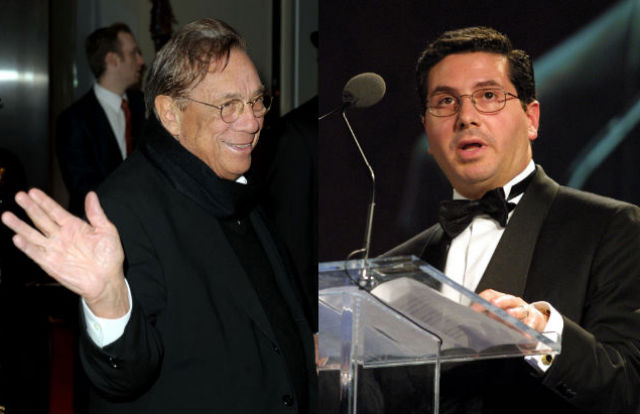
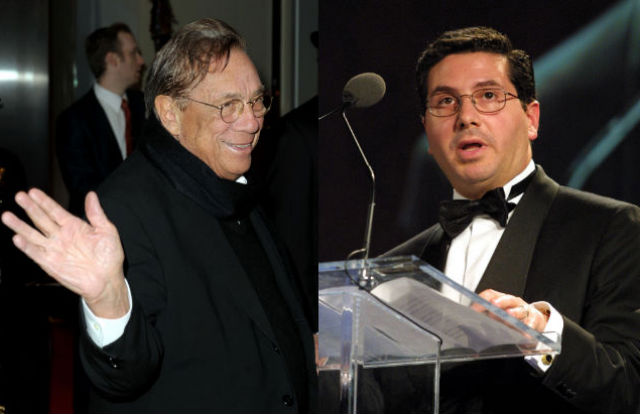
 Donald Sterling/Daniel Snyder. (Getty Images)
By DCist contributor Steve Roney
There is no argument for Donald Sterling to remain a part of the NBA.
Sure, in the age of Skip Bayless and First Take and whatever happened to MH370, there is always an “argument.” But real arguments are based upon logic, and barking dogs rarely make a point.
The argument for expelling Sterling, the NBA’s longest-tenured owner after 33 years at the helm of the Clippers, isn’t even an ethical one. He is a hateful, ignorant man for sure — but he’s been that all along. That his disembodied voice forbade his half-black, half-Latina girlfriend from bringing minorities to Clippers games, and disparaged her for her social media postings, was not a revelation.
It was evidence—not to the 29 other owners and Commissioner Adam Silver — but to the ticket-buying, jersey-wearing, re-tweeting general public who had maybe heard a rumor that Sterling was racist, or who had maybe seen a headline or overheard a mention on SportsCenter about one of Sterling’s tenant discrimination lawsuits.
This was an outrage that the NBA could not ignore.
Now, I don’t doubt for a second that the 29 other franchises, the Commissioner’s office, and every other person associated with the league finds Sterling’s words, behavior, and worldview deplorable. I am positive that they are united in agreement that Sterling, because he is a racist, must be excised from professional basketball.
But make no mistake: this was a business decision. Not one without ethical backing, and not one made with false morality. But a business decision all the same.
Imagine, for a second, a world in which Sterling was fined a nominal amount (and for a billionaire like him, all amounts are nominal): his outstanding black coach quits, for starters. His starters likely quit, for that matter, forcing their way out of town through holdouts. Fans would stay away in droves. Merchandise sales plummet, and sports writers find new and clever ways to associate the Clippers with the Ku Klux Klan.
Racist Donald Sterling had to go because if he did not, the Clippers would sink—and the NBA would go down with them. This was about dollar signs, as much as if not more than it was about hate and ignorance.
How do we know? Because there is no argument for the Washington professional football team to continue to use the term “Redskins” as their name.
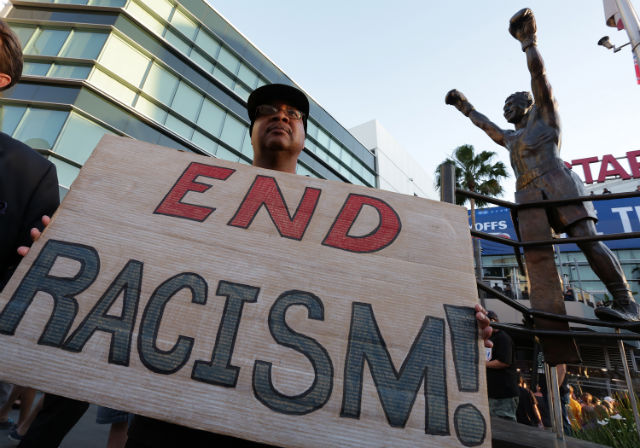 Dexter McLeod holds a sign protesting racist comments made by L.A. Clippers owner Donald Sterling outside Staples Center before a playoff game. (Photo by Jonathan Alcorn/Getty Images)
The term is used here only in the academic sense, as DCist is one of a growing number of outlets no longer recognizing the trademarked name of the Washington football team— a racial slur. It is a derogatory term for a Native American, or one with Native American heritage. Etymology does not come into play here—I have read accounts describing the term as non-offensive in origin, but I don’t think it’s in dispute that the word has been co-opted; it’s intent and implication changed in the past couple hundred years or so.
Depending on which dictionary you crack open, it’s defined as “usually offensive” (Merriam-Webster), “disparaging” (American Heritage) or “insulting” (Webster’s College Dictionary). If not consensus, that’s close enough.
Now, to be clear, Dan Snyder is not Donald Sterling. As far as I know, there have been no accusations or implications that Snyder has any racist tendencies (on the contrary, he’s made those implications to others). But what he has done is profit from a trademarked image that many find insulting and promote a brand that many find offensive. He didn’t create the image, nor did he have the idea for the name—Washington has had the same football franchise since 1932. But he hasn’t enacted change, and he continues to line his very deep pockets with the revenues generated by the offensive marks that he owns.
The question isn’t whether or not the team name should be changed, or when it will be changed, but rather, how in the world has the name survived this long? Unfortunately, the answer is simple: there has never been a powerful impetus for change.
A successful business—which is what both the NFL and the Washington football team are and have been for decades—does not change its model in the face of profit. It absolutely does not revolutionize its branding without financial incentive.
As of 2013, Washington is the third most valuable NFL franchise, at $1.6 billion, and as of the 2010 census, Native Americans make up about 1 percent of the population of the United States. They buy tickets and jerseys and Sunday NFL Ticket, but not in large quantities. There are a handful of Native Americans in the NFL, but not enough to field a full team. The NFL is not yet concerned that Washington’s team name will affect its multi-billion dollar bottom line. Robert Griffin III’s jersey is among the league’s 12 best-sellers.
If Native Americans comprised roughly 75 percent of all NFL players, this would not be the case. If Jim Thorpe had played professional football in the 1980s instead of the 1920s, and could loudly state his desire to purchase the Washington football team and change their name, this would not be the case.
But as it is, there are not 40 million Americans who are directly targeted by the racism of the Washington football team’s name. There are only three million, and they are spread out. Their footprint is small and their collective voice relatively quiet. These are not reasons that the name shouldn’t change, but they are the reasons that it hasn’t.
However, the chorus supporting a name change is growing. Senate Majority Leader Harry Reid, already an outspoken opponent of Snyder’s team name, said recently from the Senate floor “I wonder today how the leadership of the National Football League, the NFL, that money-making machine — I wonder if they have taken notice of the NBA’s decisive action.” Lawmakers clamor for a name change, but the NFL—and Commissioner Roger Goodell—seem merely to have taken it under consideration.
Daniel Snyder has shown a willingness to do everything it takes (except stop owning the team) to help Washington win. He’s also an incredibly successful businessman who would change his own name to save his businesses.
Snyder has stated time and again that he will “NEVER” change the name of his football team, but that isn’t true. If it became clear that his franchise would enter into an irreversible financial decline because of the name on the front of the jersey, he would change it. For the money, not the morality.
You can make the right choice for the wrong reasons; you can also make the right choice for a couple different reasons. The NBA did the latter, and when Snyder eventually changes his team’s name—and that day is coming—it will be because the tide of public opinion has finally swung against him, and will never swing back.
There’s no good argument for keeping the name. Enough people need to realize that to tip the scales.