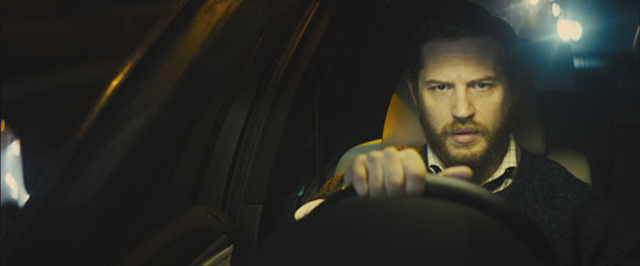
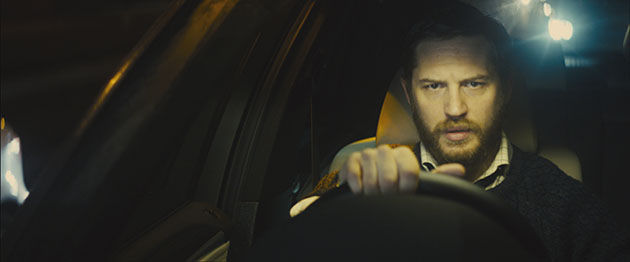
 Tom Hardy (A24)
Construction foreman Ivan Locke (Tom Hardy) has control of two things in Steven Knight’s Locke: the massive construction pit for a 55-story skyscraper, and his little Beemer. He has a harder time getting control of his life.
Locke pulls away from work the night before a historically large concrete pour is coming his way. Tired and distracted, he stops at a traffic signal and waits a second too long for the impatient commuter behind him. As we learn, this is the crossroads at which he decides where his life will take him next: home to watch a football match with his family, or on the M6 to London, where 90 minutes away, there’s a life-changing event about to happen.
The rest of the film unfolds more or less in real time during Locke’s drive along the highway. Nothing happens, but everything does, and if plenty of life incidents occur in this 85-minute ride, the pacing works against the material. A long drive has a poetic tedium (cf. The Brown Bunny), but Locke’s ride seems almost too dramatic, its symbolism too heavy—I mean, concrete!
Locke isn’t about the tedium of the road so much as the pressure of getting out of the car, the weight of the world and 55 stories worth concrete coming down on one man. The film concentrates on the driver, but the viewer feels like a passenger as we watch Locke start to make phone calls from his hands-free device, scrolling through names that at first seem like musical artists (among his contacts is one Derek Jarmyn [sic], and I’m sure I missed other references in his electronic rolodex). The calls seem mundane enough at first. Locke calls an underling to let him know he’ll supervise the pour remotely, calls his son to let him know he won’t be there for the big game. Since Hardy is the only actor visible in the film, he has to be watchable, and if his Welsh accent is distracting, he manages to convey various stages of emotion through the facial hair that limits his range of expression. The disembodied voice actors on the other end of the phone are less consistent, his co-workers flying into a rage that doesn’t seem earned at first.
Then the domestic crisis that drives Locke’s long detour is revealed. Responsible, faithful Locke has made a mistake. He keeps his telephone composure and professionalism with his family and co-workers, but his unsettled inner monologue comes out when he addresses a vacant father. Locke was apparently the product of his father’s unfaithful dalliance, and he’s worked so hard to be the responsible father that his own father wasn’t. That pressure causes him to buckle, with the structures of work and home threatening to come tumbling down upon him.
This is an exhausting look at multi-tasking, a man who puts work before family and tries to juggle personal and office life precariously from his dashboard. I like the idea of a 90-minute film about a man driving down the highway and stressing out. But despite the taut running time, the film’s rhythms feel too loose. Knight (Eastern Promises, Dirty Pretty Things) wanted to strip down cinema to the basics, but his film isn’t minimal enough, its camera wandering to capture the impressionistic blurs of life passing by as Locke’s point of view is clouded by fatigue and distress. Locke finally stops the car at the end of the movie, but the ride may not be worth it unless you really love Tom Hardy.
—
Written and directed by Steven Knight
With Tom Hardy, Ruth Wilson, Olivia Colman, Andrew Scott.
Rated R for language throughout.
Running time 85 minutes
Opens today at Landmark’s E Street Cinema.