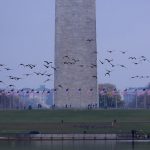
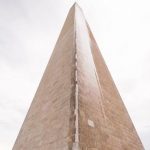
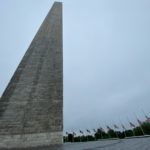
After nearly 1,000 days that have seen an earthquake, millions in damage, scaffolding and repairs, the Washington Monument will reopen Monday to the public.
In the many months since a 5.8 magnitude earthquake shook the East Coast and forced the closure of the famous D.C. obelisk, crews have been repairing hundreds of cracks and damaged stones. During a Saturday tour, tweaks were still being done to the elevator, which lifts visitors 500 feet above the ground. Only the elevator will be available to visitors on Monday, but eventually tours down the 896 stairs will begin again.
James Perry, the National Park Service’s chief of resource management for the National Mall & Memorial, said restoring and preserving the Monument is at the core of his employer’s mission. “There’s no better example of a cultural resource than the Washington Monument,” he said during Saturday’s tour.
Perry, who was working at another park when the 2011 earthquake occurred, said he saw what happened on the news and thought, “Geez, I’m glad I wasn’t up there.” One of the first things he did in his position was fly to Denver to select a proposal to assess the Monument’s more than 20,000 stones and figure out how to fix them.
“It’s a monumental task,” Perry said of the repair process, which was done in a “methodical way.” The worst cracks were immediately filled and other stop-gap measures done while they prepared to have stone masons get to work.
“What I like to say about this project is: It’s a basic, standard masonry repair that you’d do with any historic building — it just happens to be the Washington Monument.”
Bob Vogel, superintendent of the National Mall & Memorial Parks, said NPS is “so excited” to have the Monument open again. (Already, more than 16,000 tour tickets have been reserved online.) “We’ve had an outpouring of support from around the world,” he said.
It was Vogel’s third week in his position when the earthquake happened. “We were very distraught,” he said. The National Park Service was simultaneously dealing with a tropical storm that delayed the opening of the Martin Luther King, Jr. Memorial, and emergency crews had to be called to the Monument “to keep the water from pouring” in, he said. “My job has been better since,” Vogel joked.
“We’re in the preservation business,” he said of the repair process. “The repairs we make aren’t just for today, but we’ll be making sure the Monument is here 100 years from now.”
The most visible part of the process happened after the installation of scaffolding, which was illuminated at night. While some called for the scaffolding to become a permanent fixture — hundreds, Vogel said — it wasn’t a practical idea. “It would not be appropriate to have the Washington Monument in scaffolding all the time,” he said.
Steven Monroe, the superintendent for the Monument repair project from Grunley construction, said he’s worked on large projects but not on this scale or level of complication. When asked what the biggest unexpected challenge was, Shane Flynn, project manager from Lorton Stone, had an unusual answer: A raccoon at 530 feet up.
“He was under a box,” Flynn explained and escaped after the box was lifted. While animal control was called, the raccoon was never found.
Monroe said the weather was one of his biggest challenges, especially the wind for the workers hanging off the Monument. “You get up there and it’s very dangerous,” he said.
With the project completed, Monroe said it’s bittersweet: “To know that we fixed such a structure and made it beautiful — really beautiful.”