 Legendary Pictures.
There’s a scene towards the end of Godzilla—director Gareth Edwards’ reboot of the classic franchise—wherein a team of Navy SEALS parachutes out of a plane flying high above San Francisco. As they fall wordlessly toward the scorched earth, the manic, nerve-inducing score— György Ligeti’s Requiem that Kubrick used in 2001: A Space Odyssey—builds and builds. The camera mostly lingers on Aaron Taylor-Johnson’s Ford Brody—the film’s primary human protagonist—as he floats down between the colossal titular beast duking it out with two other mammoth monsters.
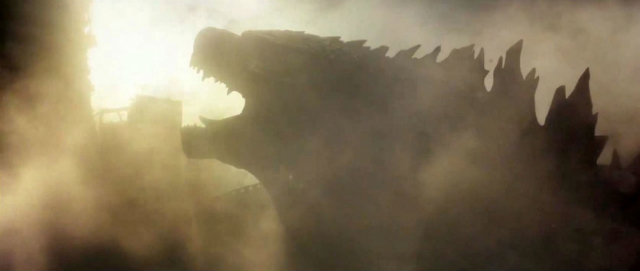
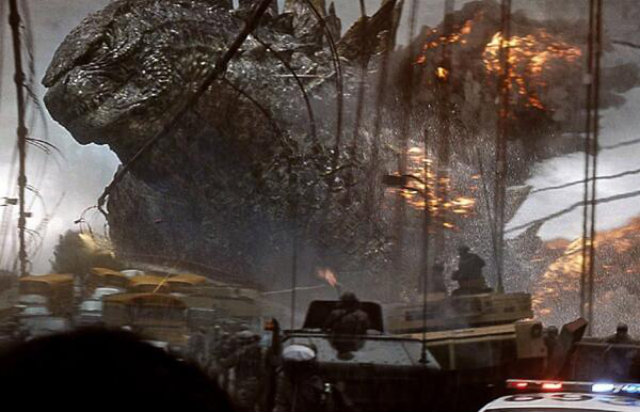
But the best part of this centerpiece scene isn’t what you see—it’s what you don’t. Only brief glimpses of the titanous monsters battling through the thick smoke of fiery buildings in ruin caused by their destruction are shown. It’s a stylish and bold move on Edwards’ part, as Godzilla skirts what so many summer blockbusters have become accustom to these days: Excess.
Rather than crowd the narrative with superfluous action sequences—to a point where there’s so much explosions and shaky camerawork, you can’t even tell what’s going on—Edwards instead favors a slow-building narrative, with a few key scenes of perfectly executed mayhem. There might not be as much shit blowing up as in any given Michael Bay film, but that’s because each action scene is masterfully constructed.
The film kicks off with vintage classified footage of the Japanese military performing “tests” of nuclear bombs in 1954—the year the original Godzilla first premiered. Those tests weren’t tests, of course—the Japanese military was trying to kill Godzilla. But in this film, Godzilla isn’t the primary threat to mankind.
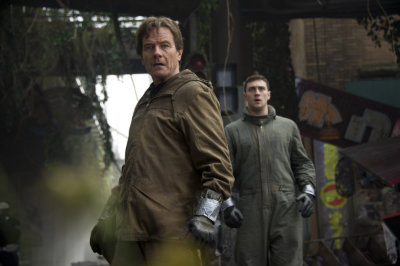
Fast forward to 1999 and we’re introduced to Bryan Cranston’s Joe Brody—a nuclear physicist working at a plant in Japan. Just before we meet Joe, a quick prologue shows us Dr. Ichiro Serizawa (Ken Watanabe) and Dr. Vivienne Graham (Sally Hawkins) meeting with an oil drilling company who unearthed the corpse of some sort of prehistoric monster. They determine that it had been killed by a of giant parasite that they soon learn was preserved and just recently burrowed out of the excavation site. It finds its home at Brody’s nuclear power plant, where it causes a major meltdown, killing Joe’s wife (Juliette Binoche) in the process.
 Legendary Pictures.
Fifteen years later, that town has been abandoned, declared a “radioactive site.” Joe’s son, Brody, arrives home after 14 months of active duty to his wife (Elizabeth Olsen) and kid, only to have to leave again to bail his dad out of a Japanese prison. Joe’s convinced that the government is hiding the truth of what happened that faithful day and he’s gone full conspiracy theory-crazy to find out the truth, trespassing in the quarantined area. As it turns out, a Rodan-like winged monster (a MUTO as it’s referred to in the film) has made its nest at the site of the power plant. It has hatched—now fully grown—and it is pissed.
Eventually, the MUTO hooks up with Godzilla, who Watanabe’s character explains is “the top predator” and doesn’t want any company when it comes to the city-destroying monster variety. It’s up to the film’s human characters to assist or get the hell out of the way.
While Godzilla is a rare visual treat for a summer blockbuster, it isn’t without its many faults, most of which revolve around the film’s lackluster and hollow human characters. Cranston is great, as usual, but he’s not given as much screen time as he deserves. As far as leading mans go, Taylor-Johnson merely trots around screen wide-eyed and open-mouthed, with a look of perpetual confusion, as if he just stumbled out of Burning Man and onto the screen. As for the film’s female characters, they are few and far between (Hawkins and Olsen being the only ones with any significant screen time, and even then it’s sparse), with their roles pretty much relegated to assisting their male counterparts. Still, it’s an improvement to the sexually objectified roles you typically see for women in major summer blockbusters these days (again, looking again at you, Michael Bay).
It’s the 60th anniversary of the Godzilla franchise and, luckily, Edwards’ reboot is a fitting anniversary present; flirting with the tone of the original films, while adding his own distinct voice, and eradicating any memory of Roland Emmerich’s colossally terrible 1998 film.That doesn’t mean Godzilla isn’t without its faults, but it’s certainly one of the more entertaining and classic summer blockbusters to come out in some time.
—
Godzilla
Directed by Gareth Edwards
Written by Max Borenstein
With Aaron Taylor-Johnson, Bryan Cranston, Elizabeth Olsen, Ken Watanabe, and Sally Hawkins
Rated PG-13 for for intense sequences of destruction, mayhem and creature violence.
Running time 123 minutes
Opens today at theaters everywhere.