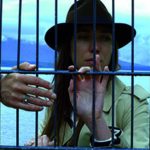
Jeremias Herskovits and Alejandro Jodorowsky (Abcko)
“You are not alone. You are with me.” The best thing about Alejandro Jodorowsky’s The Dance of Reality, an autobiographical film that is the director’s first feature in 23 years, is that Jodorowsky himself is with you. He appears in the film’s very first sequence, and he reappears to guide his young self, played by Jeremias Herskovit. At a turning point in the film, the senior Jodorowsky reassures his young familiar in a moment of despair. Suffering from a cold, abusive father, rejected by his mother after his youthful blonde locks are shorn and feeling responsible for another boy’s death, young Alejandro wants to end it all. The grizzled elder Jodorowsky comforts the boy, himself: “What you are looking for is already within you.”
It’s a sequence you might expect from an autobiographical reverie, infused by the maudlin sentiment that makes so many foreign films go down like so much cinematic candy. Somehow, Jodorowsky makes it work. The director injects life into this most conventional of coming-of-age tropes just by the nature of his personality and generosity.
Jodorowsky loves everybody: he loves the Nazis, interpreting their brown shirts into a lovely, earthy tangerine; he loves the cripples, the amputees, the dwarf, the circus freak, his abusive father (played with a naked fire and sensitivity by Jodorowsky’s son Brontis) and of course his buxom mother (opera singer Pamela Flores) who sings all of her lines. Jodorowsky’s shock and surrealism is informed by this love, and that’s why seeing him onscreen works so well, even for a sequence that should be tripe.
But the rest of the film is a mixed bag, albeit an intensely colorful and at times wildly inventive one. The film takes places and was shot in Jodorowsky’s childhood home of Tocopilla, on the northern coast of Chile. It’s a coming of age story set against the backdrop of a Chilean dictatorship led by Carlos Ibáñez del Campo (Bastián Bodenhöfer).
From the film’s first scenes, you see traces of Jodorowsky’s previous work: the barren landscape of El Topo is broken by the vibrant colors that he loves, in this case provided by the painted faces of circus performers. The music suggests Nino Rota, which announces the debt to Fellini, and the film has earned comparisons to Fellini Amarcord. But Jodorowsky’s reminiscence is his own, and despite characters that resemble Felliniesque grotesques, there’s a distinct artistic vision, and a signature optimism that shines through even the most cynical of times.
These colorful characters walk a fine line that veers toward the precious, but Jodorowsky rarely cross that line. Even if one scene or sub-plot doesn’t work, another one comes along that does. The director shows his control in epic scenes like a shore inundated with dead sardines and human seas of black umbrellas and hand-made chairs. Jodorowsky can also take a small scene of generosity, as when young Alejandro gives his beautiful red shoes to a poor boy. The more cynical among you may roll your eyes and tsk tsk that this is simple self-mythologizing, but the scene works. It’s the kind of thing only Jodorowsky can get away with. Not just the sentimental, but the shocking: the things Alejandro’s mother does would make you call in social services, but as volatile and unhinged and operatic she is (and her opera singing is one thing that doesn’t work), you feel she is there to comfort and protect her son.
The movie still feels restrained, not crazy enough despite sequences like a dog pageant (which is cute), a kind of romantic reverie in which a shirtless and suspendered Jaime falls in love with Ibanez’s white horse (which is wonderful), and a healing sequence (which is, um, earthy) that recalls of all things, The Paperboy.
The Dance of Reality is clearly the work of Jodorowsky. You see the pageantry of Santa Sangre, the golden nugget of The Holy Mountain, the vivid colors and ecumenical spirituality that runs throughout his work. This is a director who does things nobody else would think of, but his movie should be more surprising than it is — and then it surprises you in ways that you don’t expect. Jodorowsky had complete creative control for this project, spurred by his reunion with producer Michel Seydoux during the making of the terrific documentary Jodorowsky’s Dune. That film showed the ease with which creative people and ideas came to Jodorowsky, and the cast of players had the potential to generate wild creative sparks. There aren’t enough sparks in The Dance of Reality, a meticulously styled film that never goes off the rails like you expect and want from a charismatic figure like Jodorowsky. You’d almost prefer to see the making of the movie, or simply watch Jodorowsky tell the story for two hours. His passion for film can come across better in his storytelling than it does in his films. The Dance of Reality isn’t a success, but if you have any interest in Jodorowsky or in movies, you may find even his missteps worth watching.
—
The Dance of Reality
Written and directed by Alejandro Jodorowsky
With Brontis Jodorowsky, Pamela Flores, Jeremias Herskovits and Alejandro Jodorowsky
Not rated; contains graphic nudity, violence, torture.
Running time 130 minutes
Opens today at E Street Landmark Cinema