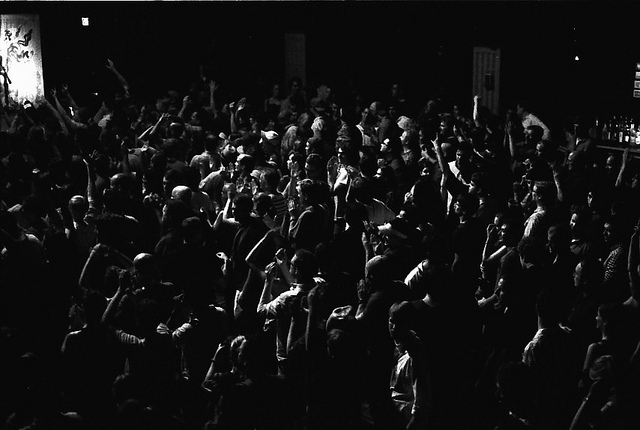
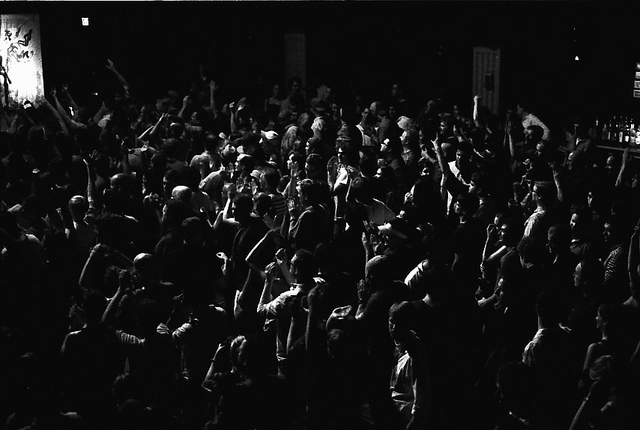
 Photo by Erin M.
Pro-tip to local bands: Stay away from Rabbl. Yesterday, the Washington Post Express published an article about the concert crowd-funding website partnering with Columbia Heights’ The Pinch in order to bring up-and-coming nationally touring bands to play in the bar’s downstairs 100-person-capacity venue space.
The model behind Rabbl is simple enough: a band creates a “rabbl,” asking fans which city they should play in during a given week; fans vote through the website by reserving a ticket to the hypothetic concert; if enough fans reserve tickets, their credit card is charged; the band then finds an appropriate venue and books the show, with the guarantee that X amount of people will show up; the show happens, the band gets paid, fans leave happy.
Easy, right? Not so much.
Through their sponsorship with The Pinch, the touring bands have already been booked. Underground favorites and critically praised acts like Brooklyn’s White Prism, “>Baltimore’s Dope Body, Seattle’s La Luz, and more have already been booked to play the venue throughout the summer. The Pinch is instead using Rabbl to get local bands to fill out the bill. “The local bands that get the most fans to pre-order tickets through the website will get to play a show,” Express reports. “Once the winners are announced, their supporters’ credit cards will be charged.”
And therein lies the problem.
While Rabbl’s model is, essentially, doing a job that any venue should already be doing (figuring out which touring bands people want to see and booking a strong bill that will draw a healthy crowd), I can see how it can make sense for some touring bands that can draw larger crowds in some cities compared to others. With the overhead costs of taking your band on the road, you’re almost guaranteed to lose money, and some up-and-coming bands would want to know ahead of time that they’re going to draw at least X amount of people to any given show (and, know exactly how much money they’re going to make).
But applying this “pay-to-play” model to booking local support for touring bands isn’t only a completely boneheaded idea, it’s an insult to the local music community. “We’re looking to find a bunch of cool local bands who maybe haven’t played out that much yet,” Rabbl co-founder Erik Needham tells Express. He says that Rabbl is gauging the local music scene to see what kinds of crowds certain bands will draw. Those local bands that draw enough pre-sale tickets from their Rabbl efforts will then “be rewarded with opening slots when the website brings bigger bands to town.”
By employing this model, Rabbl is essentially pitting local bands and artists against each other like some sort of cyber band version of Survivor. (I can see the tagline now: There’s eight bands booked for a three-band bill. Who will play? You decide!). As a local musician with my own band (who, disclosure, has played The Pinch), I would never participate in Rabbl’s “pay-to-play” model and I’m sure a majority of the local bands I’ve played with and am friends with wouldn’t either.
I believe strongly in the D.C.-area music community. And I want to emphasize that word “community,” because that’s what it is—a community of musicians and bands who work together to book and put on shows, promote, collaborate, help friends get on bills, fine venues, etc. In recent years, the D.C.-area music scene, in my opinion, has flourished. There’s a healthy crop of DIY venues working together to book shows, the diversity of different music out there is astonishing, and, best of all, hardworking local bands are beginning to get the national recognition they deserve. I think that’s very much a product of a fostering community that works together and I know that more and more bands are going to get the recognition they deserve because of it. And it’s all because of a community that works together, not because bands are competing with each other to open for whatever touring band Pitchfork is championing this month.
Not only is this model terrible for the local music community, but it also completely negates the role of bookers and talent buyers, whose job it is to pay attention to the local music community and use their expertise to tap the most appropriate local talent to open for touring bands. Venues employ bookers and talent buyers for a reason, because they know how to put together stellar lineups of national touring acts and local openers that will draw crowds. Though, in the comments of the Express article, Needham says that the venue will pick five or six bands who fit with the headliner musically to compete for an opening slot:
Some misunderstandings here. First off, RABBL works in a lot of different ways, and we’re only describing here in this article one way, which is what we call an Opener Promotion.
In an Opener Promotion, RABBL is used to help a promoter or venue decide on who gets the opening slot. They usually choose among a handful of artists that they select, who make sense musically for the show. Today, a fan has no way to help a band get that opening slot. With RABBL, they do. Fans who want to help vote (by reserving tickets to the show) in the name of the artist they want to help. If “their” artist wins, then those fans get charged for a ticket to the show, their artist gets to open, and the fans get to attend and see their artist play. So to answer your questions specifically: (1) if all a fan cares about seeing is the headliner, they would buy ticket to the show as per usual, no change there; and (2) the only artists who would participate in the Opener Promo are those that the venue or promoter already curated for musical fit.
The local music scene shouldn’t be a competition, but a collaboration. Rabbl doesn’t seem to get that and I hope The Pinch will come recognize it. In the meantime, local bands, I implore you: Don’t participate in this “pay-to-play” model. Have faith in your local music community.