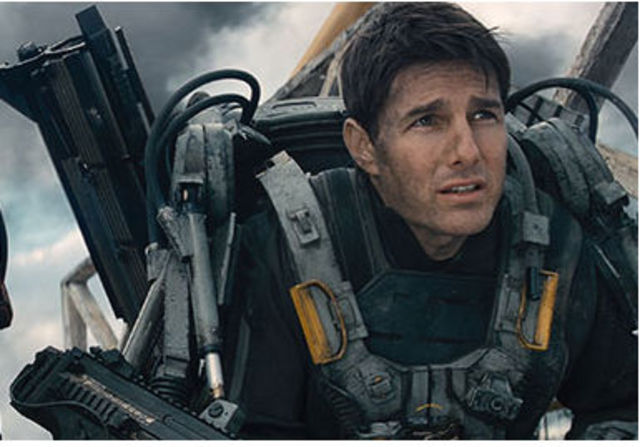
 Emily Blunt and Tom Cruise. Courtesy of Warner Bros. Pictures
Mad Men ended its fourth season with Don Draper starting an impulsive second marriage as Sonny and Cher’s “I Got You, Babe” played. The pop song set the scene’s time period, but it also clearly referenced Harold Ramis’ 1993 comedy Groundhog Day. Here was Don Draper repeating himself. Groundhog Day showed us a man trapped in a vicious cycle where he relives the same day over and over until he gets it right. It was rom-com as spiritual path.
Doug Liman’s Edge of Tomorrow casts Tom Cruise as Major William Cage in a similar role in which Cage gets to relive his life repeatedly until he gets the courage and sacrifice thing down, minus “I Got You, Babe.” Since this product arrives in the throes of blockbuster season, Edge of Tomorrow is Groundhog Day as battle-hungry video game. Unlike the movie that inspired it, this star vehicle doesn’t exactly aim for enlightenment. Tom Cruise gets another turn at the video game of life until he can save the world and get the girl. But the process is as entertaining as blockbusters get, and suggests the real enemy is internal: the mind.
The movie opens on a world in chaos, victim to “mimics,” spidery monsters that have overtaken the planet and cannot be defeated by any military power. These crawling, venomous creatures burrow underground and grind their way through Earth and concrete to overtake their victims. What’s interesting is that these creatures look like they emerged from our very nervous system. The world has been overtaken by its own anxieties and emotions, enemies that eat at us from within and that seem impossible to tame.
Enter Major William Cage, an officer who has seen plenty of PR action but no actual combat. Cage tries to smooth talk himself out of an assignment on the front lines, but General Brigham (Brendan Gleeson) has another idea. He has Cage arrested and sent on a doomed mission. Master Sergeant Farell (Bill Paxton) introduces this reluctant soldier to his fellow members of J-Squad, who understandably give this would-be deserter a hard time. Even before the squad is dropped onto a beach, the mission goes wrong. On the field, he meets Special Forces soldier Rita Vrataski (Emily Blunt), whose picture has been plastered all over the world as propaganda to boost morale. The meeting does not go well. Cage figures out his weaponry enough to kill one of the mimics, but not before it splatters acidic slime over his face, killing him.
Then he wakes up again, handcuffed and reliving the same day all over. Cage tries to convince his fellow soldiers that he knows what’s going to happen, but his cries are ignored until somewhere in this vicious cycle Rita Vrataski recognizes his plight.
What follows is kind of a battlefield rom-com about brain processes and the cinema machine. Who else but an actor could save the world by taking control of the monster that takes control of human behavior, a.k.a. Hollywood itself? Edge of Tomorrow has a generic name and injects the Groundhog Day premise (with doses of Starship Troopers and Mimic) into blockbuster tropes. Director Doug Liman, who graduated from ensemble indie thrillers like Go to Bourne blockbusters, makes it work and on multiple levels. It’s a brutal indictment of the disposability of life (as Emily Blunt shoots Cruise in the head repeatedly in a sequence that you might wish all rom-coms had); it’s perhaps a payback for cinematic misogyny and the rise of the Tom Cruise Machine, and it’s finally, it’s solid entertainment.
Our hero is stuck with the loaded name of Cage. He’s obviously trapped inside his body, but the Cage name is also the mark of the cracked actor, an apt name when you think of Cruise’s off-camera breakdowns.
Cage is a jerk as the movie starts, doing anything he can to avoid adult responsibility. This rings true for the conventional perception of Tom Cruise as a douche, and Cruise gets to play hero again by the end of the movie. Cage may change and grow balls and empathy as the movie goes on, but in one sense he has stayed true to his baser self: he cheats. He knows what’s going to happen and gets another shot. He can kill himself if he doesn’t get it right, and start all over again. Does he feel pain? Perhaps, but that’s a temporary inconvenience. The movie’s message is complicated and conflicting—are our lives a temporary cycle that we are given a chance to do over until we get it right? Does the world really revolve around our personal heroism, or lack thereof? Is the movie merely a projection of one man’s self-aggrandizing rumination, turning over heroic cinematic scenarios over and over again until the credits roll over a crowd-pleasing, dramatically satisfying conclusion? I imagine a darker epilogue, one in which the camera reveals a straitjacketed Cruise who imagined the whole thing and never left the discomfort of his institutional bedpan. Edge of Tomorrow isn’t that kind of movie. But it’s good enough that such an epilogue does not seem so far fetched.
—
Directed by Doug Liman
Written by Christopher McQuarrie, Jez Butterworth & John-Henry Butterworth
With Tom Cruise, Emily Blunt, Bill Paxton, Brendan Gleeson
Rated PG-13 for intense sequences of sci-fi action and violence.
Running time: 113 minutes
Opens today at a multiplex near you.