While there’s no shortage of cookie cutter, uninspired architecture in D.C., the city is also home to some of the greatest historic buildings in the country as well as some legitimately exciting modern structures. Even for a place as small as D.C., selecting our favorite buildings was not an easy task, so we limited ourselves to just over ten that are actually in the city limits. (I know: It was really hard not to include the Washington D.C. Temple.) We’ve also created a map at the bottom of the page where you can share your own favorite.
MUSEUMS AND THEATERS
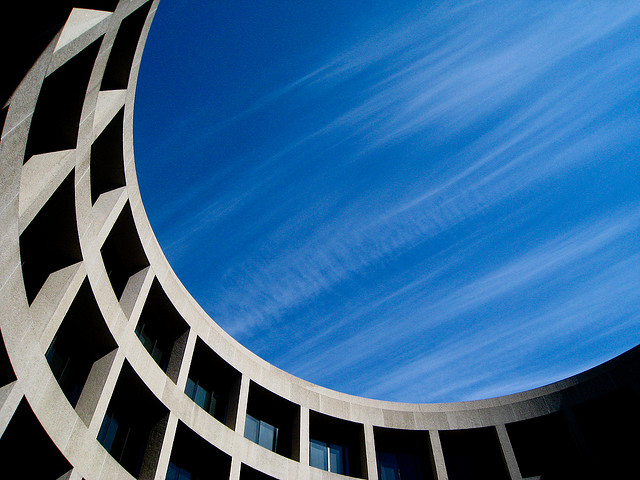 Photo by William Couch.
THE HIRSHHORN: What makes the Hirshhorn’s building on the National Mall so great is how angry it made people when it was first built. Gordon Bunshaft’s design — a cylinder with a hollowed out middle — stands out from its more traditional neighbors as much as the modern art collection inside. Directly next to the equally grand, Norman-style Smithsonian Institution Building, the Hirshhorn may never be as exciting as it could be (RIP bubble), but we’re grateful for it.
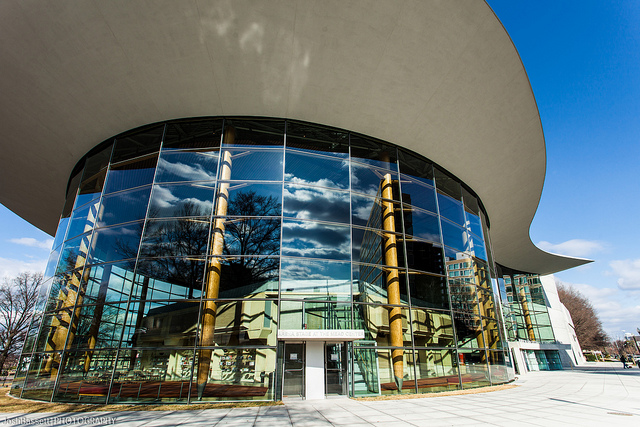 Photo by Josh Bassett.
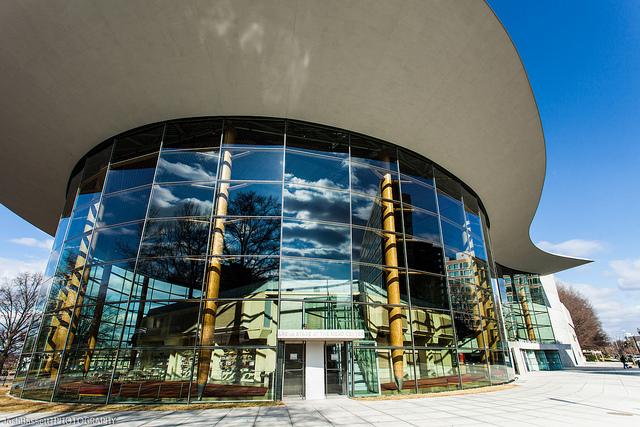
ARENA STAGE: From a modest 1950s theater in-the-round designed by the man behind the Metro to one of the most breath-taking buildings on the Potomac, the Arena Stage’s complex has set the tone for what’s the come to Southwest D.C. (Don’t mess this up, The Wharf!) Wrapped in a “glass skin,” as Arena puts it, Bing Thom created a building that is opens visitors to the water while insulating the stages in rich wood.
HISTORIC
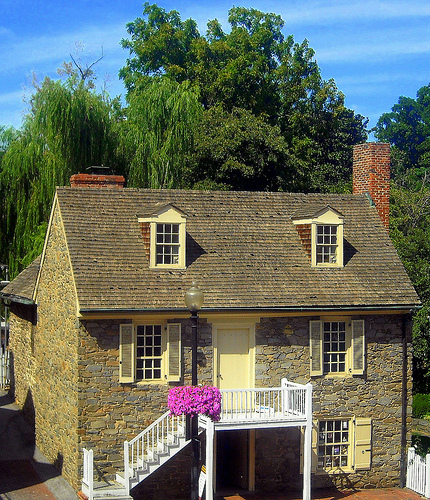 Photo by NCinDC.
OLD STONE HOUSE: Aside from being the oldest existing building in D.C., the Old Stone House on M Street in Georgetown is an interesting building. It’s a reminder of how rustic the area used to be (a simple stone building with a dirt floor) and a good example of colonial architecture. The gardens behind are nice, too. — Andrew Wiseman
UNION STATION: While New York City’s grand train station was lost in the 1960s, D.C.’s Union Station — with its Beaux-Arts design, Centurion statues, and renovated plaza — is still a building fit to be the city’s transportation hub. Yes, I’ll agree that some of the shine is gone, I still get wrapped up in the grand arches, dramatic staircase, gold leaf ceiling and marble floors whenever I pass through.
BASILICA OF THE NATIONAL SHRINE OF THE IMMACULATE CONCEPTION: It was hard to pick just one of D.C.’s many glorious houses of worship — see also: the Washington National Cathedral, the National Presbyterian Church, Sixth & I Historic Synagogue, the Islamic Center of Washington —but I went with the Basilica simply for its scale. It’s the largest Catholic church in the country, with an old-world attention to detail. Even for a non-believer, the shrines and mosaics inside are mind-blowingly beautiful.
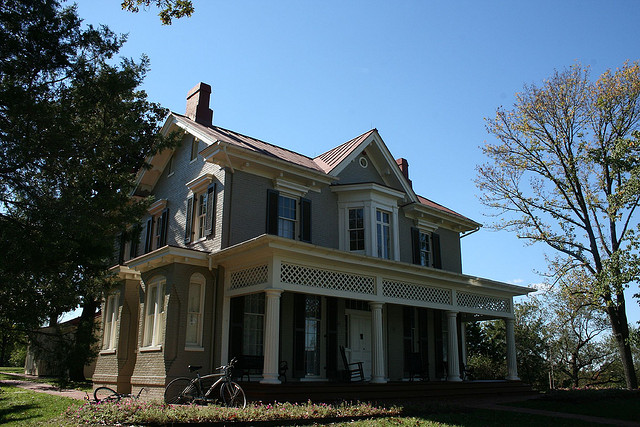 Photo by Mark Trimble.
FREDERICK DOUGLASS NATIONAL HISTORIC SITE: While many parts of D.C. lose older homes in favor of condos and cheap flips, the architecture in Historic Anacostia feels like a trip back in time, which comes with its own debate. Among the Victorian homes with large porches built into hills with some really lovely views is the former home of Frederick Douglass. The home cannot be separated from the man who lived there, nor should it be. Don’t just pass it by. Go inside and take the tour. And don’t forget to be blown away by the view view from Cedar Hill.
RESIDENTIAL
 Via Sotheby’s.
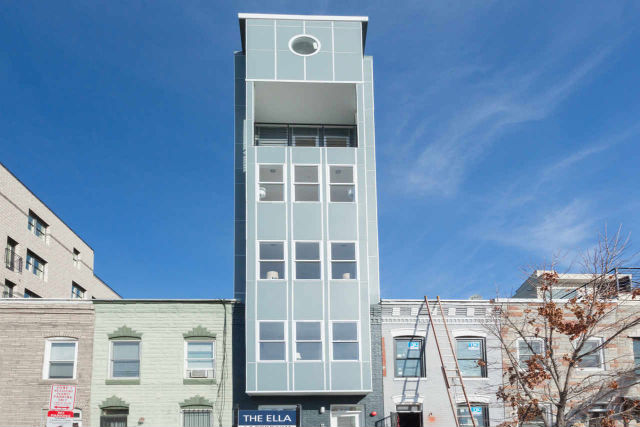
THE V STREET POP-UP: As former DCist editor Martin Austermule famously said, the pop-up at 11th and V streets NW “is a big middle finger to taste and scale.” This is very true. But the absolutely insane five-story condo building, swagger-jackingly named The Ella, represents D.C.’s current struggle: The struggle against the Height Act, higher rent prices, homogenization. The V Street pop-up is everything and nothing. (And this blurb is sarcasm!)
OFFICE AND OTHER
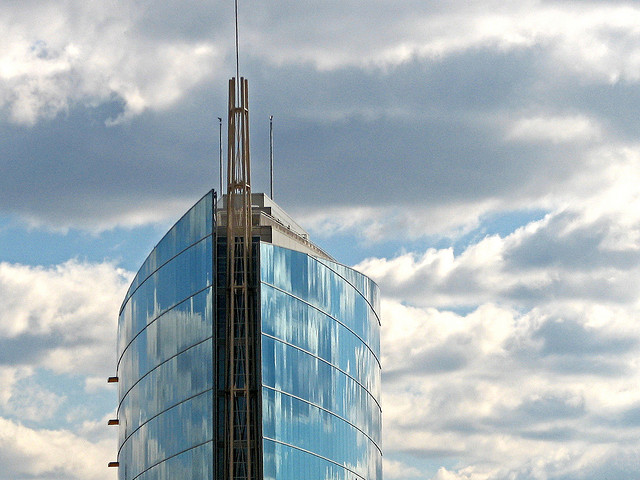 Photo by T.D. Ford.
NATIONAL ASSOCIATION OF REALTORS: There is too much glass happening in D.C. at the moment. But if you’re going to use the material, the National Association of Realtors headquarters on New Jersey Avenue is a good example of how to do it right. The triangular building looks like some futuristic airship, blending with the sky and offering some relief from the awful cement office buildings that seem to be as common downtown as suits and food trucks.
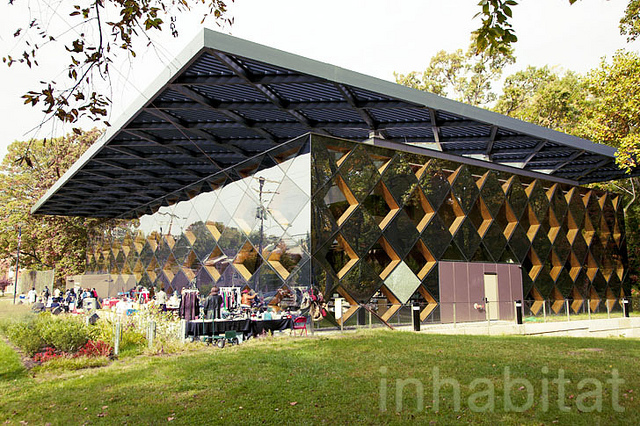 Photo by Inhabitat Blog.
FRANCIS A. GREGORY LIBRARY: A big thank you to statehood activist Josh Burch for reminding me about Francis Gregory Library on Alabama Avenue SE, which is quite simply the most incredible D.C. Public Library in the city. One of the several DCPL buildings to undergo a major renovation in recent years, Francs Gregory went from a dull brick building to a marvel of glass and geometry that blends in with the surrounding woods. The inside is just a tremendous. This isn’t to say that the many historic libraries — Shaw, Petworth, Northeast — to transform in recent years aren’t as worthy of attention.
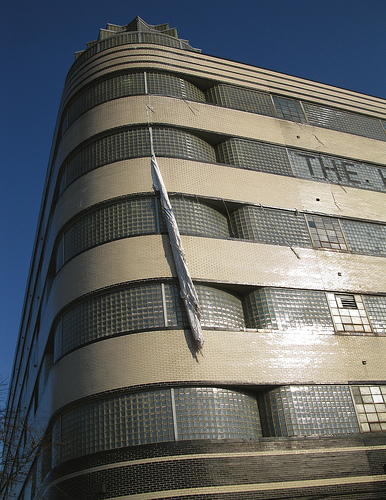 Photo by Anomalous A.
HECHT COMPANY WAREHOUSE: That the old Hecht building on New York Avenue won’t be torn down for its next act should be a huge relief to lovers of Art Deco. The warehouse will be turned into office space and the exertion — dark brick and glass blocks — will be mostly preserved. It hurts a little bit to see chains like Petco making a move on the building, but it will be good to see this vacant building come alive again.
ROBERT C. WEAVER BUILDING: I won’t apologize for this one: I love the Robert C. Weaver Building, which you might know better as the HUD Headquarters or a “brutalist atrocity.” It’s not an atrocity to me, it’s an absolute masterpiece. Designed by noted modernist Marcel Breuer – who also lent his touch to the nearby Hubert H. Humphrey Building and the iconic Pirelli Building in New Haven, Conn., the Weaver Building retains all of the aspects of brutalism that I’ve come to love, yet it’s curved facade and strangely graceful aesthetic soften it up enough to be appreciated by the average walker-by. Nevertheless, there’s no denying that it’s one of the District’s most reviled structures, at one time called (by the City Paper, no less) an unfortunate exercise in design that “sits up on stilts that look like rhinoceros feet, aloof from everything around it.” But I love it, in the same way I loved the recently-demolished brutalist church at 16th and I. —Pablo Maurer
YOUR PICKS
As we said, this was not an easy list to put together. That’s why we’re asking you to pick your favorite building on the map below and maybe even write a sentence of two about why you feel that way.
View Best Buildings D.C. in a larger map