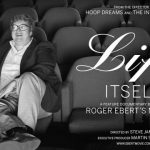
AFI Docs, the film festival formerly known as Silverdocs, offers over 50 documentary features and 27 shorts this year. Not all titles were available for preview (I think it’s safe to assume that Life Itself, the Roger Ebert film by Hoop Dreams director Steve James, is worth seeing), but the DCist staff has done the work for you with a representative sample of the festival’s stellar lineup. So, what are you waiting for? Go see some docs! — Pat Padua
 Via AFI Docs.
I Am Big Bird
Directed by Dave LaMattina and Chad Walker. 90 minutes.
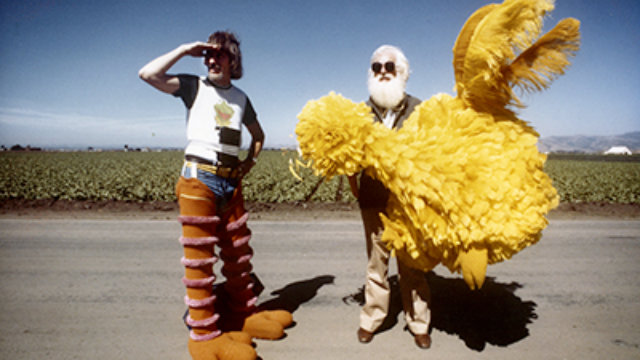
A few years ago, Being Elmo showed Sesame Street fans the emotional conflict stemming from Kevin Clash, the very real man who voiced and operated the famous furry red monster for many years. In I Am Big Bird—another behind-the-scenes look of an iconic PBS character—even the title suggests that there’s not an immense level of separation between actor/puppeteer Carroll Spinney and his yellow, eight-foot tall alter ego.
Although the accompanying visual elements that illustrate his troubled early years are mostly still photographs and Spinney’s own animations, there’s a wealth of archival footage that he and his wife Debra have taken over his 40-plus years as Big Bird. As such, Spinney is revealed not only through behind-the-scenes shots on the set of Sesame Street and heartfelt interviews, but through several glimpses of warm family interactions and private events with his cast members.
The man that comes to life in those scenes is just as complex and likable as the Bird he portrays: someone who might be smiling or rolling down a hill, but also someone who struggled mightily with loss, feelings of inadequacy, and the desperate desire to be liked. While the film hits on some familiar touchstones—like the deaths of Jim Henson and Will Lee who played Mr. Hooper on Sesame Street—some of the moments that figured strongly in his life, like the filming Big Bird did in China, may be new to younger viewers. If you’ve thought intuitively for decades that you really know Big Bird, this film essentially proves you right. — Valerie Paschall
I Am Big Bird screens Saturday, June 21 at 1:45 p.m. at the National Portrait Gallery and Sunday, June 22 at 11 a.m. at the AFI Silver Theater. Tickets and info here.
 Via AFI Docs.
The Internet’s Own Boy
Directed by Brian Knappenberger. 105 minutes.
Internet activist Aaron Swartz devoted most of his short life to defending freedom of information on the internet, but there’s a good chance that you hadn’t heard his name before his untimely suicide early last year. Current threats to internet freedom like the Stop Online Piracy Act (SOPA) are now familiar concepts to even casual users of the internet, but according to the Brian Knappenberger’s engaging film, The Internet’s Own Boy, we owe that awareness, in large part, to Aaron.
The film relies largely on talking heads and the occasional infographic to deftly explain a range of topics that Aaron toiled to bring to public attention—SOPA and PIPA, modern hacktivism, copyright law and creative commons. The remainder of the film effectively relies on home video footage of Aaron as a touchingly sweet and precocious child, juxtaposed with interview footage of an overstressed Aaron in his final months, to pack its emotional punch. Yet, the film nevertheless waffles on picking a focus for its indignation; accusations are (vaguely) lobbed at the FBI, MIT, the state and federal governments, and even JSTOR for causing Aaron’s suicide. Though despite its best efforts, the film can’t quite settle on a villain for its story.
In this regard, The Internet’s Own Boy never quite becomes the jarring call to action that it wishes itself to be. But, in its ability to elucidate some of the murkier concepts of hacktivism and internet rights, the film serves as a fitting tribute to Aaron’s memory. — Riley Croghan
The Internet’s Own Boy screens Thursday, June 19 at 7:15 p.m. at the Naval Heritage Theater (as a part of AFI Docs’ Catalyst Screenings series), and Saturday, June 21 at 3:45 p.m. at the AFI Silver Theater. Tickets and info here.
 Via AFI Docs.
The Hand That Feeds
Directed by Rachel Lears and Robin Blotnick. 88 minutes.
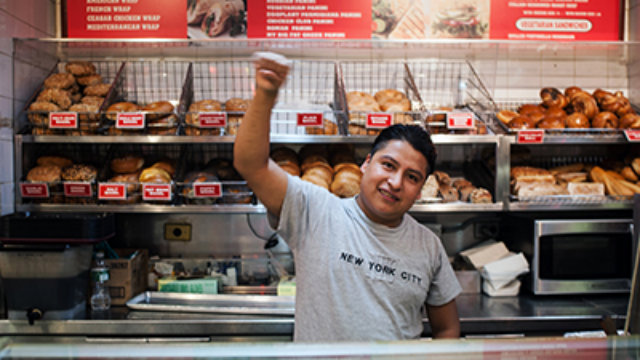
For New Yorkers, the name Hot and Crusty is synonymous with bagels: the 24-hour bakery and deli has locations dotting the island of Manhattan. But after watching The Hand That Feeds, it’s also hard not to associate Hot and Crusty with something far more unsavory: exploitative labor practices.
The film centers on a group of undocumented immigrants working at the 63rd Street Hot and Crusty outpost. No one would call low-wage work glamorous, but the film brings to light many of the daily indignities that these workers face. They are paid less than minimum wage, denied overtime and sick days, and toil in unsafe conditions under an abusive manager. But being undocumented doesn’t mean you can’t take collective action. With the help of several community organizers and the Occupy Wall Street movement, the workers set out to unionize and demand fair pay and benefits from Hot and Crusty.
The Hand That Feeds is unquestionably a classic David and Goliath tale, and one that actually has a few unexpected twists along the way. We see little of the store owners, who decline to be interviewed for the film. We do, however, get a much closer look at the lives of the Hot and Crusty workers. It is a deeply humanizing look at the low-wage workers in the back of the house—the ones we rarely see as customers. We hear sandwich maker Mahoma talking about crossing the border into the U.S. and the years dishwasher Margarito has spent apart from his family so he can earn enough money to send his daughter to college. By the end, it’s hard not to feel humbled by their perseverance and invested in their fight.
In an country where the power of organized labor has been crippled over the last 30 years, the Hot and Crusty workers’ story is nothing short of remarkable. The film also makes a nod to its broader political and economic context: rising income inequality, calls to raise the minimum wage, and recent walk-outs staged by fast food workers. Yet for all it’s cheerleading, it’s hard to walk away feeling like organized labor has solved all of the Hot and Crusty workers’ problems—they are, after all, still minimum wage workers trying to get by in the one of the most expensive cities in America. But I suppose that’s the hallmark of any good documentary—to leave the viewer wanting to take action. — Alicia Mazzara
The Hand That Feeds screens Friday, June 20 at 4:45 p.m. at the AFI Silver Theater and Saturday, June 21 at 3:45 p.m. at the Goethe-Institut. Tickets and info here.
 Via AFI Docs.
1971
Directed by Johanna Hamilton. 80 minutes.
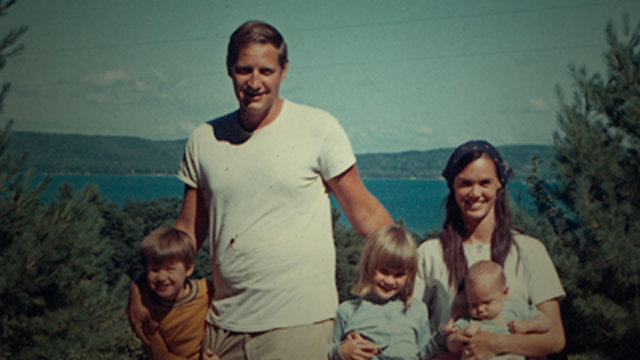
“Before the Pentagon Papers and WikiLeaks, before Edward Snowden’s NSA revelations, there was Media, Pennsylvania,” 1971 begins. The documentary, about the regional FBI office break-in that took place that year, is a must-see for anyone who: 1) is concerned about government surveillance activities; 2) is as obsessed with the 1960s and ’70s as I am; or 3) appreciates a good story.
A mix of original footage, modern-day interviews, and dramatic reenactments are used incredibly well to share the motives and methodology behind the crime. A small group of professors and twenty-somethings were fed up with the war in Vietnam and the police’s treatment of protesters, and believed the FBI was engaged in “immoral, if not illegal” activity. As one participant recalled, “the factual story about the history of our involvement [in Vietnam] was just appalling…I was angry that our country would do something like that, I was angry that they would lie about it, I was really angry that they would try to send me over there.” After student protesters were killed by police at Kent State and Jackson State Universities, he told himself “I have to do something about these bastards. I was done talking about it at that point…time to be confrontational.”
Plenty of violent confrontation was taking place by activist groups, but this particular group (the “Citizens’ Commission To Investigate The FBI”) sought another approach — to do “nonviolent damage to the War Machine.” Records only existed on paper at the time, so “destroying it was a major disruption,” another group member said. This is what prompted the Citizens’ Commission to gain entry to the local FBI office and take all of its files.
Specific details on the FBI’s actions under director J. Edgar Hoover were uncovered, including their infiltrations of college campuses, efforts to “enhance paranoia”, anonymous threats sent to Martin Luther King, Jr., and more. The Citizens’ Commission then delivered photocopied documents to all the major news outlets. Those who decided to report the information blew the lid on what had been a revered agency, which led to the first-ever Congressional investigation of U.S. intelligence programs.
1971 succeeds in adding important context to the country’s ongoing intelligence conundrum. The idealist attitude at the time, toward both government surveillance and citizen empowerment, is worth remembering as we navigate challenges today. — Nicole Dubowitz
1971 screens Thursday, June 19 at 1:30 p.m. at the National Portrait Gallery and Saturday, June 21 at 11:15 a.m. at the AFI Silver Theater. Tickets and info here.
 Via AFI Docs.
Bronx Obama
Directed by Ryan Murdock. 90 minutes.
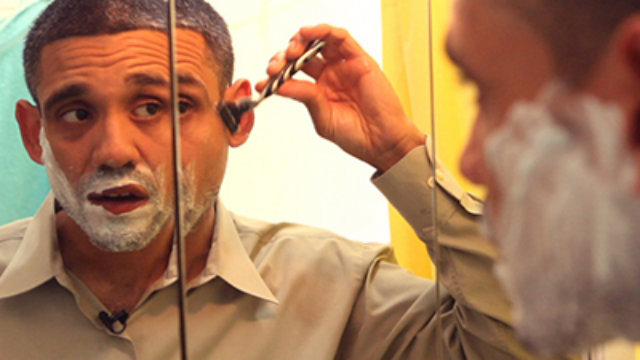
Louis Ortiz had a steady job at a phone company in New York, but was laid off in 2007. During the 2008 presidential primaries, his friends joked that he looked like one of the popular Democratic candidates, Barack Obama — so much that they suggested he be an impersonator. Ortiz didn’t see the resemblance, but after finally being convinced to shave his goatee, he did a double-take at his reflection.
He bought his first suit and went out on election night, where he was cheered on by passersby. Now unemployed for a year, Ortiz decided to give being a professional look-a-like a real shot. Bronx Obama follows Ortiz through his newfound career, which takes him out of the Bronx for the first time in his life. He does commercials in Asia, meets the Dalai Lama, and joins a politico impersonator group that tours nationally before the 2012 election.
It soon becomes clear that looking like Obama is not enough to make a living. Ortiz must also be an actor (and lose his strong Bronx accent), a comedian, and at times, a figurative punching bag. When the President’s approval ratings fall, Ortiz has to change his shtick and prepare for jeers. He notes that people would never say certain derogatory remarks to Obama himself, but they have no problem directing them to Ortiz.
The documentary shares Ortiz’s experience and shines some light on his fellow impersonators’ lives and changing careers, such as “Bill Clinton” (“the gift who keeps on giving,” says his impersonator), “Mitt Romney,” and others. All the while, Ortiz struggles to remain close to his teenage daughter, who, by now, has spent several formative years with her dad on the road.
Bronx Obama is thoughtful and well-done, giving insight into a line of work most people never, or aren’t able to, consider for themselves. But as Ortiz says, “if you woke up one day, and looked like the most powerful person in the world … wouldn’t you do what I’m doing?” It’s not always clear to see how a president affects people’s wellbeing, but Obama certainly shapes Ortiz’s in a remarkable way. — Nicole Dubowitz
Bronx Obama screens Saturday, June 21 at 11:00 a.m at the National Portrait Gallery and Sunday, June 22 at 3:30 p.m. at the AFI Silver Theater. Tickets and info here.
 Actress.
Actress
Directed by Robert Greene. 87 minutes.
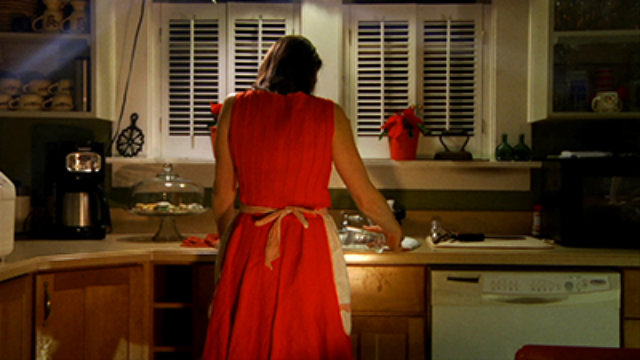
Brandy Burre is an actress. Well, she was an actress (most notably, Theresa D’Agostino on The Wire). Now, she’s a stay-at-home mom and she hates it. She’s ready to break free of the responsibilities and burdens of motherhood and get back on the stage, the screen, anywhere but where she is.
Being an actress is the core of Burre’s identity, and she delivers her lines in this documentary as if she was cast for the role. When she discusses her relationship with her partner, Tim, a single tear rolls down her cheek. Driving down the road, reflecting on the current state of her life, she takes a moment to stare off into the distance. Sincere moments, or small performances?
Director Robert Greene creates a melancholy atmosphere, with crooning background music and shots of dreary weather, meshing with Burre’s current state of mind. He includes her heart-felt soliloquies, but also scenes that contradict her words. She loves her children—they’re her world, she tells everyone she meets—but Greene catches her cringing when they try to interact with her. In Actress, it’s the familiar struggle of how we see ourselves, and how we really are; the lives we’re living, and what we long to be. — Lis Grant
Actress screens Friday, June 20 at 9:15 p.m. at the AFI Silver Theater and Sunday, June 22 at 6:15 p.m. at the Goethe-Institut. Tickets and info here.
 Via AFI Docs.
An Honest Liar
Directed by Justin Weinstein and Tyler Measom. 92 minutes.
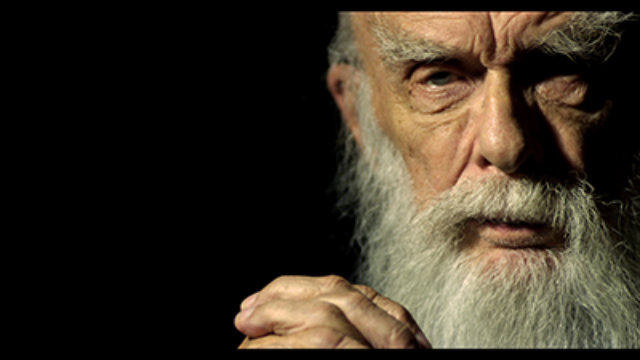
The world of professional magic isn’t one that necessarily demands to be taken seriously. And yet, An Honest Liar—a documentary about the fantastical career of the Amazing Randi—is an engrossing exploration of truth and redemption, showmanship and deception. Born James Randi, his childhood is the stuff of show business legend: born into an indifferent family—Randi claims his father spoke to him directly just two times—he left his native Toronto and joined a traveling carnival performing tricks (er, illusions) at the age of 17. Initially captivated by the seductive power of the business, Randi began his storied career by using his vaudevillian talent and charisma to prey on the public’s vulnerabilities. Following a quick change of heart, he used his understanding of magic to expose charlatans whose psychic powers fleeced unsuspecting people of their money. His public spats with two of his prime targets—illusionist Uri Geller and televangelist Peter Popoff—comprise much of An Honest Liar, both instances illustrating Randi’s single-minded desire to uncover fraud, even when it meant constructing falsities in the process.
While the film leads up to a personal revelation that finds Randi in the unenviable
position of being exposed himself, the subsequent bombshell serves to humanize a
man consumed by hardnosed rationality. An Honest Liar is a fascinating account of a
showman whose dual passion for transparency and deception helped him construct a
lasting legacy that continues to endure. — Matt Siblo
An Honest Liar screens Friday, June 20 at 4:30 p.m. at the Goethe-Institut and Saturday, June 21 at 9:30 p.m. at the AFI Silver Theater. Tickets and info here.
 Via AFI Docs.
Heaven Adores You
Directed by Nickolas Rossi. 104 minutes.
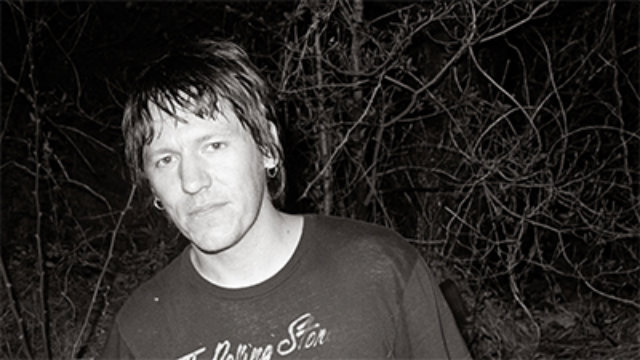
More than ten years after his death, the music of Elliott Smith still aches with a sense
of loss and tragedy. Nickolas Rossi’s Heaven Adores You—the first documentary to garner the blessing of Smith’s estate—attempts to celebrate the life beyond the pain that’s normally associated with the singer/songwriter. It’s a challenging task, and one the film only partially achieves.
Heaven Adores You received early attention for its inclusion of unheard recordings, many from Smith’s childhood; a somber ode to the isolation
within one’s bedroom is exactly what one might expect of his early compositions. Little details—like Smith’s affiliation with a Portland-based Devo cover band—the Spud Boys— hint at the singer’s lighter side. But its intentional side-stepping of Smith’s depression and addiction—referenced indirectly, if at all—and complete omission of the singer’s former girlfriend Jennifer Chiba (a by-product of his family’s participation since the two parties’ relationship remains fractured) make this an imperfect tale told incompletely, one that seems overly concerned with mood and atmosphere at the expense of relevant information.
Much like the posthumous best-of release, New Moon, Heaven Adores You serves as an adequate introduction to a body of work that demands attention. For those familiar with the chronology of Smith’s all-too-brief career, a more nuanced portrait of his life and music can be found elsewhere. Perhaps a singular account of an artist as complicated as Smith is unrealistic, one whose life still raises as many questions as his heartbreaking songs provide solace. — Matt Siblo
Heaven Adores You screens Friday, June 20 at 9:30 p.m. at the AFI Silver Theater and Saturday, June 21 at 6:15 p.m. at the Goethe-Institut. Tickets and info here.
 Via AFI Docs.
Fast Ice: Rescue From Antarctica
Directed by Laurence Topham. 20 minutes (screens as part of the “Face The Music” shorts program).
Fast Ice: Rescue From Antarctica tells the story of an Antarctic expedition gone wrong. On Christmas Eve in 2013, a ship carrying scientists, a handful of tourists, and crew was navigating sheets of ice in the Antarctic—past groups of adorable penguins and relaxing seals—when their ship became wedged in the ice, surrounded on all sides by dangerously shifting icebergs. After two unsuccessful boat rescues, the group was finally rescued by helicopter sent by the Australian government. All told, the rescue cost is estimated at one million pounds. While the landscapes are beautiful and the tale is potentially harrowing, this short film fails to find tension, but does succeed in being an interesting look at how things can so quickly and easily go wrong in a foreboding land. — Lynne Venart
Fast Ice: Rescue From Antartica screens Thursday, June 19 at 1:15 p.m. at the AFI Silver Theater and Sunday, June 22 at 11 a.m. at the Goethe-Institut. Tickets and info here.
 Via AFI Docs.
Art and Craft
Directed by Sam Cullman, Jennifer Grausman, and co-directed by Mark Becker. 89 minutes.
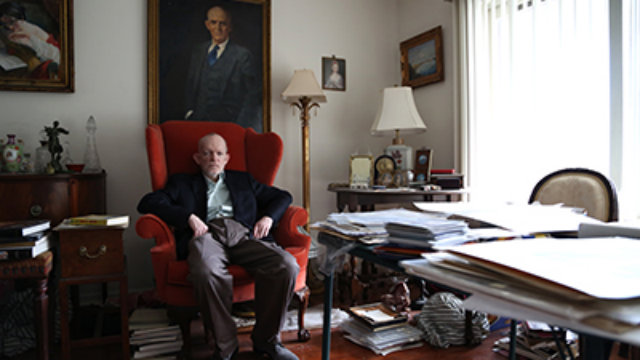
Art and Craft isn’t just a documentary about art forgery; it is a truly fascinating narrative with colorful characters and intrigue. Mark Landis is schizophrenic, having spent over a year in a mental institution at eighteen. He lives alone in his deceased mother’s apartment in a small town in Mississippi, but, he’s the most prolific art forger in the United States.
As the film shows, he always donated the work, and it’s up to museums to determine their authenticity, but questions still linger: Did he break any laws? Why did he do it? Landis claims, “it was my calling … I always knew they’d find out sooner or later.” And they did. The registrar at the Oklahoma City Museum of Art discovered the forgery and posted his findings on a popular registrar’s list serve, receiving tons of messages from museums around the country in return. Landis had duped 46 museums in 20 states, including the Philadelphia Museum of Art, the National Portrait Gallery, and the School of the Art Institute of Chicago.
Art and Craft follows the fascinating story about the quirky Landis, the registrar who had become obsessed with outing him, and other duped museum staff. One of the duped was so intrigued that he notes, “there’s kind of a performance art quality to the act,” and later created the first honest exhibition of Landis’ work. — Lynne Venart
Art and Craft screens Friday, June 20 at 9 p.m. at the Naval Heritage Theater and Sunday, June 22 at 1 p.m. at the AFI Silver Theater. Tickets and info here.
 Soft Vengeance.
Soft Vengeance: Albie Sachs and the New South Africa
Directed by Abby Ginzberg. 84 minutes.
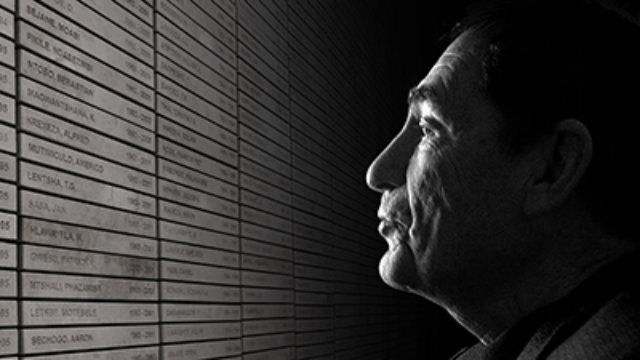
Soft Vengeance documents the South African anti-Apartheid youth movement, of which Nelson Mandela was the first to be arrested. The film discuss the overall history of the movement, but focuses on, and celebrates, the life of Albie Sachs—a young Jewish lawyer who was one of the first white South Africans to fight and challenge the system. Though many of his colleagues had been killed or severely tortured in South Africa, he survived two stints in jail, including 168 days in solitary without ever being charged. For his safety, he fled the country and later joined a group of intellectuals in newly independent Mozambique, where he and his colleagues were still under violent attack. Albie survived an attempted assassination in Mozambique but was badly injured and required extensive rehabilitation—many of his colleagues were not so lucky to escape death.
Despite the group facing such violence, they stood for peace and human rights for all South Africans. As the group’s lawyer, Albie drafted a prisoner’s Bill of Rights, guaranteeing that they would not torture, kill or hurt any of their own prisoners. Albie Sachs was officially recognized once Mandela was freed and elected President, when he appointed Albie as one of the first justices of the Constitutional Court.
In focusing on one key member of the anti-Apartheid movement, Soft Vengeance succeeds in telling the larger tale of the challenges and dangers the group faced, as well as their resolve to keep fighting for what is right and fair for all South Africans. — Lynne Venart
Screens Friday, June 20 at 1:30 p.m. at the AFI Silver Theater. Tickets and info here.
 Via AFI Docs.
Font Men
Directed by Dress Code. 10 minutes (screens before Art and Craft).
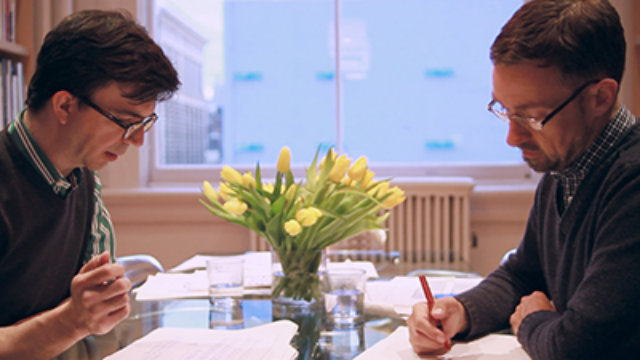
Fonts are everywhere: they can make something seem serious or fun, official or friendly, fancy or cheap. Font Men is the brief introduction to Jonathan Hoefler and Tobias Frere-Jones, two of the most famous current typeface designers who created, among other things, fonts used in the Obama Presidential campaign. Using clever animations and editing, this 10-minute film illustrates the decisions to be made around creating a new typeface while briefly talking about their collaboration.
The film was created for a professional association of designers, AIGA, to celebrate a 2013 award they presented to the two, and as such it seems more like a trailer than a film. It hints at the pair being opponents who eventually teamed up, and it briefly shows how their fonts are used, but it ultimately leaves us wanting to know more. Considering when it was made, it doesn’t mention the 2014 professional split and the $20 million lawsuit between the two. I hope the filmmakers, Dress Code, can make a feature-length film about the topic in the future as it seems ripe and would certainly be fascinating. — Andrew Wiseman
Font Men screens Friday, June 20 at 9 p.m. at the Naval Heritage Theater and Sunday, June 22 at 1 p.m. at the AFI Silver Theater. Tickets and info here.
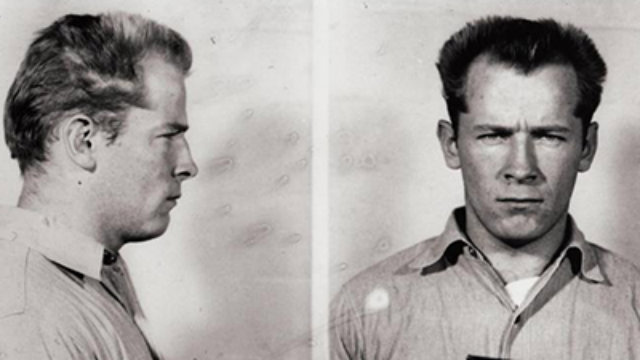 Whitey: United States Of America V. James J. Bulger.
Whitey: United States of America v. James J. Bulger
Directed by Joe Berlinger. 107 minutes.
James “Whitey” Bulger is a famous crime boss from Boston with an unusual background: his brother was the president of the Massachusetts State Senate. For decades, Whitey dominated the underworld of South Boston, allegedly responsible for killings, extortion, drugs and more. He disappeared in 1994, only to be captured in 2012 and put on trial the next year. His life, though not his capture and trial, was the inspiration for Martin Scorcese’s Oscar-winning 2006 film The Departed.
While named after him, Whitey: United States of America v. James J. Bulger focuses more on the families of victims and the role the FBI played in his crime spree than of the trial itself, which was something of a foregone conclusion. Many—including journalists, fellow criminals, victims’ family members, law enforcement, and his defense team—argue that the FBI undertook a massive conspiracy to protect Bulger, alleging, among other things, that the government claimed he was an informant to allow them to arrest Italian mafia figures and that Bulger was paying off numerous law enforcement officials to protect himself. Various people cite numerous pieces of potential evidence, such as his ability to live free despite many crimes, potential informants on Bulger’s crimes getting killed, and his disappearance right before an FBI sting to arrest him.
Like many crimes and their subsequent trials, the evidence and motivation for and against the film’s central conspiracy is murky—with unreliable criminals out to save themselves and lawyers arguing to protect their clients. The strange tale includes prosecutions of government officials and Bulger’s victims’ family members hoping he’ll testify to acts by the government that they believe led to their loved ones’ death.
At a little over two hours, the film seems stretched and lags at times, though there’s a lot of information, people, claims, and counter-claims to pad the run time. It’s told mostly by victims’ families, attorneys for both sides, and former FBI investigators, as the FBI refused to participate or comment. A few scenes—like ones of Bulger’s lawyers speaking with him on the phone—are a little stilted, but the emotion (or chilling lack thereof among some of his accomplices) makes for a powerful film. The end is hardly a surprise, as Bulger is currently in prison, but the path that led him there makes for a wholly fascinating story. — Andrew Wiseman
Whitey: United States of America v. James J. Bulger screens Thursday, June 19 at 6:15 p.m. at the Goethe-Institut and Friday, June 20 at 3:45 p.m. at the AFI Silver Theater. Tickets and info here.
 Via AFI Docs.
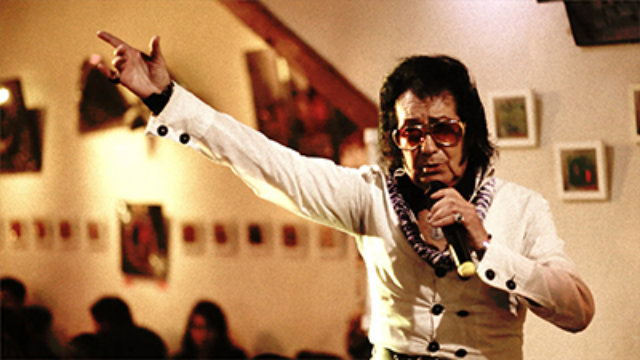
The Chilean Elvis
Directed by Marcelo Kiwi Bieger. 11 minutes (screens as part of the “Gone Hollywood” shorts program)
“Today’s bands all sound the same. They all wear dirty, smelly t-shirts and they give you an unclean feeling: Dirty!” Director Marcelo Kiwi gives us ten minutes in the life of 77-year old Marcelo Rossi, who walks the winding streets of Valparaiso, Chile, plying his trade as an Elvis impersonator. Kiki alternates color performance footage with black-and-white interviews in which Rossi talks about the Rolling Stones (he does a dismissive Jagger impersonation), touring Chile with Sandro (the Argentinian Elvis) and the sideburns he claims he’s had all his life. “The Chilean Elvis” may not be able to sustain a feature-length documentary, but ten minutes with Rossi will leave you asking for more, and isn’t that what showbiz is about? — Pat Padua
The Chilean Elvis screens Thursday, June 19 at 1:30 p.m. at the Goethe-Institut and Friday, June 20 at 11:15 a.m. at the AFI Silver Theater. Tickets and info here.
 Via AFI Docs.
Cherry Pop: The Story of the World’s Fanciest Cat
Directed by Kareem Tabsch. 12 minutes (screens as part of the “Gone Hollywood” shorts program).
Director Kareem Tabsch’s 10-minute film about a Persian cat named Cherry Pop and the millionaire Florida couple who made her life so opulent will naturally appeal to the
life.
While appropriately silly, I found myself a bit bored, even by footage of a luxuriously groomed cat being led on a red carpet to a yacht for her birthday party. The price we pay for having an unlimited supply of cat videos? I won’t spoil the end for you (here’s a hint:
Cherry Pop was born in 1981, so…) but the final two minutes provide a nice emotional payoff, thanks to the man behind the world’s fanciest cat. — Sarah Anne Hughes
Cherry Pop: The Story of the World’s Fanciest Cat screens Thursday, June 19 at 1:30 p.m. at the Goethe-Institut and Friday, June 20 at 11:15 a.m. at the AFI Silver Theater. Tickets and info