Martin Austermuhle
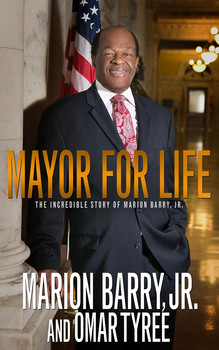 Courtesy Strebor Books.
Totally self-congratulatory back-patting? Check. (“The people of the city were clamoring for me to return.”) Airing of the grievances against enemies both real and imagined? Check. (“So when the FBI set me up at the Vista, they were really trying to kill me.”) Somewhat salacious details that you maybe didn’t need to know? Check. (“The cocaine was a powerful stimulant that went straight to my penis.”) Selective memory syndrome? Check, check, check.
Yeah, Marion Barry’s new autobiography, Mayor for Life: The Incredible Story of Marion Barry, Jr., has all the makings of your boilerplate political memoir. (Well, to be fair, not many political memoirs have vivid descriptions of the effect of cocaine on one’s penis.) But unlike many a memoir out there (Hi, Hillary!), Barry didn’t put pen to paper to establish his credentials for a shot at higher office. If anything, Barry is in the twilight of his political career, and with his health being what it is, decided that now is as good a time as any to define his legacy.
That’s what makes his autobiography, co-written by novelist Omar Tyree, a missed opportunity. In writing the book, Barry had nothing to lose. He likely could have changed more opinions about his own life and legacy had he been both honest and introspective. Instead, he’s largely combative, defending his terms in office while maligning just about anyone who would seek to find fault with them.
And that’s too bad. Love him, hate him or just plain sick of him, Barry’s a fascinating figure who has left his imprint — both good and bad — on D.C. Born to a family of Mississippi sharecroppers, Barry quit graduate studies in chemistry to join the civil rights struggle, a fight that eventually brought him to D.C. While here, he put his organizing talents to work by organizing a bus boycott, working to get young blacks jobs and eventually running for office as a member of the Board of Education, D.C. Councilmember and eventually mayor. His first terms were progressive and empowering; he started the summer jobs program that continues to this day, and fought a power structure — both local and federal — that largely saw the city a congressional fiefdom.
But like any long-serving politician, Barry’s later terms weren’t nearly as good as the first, and he succumbed to a variety of personal distractions: alcohol, drugs and women. Those weaknesses — which he does admit to, albeit in passing — came to a head at the Vista Hotel in 1990, where he was arrested for allegedly smoking crack. He was sentenced to six months in prison, served them, returned to D.C., and mounted a political comeback. His last term coincided with the virtual collapse of the city’s finances and the imposition of a congressionally mandated Control Board, which left Barry a mayor in name alone. He eventually opted against a fifth run, but returned to the D.C. Council, where he remains to date.
Barry writes early on that he doesn’t want to be defined by what happened at the Vista, and that’s a fair request. There’s a lot more to Barry, plenty of it good. He even proves as much in the book’s final chapter, where he lays out his vision for what the next civil rights movement should be: the fight for financial literacy and economic opportunities for the city’s black residents. For a short moment, I felt like this is the Barry I want to know exists: a man who has learned from a long life full of successes and setbacks.
But in pretending that the Vista Hotel bust was a mere hiccup in an otherwise brilliant political career ignores his other failings: that associates were linked to corruption, that he didn’t pay his taxes, that he took money from D.C. contractors and was censured for it, and that he steered a lucrative contract to a girlfriend. Even worse, it further fuels Barry’s never-ending belief that he’s indispensable to D.C., that we’d all have been far worse off had he not run again after his arrest.
Had Barry taken the 324 pages of his memoir as an opportunity to confess sins instead of settling scores, he could have produced an autobiography as revolutionary as the leader he once was. But that’s not the Barry we’ve all grown to know, and which Jonetta Rose Barras so perfectly summarized in 1998’s The Last of the Black Emperors: The Hollow Comeback of Marion Barry in the new Age of Black Leaders:
Politics at its finest is the art of packaging and spinning. A skillful politician repackages himself every two or four years, inducing selective amnesia in the electorate. The public is artfully manipulated into looking out the window while the politician quietly frames selected snapshots, blocking views of his career’s entire landscape.
That’s exactly what Barry’s memoir is: his last repackaging, the final attempt to frame those selected snapshots while blocking the view of his entire career. And like many other memoirs, it will merely reinforce those who already support him while changing none of the opinions of those who don’t.