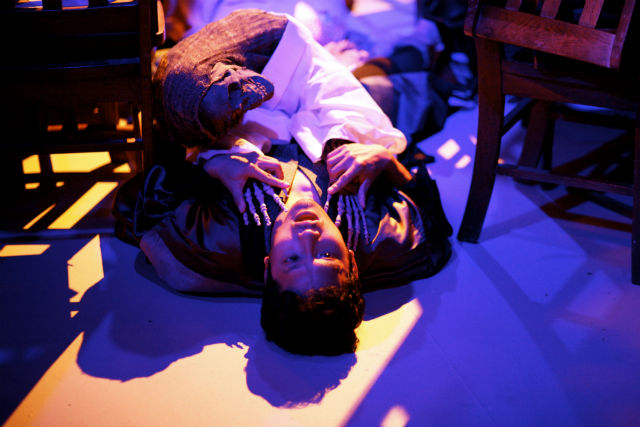
 Jacob Yeh hunted by the skeleton of his lover in “Kwaidan.” Photo by Evy Mages.
By DCist contributor Riley Croghan
This weekend marks your last chance to be spirited away to a haunted Meiji era Japan by the talented guides of Spooky Action Theater Company’s Kwaidan. Directed by Izumi Ashizawa, the production takes the form of a haunted tour through the narrow passageways and stairwells of the Universalist National Memorial Church, Spooky Action’s usual venue. Though the audience will encounter graveyards, mountains of skulls, and the constant sense of ghosts lurking unseen just beyond the next turn, this is not your standard American haunted house, with ghouls waiting in the shadows to jump out and startle the unwary. Instead, this adaptation of 15 ghost stories chronicled in a book by Lafcidio Hearn (reincarnated convincingly here by David Gaines to serve as the primary guide for the audience as they travel from scene to scene) unfolds in a loosely confederated series of ghostly vignettes.
The production takes pains from the start to fill its audience with a sense of being transported to somewhere else; the play has technically already started by the time guests queue up for will call, which is handled by a customs registration agent who takes names and stamps passports at the door. This marks the audience’s arrival in Japan, in the spirit world and, when the play is at its most spectacular, in the world of dreams.
Kwaidan’s descent into the spirit world is deceptively slow. An early scene unfolds as four women in the center of a normal looking living room (save for the furniture draped in sheets) pour tea and swap ghost stories as they unwind from a hard day’s work. But as the play progresses, the audience encounters faceless ghouls and monstrously huge spirits that feed upon the dead. The finale, involving a stylized, spooky wedding-like procession down the center aisle of the church, is something purely derived from the world of dreams.
Kwaidan features a large ensemble of actors who each take on several roles. They often emerge from hidden entrances when you would least expect to see them, having encountered them in another costume in another location in the church only moments before, which is one of the most deliciously disorienting features of the play. With such a large cast playing such a range of characters, it’s difficult to commend any one performer, although Philip Chang displays an impressive blend of acting and improv audience interactions throughout. Three kimono-clad actresses (MiRan Powell, Gusela White and Jenna Zhu) serve primarily as guides, and though they aren’t involved in any of the ghost stories per se, their silent presence as they shepherd the audience from scene to scene is an integral part of the ethereal feeling of the night.
While the sprawling nature of the play is one of its greatest charms, it is also one of Kwaidan’s biggest flaws. Ashizawa’s direction positions the audience to get the most out of a forced perspective to pull off some canny illusions, but it’s entirely possible to miss vital parts of some scenes when half the audience is stranded, for example, at the bottom of a stairwell while a scene is unfolding one and a half flights above. Overall, though, the audience is shuffled so frequently that everyone will experience some scenes in the best seats in the house, and some from the nosebleed seats, as it were.
For those who can muster the appropriate sense of adventure, this weekend will be your last chance to explore a play unlike any others in the D.C. area. A later showing is strongly recommended, as the heat will have dissipated (much of the church is not air conditioned). After all, a good ghost story should always be told in the dark.
KWAIDAN by Spooky Action Theater plays through June 22nd at 1810 16th Street NW. Tickets are available here.