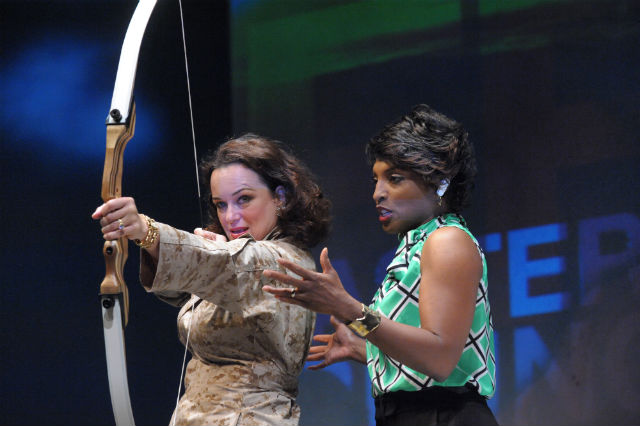
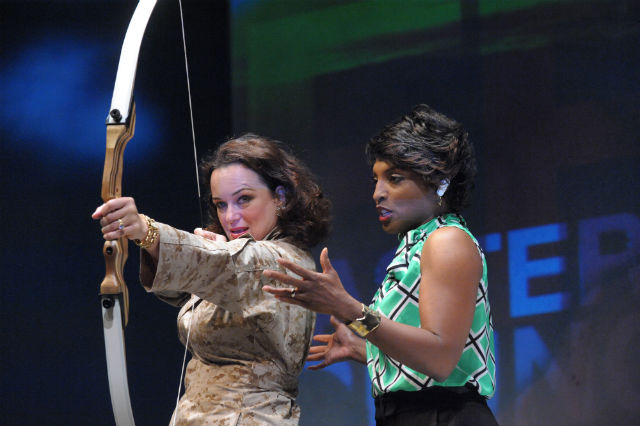
 Emily Townley and Dawn Ursula in “Totalitarians.” Photo by Stan Barouh.
By DCist contributor Riley Croghan
Forget red versus blue, or donkey versus elephant. For those who are sufficiently disillusioned by Washington politics, the only important distinction between politicians is stupid versus evil. Kudos, then, to Woolly Mammoth Theatre Company for having the courage to reach across the aisle and combine the two into a maybe-evil, definitely-stupid candidate from hell in Peter Sinn Nachtrieb’s hilarious political satire, The Totalitarians.
Penelope Easter, the cotton-headed candidate in question, is portrayed by a relentlessly pitch-perfect Emily Townley as a folksy Bachman-Palin amalgam. Penny is a former roller derby queen devoid of any political motivation beyond a desire to be elected. She has a thirst for power rivaled only by Frank Underwood, though she doesn’t have the brains to devise a scheme for power that doesn’t involve a balloon drop.
Penny’s only asset is ostensibly her perfect, beauty-pageant hair (“as inspiring as Olympic diving”), which isn’t quite enough to make up for the fact that she sabotages her campaign with accidental, innuendo-heavy Bushisms every time she speaks without a teleprompter (“Sometimes things just come wrong in my mouth.”)
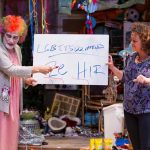
Luckily, Penny has plenty of help along the way, a good deal of it from Woolly’s design team. Costumer Frank Labovitz employs an array of politician-Barbie pantsuits (classic red blazer, hunting camo, military dictator) that feel like only a slight exaggeration of something you’d find on Palin. And set designer Misha Kachman, in a move entirely characteristic of Woolly, has transformed the small stage into something of epic proportions, with canny tricks including set pieces that work for multiple locations with a swivel (see: an Ikea bed with a Welcome to Nebraska sign as its headboard), and a two-story screen that serves as a canvas for grainy terrorist YouTube screeds, outdoor scenes, or a huge grid of larger-than-life Pennys beaming out at the audience.
A similar magic trick in scale is performed by the cast. Under Robert O’Hara’s direction, a cast of only four (almost never all on stage at the same time) is leveraged into vividly realized — and intentionally dull — Nebraska. And while the play is largely concerned with Penny’s unlikely rise to power, there’s a reason Nachtrieb titled his play “totalitarians” plural; each of the four characters is determined to achieve pure control over their own small slice of life in Nebraska.
Young YouTube-revolutionary Ben (a perfectly twitchy, wide-eyed Nicholas Loumos) is driven by the theory that Nebraska is run by a shadowy Organization of Four who control everything in the state: “They want more power, and so they’ve devised a simple, devastating plan to make that happen.” While Ben may or may not be right about this particular conspiracy in state politics, in terms of the play he’s absolutely correct. The four delightfully, wickedly selfish characters are each determined to extract what they want out of life by manipulating and hurting the people they most need to rely on—helped immensely by actors who highlight the humanity in each character and make them surprisingly sympathetic as they struggle for absolute control.
Penelope’s totalitarian thirst accounts for the biggest stakes in the play; her inept lack of direction leaves her to rely on the powerful prose of her speechwriter Francine Jefferson. Portrayed cleverly here as reluctantly ruthless by Dawn Ursula, Francine is tasked to come up with a slogan to incite Penny’s Nebraskan audience into patriotic fervor — without actually saying anything of substance at all. Francine settles on a “vaguely feasible” but empty slogan, Freedom from Fear—or “ffff, fffff, fffffff” for short. Francine displays some initial misgivings but very quickly decides to sell her soul and support a woman she hates in exchange for a chance at fame. Francine needs an empty vessel to broadcast her words just as desperately as Penelope needs Francine to fill her teleprompter. The two exist in a catty love-hate relationship that tips further into the “love” side of things as the play progresses, and Francine eschews the emotional (but not politically useful) support of her physician husband Jeffrey (Sean Meehan).
In Meehan’s hands, Jeffrey is a perfectly put-upon and amusingly pathetic Cyril Figgis to Ursula’s Lana Kane. Jeffrey wants a child more than anything. Though his pitiable begging to Francine for a child (and, more generally, for sex, which she has ignored for months) might be a less obvious power-play toward achieving his goals, he will reluctantly claim that he only appears to let his wife walk all over him as “a management strategy.” As his advances continue to be spurned, he finds himself drawn in by the joie de vivre of his patient, the anarchist Ben, who is manically cheery considering that his body is riddled with untreatable cancer.
These four separate power struggles come to a head in the surprisingly action-packed finale, which features even grander sets, costumes, and stakes. In sheer manic giddiness, the play abruptly departs from an otherwise almost-believable tale of lust for power in Nebraska. But perhaps The Totalitarians seems to exceed belief only because it’s premiering on a non-election year. Will the play feel more believable in hindsight by 2016? You betcha.
The Totalitarians runs at Wooly Mammoth Company through June 29th. Tickets are available here; $20 discount tickets are available to patrons 30 and under.