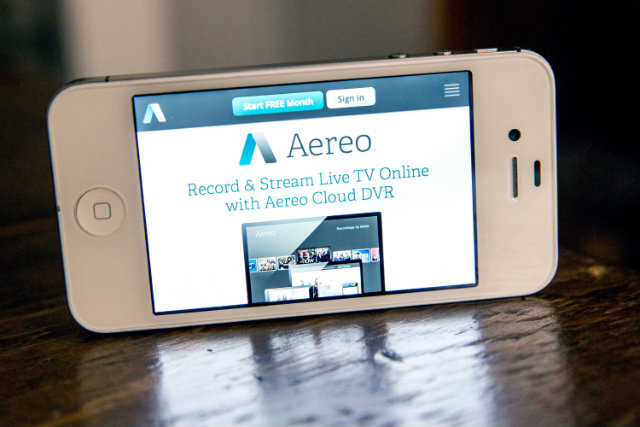
 Photo Illustration by Andrew Burton/Getty Images.
In a 6-3 ruling, the Supreme Court of the United States has ruled against Internet start-up Aereo, Inc., saying that it violates copyright laws by live-streaming broadcast TV programs over the web to customers.
The historic ruling is one of six major cases—involving religion, abortion, cell phone privacy laws, Presidential powers, labor laws, and broadcast TV laws—that the Supreme court is issuing over the next several days. Aereo, an Internet startup that allows its customers to watch TV online live, first launched in New York City in February of 2012 before expanding to nearly two dozen other markets in January of this year. Shortly after Aereo launched their service, The American Broadcasting Companies, Inc. filed a lawsuit against Aereo, claiming that the company was illegally retransmitting their programs and content without paying.
The preliminary injunction filed by the broadcasters was denied by a Federal Court judge, leading them to file an appeal with the Second Circuit Court of Appeals, which upheld the Federal Court’s initial decision. But the broadcasters took their appeal to the Supreme Court, who found that Aereo’s business model violates copyright laws by not paying broadcasters for “retransmission” of their content.
Barry Diller, one of Aereo’s main backers, told CNBC after the ruling came out that, after a long fight, the Supreme Court’s decision is a major blow for them. “We did try, but now it’s over,” he said. He added that “it’s not a big [financial] loss for us, but I do believe blocking this technology is a big loss for consumers, and beyond that I only salute Chet Kanojia and his band of Aereo’lers for fighting the good fight.”
The three Supreme Court justices that dissented were Antonin Scalia, Clarence Thomas, and Samuel Alito. You can read the full Supreme Court opinion below:
Update: Here’s a statement from Aereo CEO and Founder Chet Kanojia:
“Today’s decision by the United States Supreme Court is a massive setback for the American consumer. We’ve said all along that we worked diligently to create a technology that complies with the law, but today’s decision clearly states that how the technology works does not matter. This sends a chilling message to the technology industry. It is troubling that the Court states in its decision that, ‘to the extent commercial actors or other interested entities may be concerned with the relationship between the development and use of such technologies and the Copyright Act, they are of course free to seek action from Congress.’ (Majority, page 17) That begs the question: Are we moving towards a permission-based system for technology innovation?
“Consumer access to free-to-air broadcast television is an essential part of our country’s fabric. Using an antenna to access free-to-air broadcast television is still meaningful for more than 60 million Americans across the United States. And when new technology enables consumers to use a smarter, easier to use antenna, consumers and the marketplace win. Free-to-air broadcast television should not be available only to those who can afford to pay for the cable or satellite bundle.”
“Justice Scalia’s dissent gets its right. He calls out the majority’s opinion as ‘built on the shakiest of foundations.’ (Dissent, page 7) Justice Scalia goes on to say that ‘The Court vows that its ruling will not affect cloud-storage providers and cable television systems, see ante, at 16-17, but it cannot deliver on that promise given the imprecision of its results-driven rule.’ (Dissent, page 11)”
“We are disappointed in the outcome, but our work is not done. We will continue to fight for our consumers and fight to create innovative technologies that have a meaningful and positive impact on our world.”