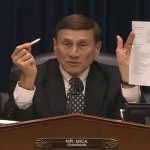
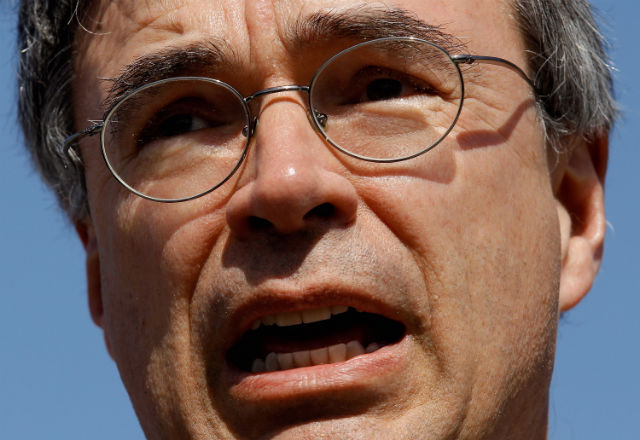
 Rep. Andy Harris (R-MD). (Photo by Chip Somodevilla/Getty Images)
Though the D.C. Council passed a bill to decriminalize small amounts of marijuana, which was later signed into law by Mayor Vince Gray, the future of relaxed pot laws in the District is still in jeopardy, thanks to a committee in the U.S. House of Representatives.
Earlier today, the House’s Appropriations Committee passed an amendment introduced by Maryland Rep. Andy Harris to block D.C.’s marijuana decriminalization law. The amendment passed in a 28 to 21 vote.
So what does this mean for the future of D.C.’s marijuana decriminalization law? Is it up in smoke, thanks to 27 Republicans and one Democrat? Is this the end for the Simple Possession of Small Amounts of Marijuana Decriminalization Act of 2013? Hardly.
Now that the amendment passed the House’s Appropriations Committee, it’ll be voted on by the entire House of Representatives. If that passes, it still has to pass a vote with the majority of the Senate, and then it has to be formally approved by President Obama. Only three times in the history of Home Rule has a D.C. bill been disapproved by a president.
But, even if that was to happen, there’s a chance that the House’s amendment could create de facto legalization of marijuana in D.C., according to one group. Yes, you read that right.
“Basically what would happen is, this amendment—the way it’s written—would not re-criminalize or rewrite the laws around criminalization of marijuana,” Dr. Malik Burnett, Policy Manager for the Drug Policy Alliance, says. “Police issuing tickets to people who they found to have marijuana on their person wouldn’t be able to do so, that would create a sort of de facto legalization.”
While the law is scheduled to take effect in D.C. on July 17th, it wouldn’t be until much later that the amendment would take effect, if it did happen to pass the House and Senate, and was signed by the President. So if it were to pass, and D.C. police officers who are writing tickets for the possession of small amounts of marijuana under the law are suddenly forced to stop doing that because of this amendment, then they wouldn’t be able to arrest for possession, because the amendment does not address the criminalization of marijuana—just the decriminalization of it. Thus it “would have practical effect of making marijuana possession essentially legal in the Nation’s Capital,” Burnett says.
Of course, this is something that, once Andy Harris figures out, he will almost certainly rewrite the language of the amendment to ensure doesn’t happen. Because if it did, well, irony (and no, not the Alanis Morrisette definition).
But it’s still a long shot that the amendment makes it past the House, Senate, and gets signed off by the President. Still, the whole amendment makes Harris and the House Republicans look bad, Burnett thinks, especially at a time when marijuana decriminalization laws are popping up all over the country, even in Harris’ own state.
“I think that the fact is that this act, as much as Rep. Andy Harris tries to shy away from it, it’s an attempt to politically grandstand around the issue of marijuana hear in the District of Columbia,” Burnett says. “It’s just an opportunity to make a statement of his personal views. Unfortunately, his personal views do not mesh well with his own constituents in Maryland, nor do they mesh with those of the residents of the District of Columbia.”