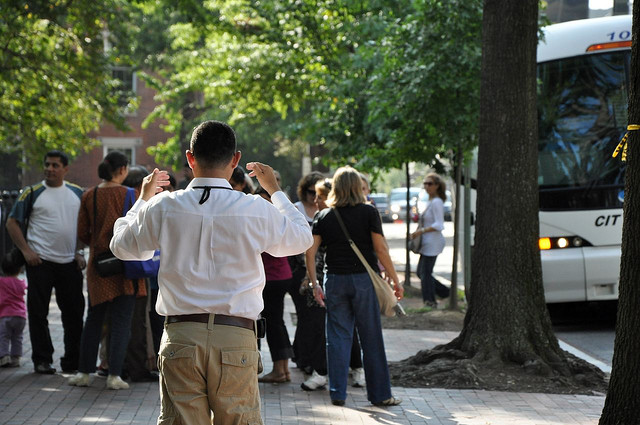
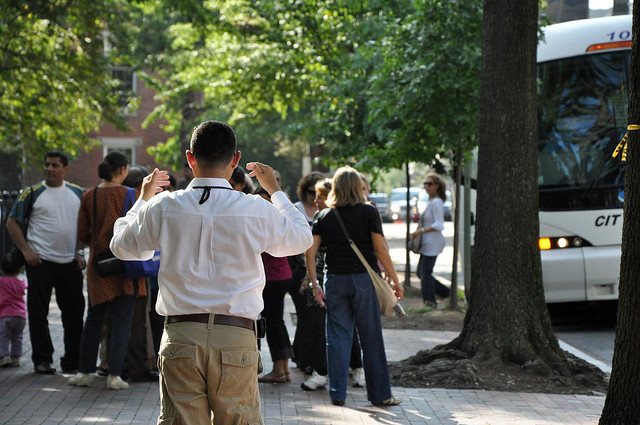
 Photo by Clarissa Stark.
Under D.C. regulations, it’s illegal for anyone operating under the guise of a “tour guide” to lead a paid tour without having passed a 100-question test and paid the city $200 for a license. However, a federal appeals court ruled today that those regulations, that the city has enforced for 110 years, are unconstitutional.
“In Washington, D.C., it is illegal to talk about points of interest or the history of the city while escorting or guiding a person who paid you to do so—that is, unless you pay the government $200 and pass a 100-question multiple-choice exam,” Judge Janice Rogers Brown wrote in her opinion. “Finding the record wholly devoid of evidence supporting the burdens the challenged regulations impose on Appellants’ speech, we reverse and remand,” it ultimately decided in a 3-0 vote.
The ruling stems from a lawsuit Bill Main and Tonia Edwards—a husband and wife team who give segway tours of the city through their business, Segs in the City—filed against D.C. in 2010, claiming that the tests potential tour guides are required to pass restricts what guides can tell customers and his thus a violation of the First Amendment.
After a District Court judge upheld the city’s regulations, “reasoning [that] the scheme placed only incidental burdens on speech that were no greater than necessary to further the District’s substantial interest in promoting the tourism industry,” Main and Edwards took their fight to the Court of Appeals, who ultimately ruled in their favor.
According to city regulations, the point of the exam is to ensure that tour guides do, in fact, know what they’re talking about, and aren’t con artists or charlatans out to swindle tourists out of money. But, in her opinion, Judge Brown wrote that there’s no evidence the multiple choice exam issued by the city is an effective method to protect tourists against phony tour guides. “The city has provided no convincing explanation as to why a more finely tailored regulatory scheme would not work,” she writes.
Additionally, Judge Brown also wrote that the the general exam doesn’t apply for those giving specialty tours, like ghost, food, or movie tours. “Even if we indulged the District’s apparently active imagination, the record is equally wanting of evidence the exam regulation actually furthers the District’s interest in preventing the stated harms,” she writes. “Also puzzling is the applicability of the exam requirement to specialty tour guides, such as those focused on ghost, food or movie tours. A general exam requirement is ill-suited to ensuring such specialty guides are well informed. And the existence and persistence of such varied themes highlights how tourism is as much about entertaining as
educating.”
You can read the full opinion here.