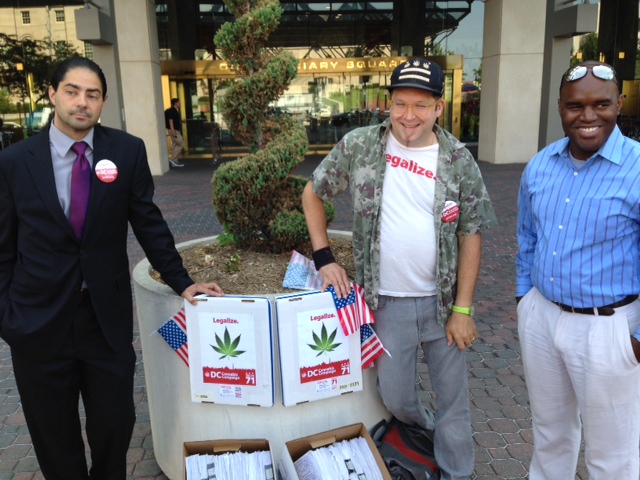
 L to R: D.C. Cannabis Campaign’s Nikolas Schiller, Adam Eidinger, and Dr. Malik Burnett outside the D.C. Board of Elections. Photo by Matt Cohen.
It’s been a long road, but the D.C. Cannabis Campaign says they’ve gathered enough signatures to get their marijuana legalization initiative on the November ballot.
Earlier today, Cannabis Campaign head Adam Eidinger, along with Drug Policy Alliance organizer Dr. Malik Burnett and several other volunteers presented more than 57,000 petition signatures to the D.C. Board of Elections. In order for the signatures to be counted as valid, at least 22,373 need to be from D.C. residents who are registered to vote in the District. Eidinger estimates that “at least 50 percent” of them are valid signatures, putting the group well over the minimum.
In a recent poll conducted by the Washington Post, about 63 percent of D.C. residents favor legalizing marijuana in the District. In addition to the Cannabis Campaign’s ballot initiative, Councilmember David Grosso (I-At Large) has introduced his own marijuana legalization legislation that incorporates a taxation and regulation element. The Cannabis Campaign’s ballot initiative only proposes legalizing two ounces or less of marijuana for personal use, as well as the home cultivation of up to three mature plants.
But despite the support from both D.C. voters and local politicians (in addition to Grosso’s support, both Councilmember Tommy Wells and Councilmember and mayoral candidate Muriel Bowser have signed their petition, among others), the legalization effort could be threatened by Congress. A few weeks ago, Maryland Rep. Andy Harris introduced an amendment to defund D.C.’s recent marijuana decriminalization law.
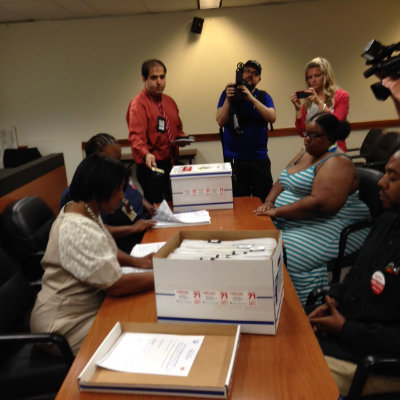 D.C. BOE begin counting the ballot signatures.
But Eidinger isn’t afraid to put up a fight against Harris and Congress, should they try and interfere with their ballot initiative. “I hope that the House Republicans will let Republicans vote their conscious when it comes to the floor, and they won’t be whipped into voting the party line,” he says.
In addition to the Cannabis Campaign’s legalization initiative (should it make it on the ballot), this November’s election will certainly be an interesting one for District voters: for the first time, they’ll be able to vote for an attorney general. Eidinger and Burnett say they’re working closely with attorney general candidate Paul Zukerberg to get residents registered to vote for this election, the outcome of which they hope Congress won’t tamper with, like they’re doing with the marijuana decriminalization law.
“You know what countries overturn elections? China and Russia. Are we going to do this to the people that live in the capital of the United States?,” Eidinger says. “We should be allowed to vote on this with no interference from the federal government and let the will of the voters be the law.”